7 Steps to Prepare For the Debt Settlement Process

Being in debt can be stressful, especially when you're trying to manage several payments, high interest rates, and constant calls from creditors. Debt settlement could help you negotiate with creditors and lower the total amount you owe, making things a little easier financially. But it's not something you should rush into. Without proper planning or understanding the risks, you could end up facing even more financial trouble.
Before getting started, take some time to review your finances, figure out how much you can realistically afford to pay, and understand how the negotiation process works. A little preparation can go a long way in helping you make better decisions and avoid common mistakes.
What Debt Settlement Is, and What It Isn't
Debt settlement solutions means negotiating with a creditor to pay less than the full amount you owe, usually as a one-time lump sum. It is most often used for unsecured debts such as credit cards, medical bills and personal loans. These are debts that are not tied to your home or car.
Here is what it is not. It is not a government program, and it is not a guarantee. A creditor can say no, and a settlement company often cannot settle every debt you have. Many programs also ask you to stop paying your creditors while you save money for a settlement. That can lead to late fees, extra interest, more calls from collectors and, in some cases, a lawsuit. The Consumer Financial Protection Bureau (CFPB) warns that settlement can even leave you deeper in debt than when you started.
Think of settlement as one tool among several, and take time to understand how debt settlement works before committing. The steps below help you find out whether it is the right one for you.
Step 1: List Every Debt and Where Each One Stands
Start with a clear picture. You cannot make a good plan until you know exactly what you owe, to whom, and what condition each account is in.
Make a simple table with these columns: the creditor's name, the balance, the interest rate, the account status and the date of your last payment. For status, note whether each account is current, late, with a collector or in a lawsuit.
Be thorough. Include informal loans from friends or family, and any account you co-signed for a relative, because you are responsible for those too.
Here is a made-up example to show how it looks. These numbers are not from a real case.
Creditor | Balance | Interest rate | Status | Last payment |
Credit card A | $6,400 | 24% | Late | August |
Medical bill | $2,100 | None | With a collector | March |
Personal loan | $4,800 | 11% | Current | October |
Pay special attention to any court papers. If you have been sued, there is a deadline to respond, and ignoring it can hurt you badly. We cover that in Step 4.
Also check how old each debt is. Most states set a statute of limitations on debt collection that limits how long a collector can sue over an old debt, often three to six years, though it varies by state and debt type.
A partial payment or admitting the debt may restart that clock. If a debt is very old, speak to a lawyer or a nonprofit counselor before you pay anything. The CFPB explains how old debts and time limits work.
Step 2: Check Whether Settlement Is Right for You
Settlement is one of four main paths. Before you choose, compare them.
Pay directly. You can negotiate your credit card debt by calling your creditors, explaining your situation, and asking for a lower rate, a payment plan, or a reduced balance. . It costs nothing, and you can do it yourself.
Debt management plan. A nonprofit debt management solution sets up one monthly payment that it passes on to your creditors. It covers unsecured debts, usually takes four years or more, and may carry fees. It cannot erase what you owe.
Debt settlement. You, or a for-profit company working for you, negotiate to pay less than the balance. It can lower what you pay, but it carries the risks in Step 4.
Bankruptcy. A bankruptcy attorney can explain what to know before filing for bankruptcy and whether it fits, since it has serious long-term effects.
Then ask yourself a few questions:
Could I pay in full if I had more time or a lower rate?
Am I already behind, or close to being sued?
Do I have a lump sum, or can I build one?
If you could pay in full with more time, a payment plan, direct talks, or debt relief loans may serve you better. Nonprofit status alone does not guarantee a good counselor, so check any agency as carefully as you would a settlement company.
Step 3: Build a Realistic Budget and Settlement Fund
Settlement usually depends on having cash to offer. A budget shows how much you can set aside without putting your family at risk.
Start with essentials: housing, food, utilities, transportation, insurance, and any support you give to family, then calculate your debt-to-income ratio to see what is left each month. Then see what is left each month. Be honest with yourself, because a budget you cannot keep is worse than none.
Many programs ask you to put money into a separate savings account over time until there is enough to make settlement offers. If you do this on your own, open an account that is separate from your daily spending so the money does not quietly disappear.
Here is something to understand before you begin. Many settlement programs tell you to stop paying your creditors while you save. That usually brings late fees, extra interest and more collection activity.
If you send money to relatives abroad, include it in your budget openly. Do not leave it out because it feels private or emotional. A plan that hides real expenses tends to fall apart. If the amount needs to change for a while, it is better to decide that on purpose than to be forced into it later.
Finally, be wary of anyone who promises a specific timeline or savings amount. No one can honestly guarantee either.
Step 4: Understand the Risks Before You Stop Paying Anything
This is the step many people skip, and it matters most. Know what can happen before you act.
Credit damage. Late payments and settled accounts can lower your credit scores and make it harder to get credit later. Accurate negative items generally stay on your credit report for seven years.
More fees and interest. Missed payments usually bring late fees and penalty interest, so your balance can grow while you save.
Collection calls. Creditors may step up their efforts to collect.
Lawsuits. A creditor or collector can sue you, even if you are working with a settlement company.
If you are sued, do not ignore it. Respond by the date on the court papers. Responding is not the same as admitting that you owe the debt. If you do nothing, the court can enter a default judgment against you. Depending on your state, a judgment can lead to wage garnishment, liens or frozen bank funds. You may still be able to settle before a judgment, so contact a lawyer or a legal aid group quickly.
Also remember that a creditor can refuse to settle, and a settlement company often cannot settle all of your debts.
Knowing these risks does not mean settlement is wrong for you. It means you can go in with your eyes open.
Step 5: Vet Any Settlement Company Before You Sign
You can settle debts on your own, but many people prefer help. If you choose a company, check it carefully. Scams in this area are common.
Walk away if a company:
Asks for fees before it settles any of your debt
Guarantees it will settle all your debts, or promises a set percentage reduction
Says it is part of a new government program
Tells you to stop talking to your creditors
Promises to stop all collection calls and lawsuits
The Federal Trade Commission (FTC) says only scammers try to collect fees before they settle any of your debts. A real company can charge only a portion of its fee each time it settles a debt. The FTC's rule against advance fees covers companies that sell debt relief by phone, so read the FTC's current guidance if you are unsure how it applies to you. Its alert on how to avoid a debt relief scam is a good place to start.
Here is how to check a company:
Contact your state attorney general and local consumer protection office. Ask about complaints and whether the company must be licensed in your state.
Remember that no complaints does not prove a company is honest.
Get every fee and term in writing before you sign.
Questions to ask: How much do you charge, and when? How will you pay my creditors? What happens if a creditor sues me? Can I leave the program, and what will it cost?
If you run into a scam, report it at ReportFraud.ftc.gov.
Step 6: Gather Documents and Organize Creditor Communication
Good records make everything easier, and they protect you if there is a dispute. Collect these in one folder, on paper or on your phone:
Recent statements for each account
Letters from collectors
Any court notices
Your ID and proof of income
A list of the payments you have made
Keep a call log. Each time a creditor or collector contacts you, write down the date, time, the person's name and what was said. Keep letters and emails too.
When a collector contacts you, you can ask for the amount owed, the name of the creditor and how to dispute the debt in writing. Do your talking in writing when you can, so there is a record.
Know your rights. Collectors generally cannot call before 8 a.m. or after 9 p.m., and they cannot harass or deceive you. You can write to a collector asking it to stop contacting you, but that does not stop a lawsuit or credit reporting.
If English is not your first language, keep any translated copies with the originals, and ask a nonprofit agency or legal aid office whether they offer help in your language.
Step 7: Plan for the Tax Bill on Forgiven Debt
Here is a surprise many people do not expect. When a creditor grants credit card debt forgiveness for part of your balance, the IRS generally treats the forgiven amount as income, and you may owe tax on it.
The creditor may send you a Form 1099-C, Cancellation of Debt, showing the amount. If the form is wrong, contact the creditor, but you still need to report the correct amount.
There are exceptions. For example, you may not owe tax on forgiven debt to the extent you were insolvent when it was forgiven, or if the debt was canceled in a bankruptcy case. If you qualify, you report the excluded amount on Form 982 with your tax return.
These rules are technical, so talk to a tax professional such as a CPA or enrolled agent before you settle. They can help you estimate the possible tax and plan for it, so a settlement that looks like a win does not turn into a bill you cannot pay.
It is much easier to plan for a tax bill than to face a surprise one. Build that into your budget from the start.
Debt Settlement Considerations for South Asian Households in the US
Every family is different, but some situations come up often in South Asian households. If one sounds like yours, mention it to your counselor or adviser so the plan fits your real life.
Money sent home. Regular support for parents or relatives abroad is a real part of your budget. Include it so your plan is honest.
Co-signed loans. If you co-signed for a relative, the debt is also yours. Add it to your list in Step 1.
Community loans and savings circles. Informal borrowing among friends, relatives or community groups often has no paperwork. Write down what you owe and to whom.
A short US credit history. If you are newer to the US and still building your credit score range, a few missed payments can weigh heavily on a thin credit file.
Worry about immigration status. Many people fear debt problems could affect a visa or green card. This is a legal question, and the answer depends on your situation. Please speak to an immigration attorney before assuming anything either way.
Shame and privacy can keep families silent. Asking for help early usually gives you more options than waiting.
Your Next Step
Take Step 1 today: list your debts and see where each one stands. Even an hour of honest work gives you a clearer picture and calmer nerves.
If you would like to talk it through, Ooraa offers a free debt relief consultation with no pressure. You can also contact a nonprofit credit counseling agency for an independent opinion. Whatever you choose, take your time and ask questions. The right choice is the one you understand.
Frequently Asked Questions
Does debt settlement hurt my credit?
It can. Late payments and settled accounts can lower your credit scores and make future credit harder to get. Accurate negative items generally stay on your report for seven years. Ask how settlement would affect you before you commit.
Can I be sued during settlement?
Yes. Working with a settlement company does not stop a creditor from suing you. If you get court papers, respond by the deadline and get legal help. Ignoring them can lead to a default judgment.
Is forgiven debt taxable?
Often, yes. Forgiven debt is generally treated as income, and you may receive a Form 1099-C. Exceptions such as insolvency may apply, so check with a CPA or enrolled agent.
Can I settle debt without a company?
Yes. You can contact your creditors yourself and ask for a lower balance or a payment plan. It costs nothing, but it takes time and patience. A nonprofit credit counselor can also give you guidance.
Ready to Get Started?
Get a free consultation with a certified debt consultant to see if debt settlement is right for you.
Get Free ConsultationAbout the Author
Bhupinder Bajwa
.
Related Articles
What Are Debt Relief Loans?
10 min read
Which Debt Should I Pay Off First?
10 min read

Does Debt Settlement Work? What to Know Before You Start
11 min read
What Debts Can Be Included in Debt Relief?
13 min read

Debt Settlement for $20,000 in Credit Card Debt: What to Expect
11 min read
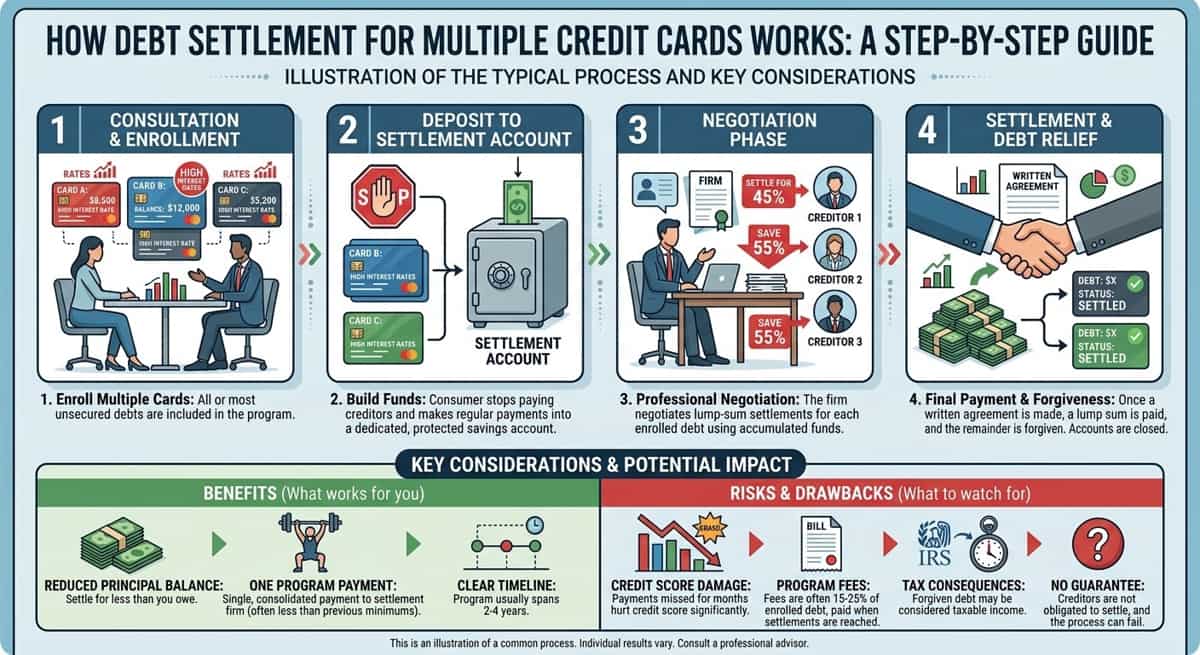
Debt Settlement for Multiple Credit Cards: How Does It Work?
10 min read
Get Your Free Consultation
Speak with a certified debt consultant to explore your options.
Start NowNo obligation • Free consultation
Related Posts
- What Are Debt Relief Loans?
10 min read
- Which Debt Should I Pay Off First?
10 min read
- Does Debt Settlement Work? What to Know Before You Start
11 min read
- What Debts Can Be Included in Debt Relief?
13 min read