Debt Settlement for Multiple Credit Cards: How Does It Work?
If you're juggling minimum payments on three, four, or five credit cards, you already know the feeling. You pay one card, the interest on the others keeps climbing, and no matter how much you send in, the balances barely move. For a lot of South Asian families in the U.S., there's an extra layer to this stress: you might also be sending money home to parents, covering a shared household budget, or simply not wanting anyone in the family or community to find out how bad things have gotten.
If you've started researching your options, you've probably come across the term "debt settlement." It sounds simple: negotiate with your credit card companies, pay less than you owe, move on.
How Debt Settlement Works When You Have Multiple Credit Cards
Settling one credit card is a process. Settling three, four, or five at once is a longer, more involved version of that same process and it's important to understand it step by step before you commit.
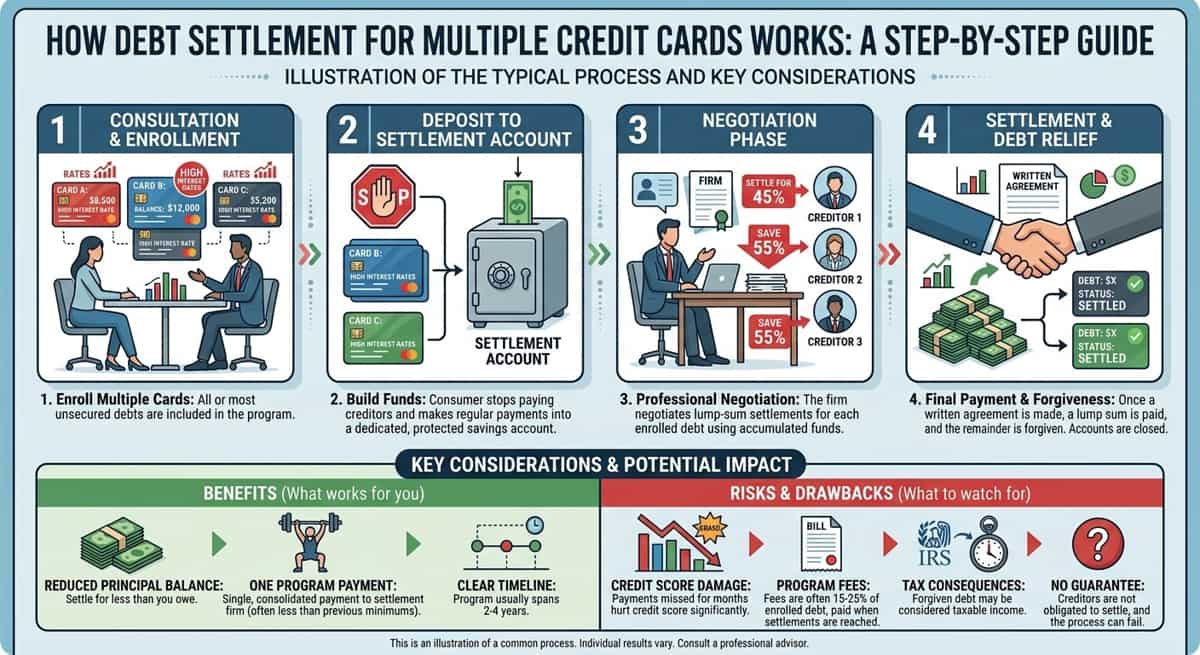
1. You stop paying your credit cards and start saving instead. Rather than sending minimum payments to each card, the money goes into a separate savings account. This is the fuel for your future settlement offers.
2. Your accounts fall behind and eventually get charged off. As payments stop, each card individually becomes delinquent. After several months of missed payments (often 90 to 180 days), the creditor may charge off the account meaning they write it off as a loss on their books, though you still legally owe the money.
3. Negotiations begin one card at a time. This is the part people often don't expect: each credit card is a separate creditor with its own account, its own timeline, and its own willingness to negotiate. Settling Card A does nothing for Card B. You (or your settlement company) will be having separate conversations, and often separate settlements, for every single card.
4. Settlement offers usually land somewhere between 30% and 50% of the balance, though this varies a lot depending on the creditor, how old the debt is, and how much you can pay upfront. There's no fixed number; some creditors settle for less, some hold firm for more.
5. You pay the agreed amount, usually as a lump sum. Once you and the creditor agree on a number, you pay it either all at once or, sometimes, in a short series of payments. Always get the agreement in writing before you pay anything.
6. You repeat this for every card you're trying to settle. Because each negotiation happens on its own timeline, settling multiple cards commonly takes 24 to 48 months from start to finish. During this stretch, the cards you haven't settled yet are still accumulating late fees and interest, and your credit is taking a hit from each one individually. This is the biggest difference between settling one card and settling several of the risk and damage compounds with every account still open and unpaid.
Debt Settlement vs. Debt Consolidation vs. Credit Counseling vs. Bankruptcy
Debt settlement isn't your only option, and it's not always the best one. Here's how it stacks up against the other common paths:
Option | How It Works | Credit Score Impact | Typical Cost | Best For |
Negotiate to pay less than you owe, usually a lump sum | Significant short-term drop; missed payments and "settled" status stay on your report for years | Settlement company fees often 15–25% of enrolled debt | People with serious hardship who can't keep up with payments and have some lump-sum savings potential | |
Combine multiple debts into one loan or balance-transfer card, ideally at a lower interest rate | Minor, temporary dip; can improve over time with on-time payments | Loan interest, balance transfer fees | People with steady income who qualify for a lower rate and want to simplify payments | |
Credit Counseling / Debt Management Plan | A nonprofit credit counselor negotiates lower interest rates and consolidates payments into one monthly payment, but you pay the full balance | Minor impact; usually improves as you make consistent payments | Small monthly fee, often $25–50 | People who can afford to repay in full with a lower rate and more structure |
A legal process that eliminates or restructures debt through the courts | Severe, long-term impact (7–10 years on your report) | Court and attorney fees | People with debt far beyond what any repayment plan can realistically resolve |
If you have multiple maxed-out cards and can't even cover the minimums, settlement or bankruptcy tend to be the realistic options consolidation and counseling usually require enough income to keep paying, just on better terms. The right choice depends on your income stability, how much debt you're carrying, and how much financial and emotional runway you have to get through a multi-year process.
Why This Looks Different for South Asian Families in the U.S.
Most articles about debt settlement are written as if everyone's financial life looks the same. For a lot of South Asian households, it doesn't and that changes how this process actually plays out.
Shared financial obligations are common. It's not unusual to have a co-signed credit card with a spouse, parent, or sibling, or to be contributing to a shared household budget that also supports family back home. Money that could go toward a settlement fund is often already spoken for, sent as remittances, saved for a sibling's education, or set aside for a family event. This can make it harder to build up the lump sum a settlement requires, and it's worth factoring in honestly when you're deciding how much you can realistically set aside each month.
The stigma around debt can delay getting help. In many South Asian families, financial struggle is something people quietly manage rather than talk about. There's often a real fear of being judged, or of family finding out. That silence is understandable, but it can also mean people wait far longer than they should before looking into their options, while interest and late fees keep adding up. Reaching out for help, whether that's a nonprofit credit counselor or simply a trusted resource like this one, isn't a failure it's the practical first step.
Building credit as a newer arrival can complicate things. If you moved to the U.S. more recently including on a visa like an H-1B you may have a shorter credit history than someone who grew up here. A thinner credit file can make it harder to qualify for consolidation loans or lower-interest cards, which sometimes pushes settlement further up the list of realistic options, even though it comes with real trade-offs.
One important thing to clarify directly: debt settlement is a financial and contractual matter; it is not an immigration matter. Falling behind on credit card debt or settling it does not, by itself, affect your visa status or a future green card or citizenship application. If you have specific concerns about how your finances intersect with your immigration case, that's a conversation for an immigration attorney, not something this article or any financial website can accurately answer for your specific situation.
Pros and Cons of Settling Debt Across Several Cards
Potential upsides:
You could end up paying meaningfully less than your total balance
It can resolve debt faster than making only minimum payments for years
It avoids the long-term impact and legal process of bankruptcy
Once settled, you're done with that account no more collection calls on it
Real downsides:
Your credit score will likely drop significantly while accounts are delinquent
Late fees and interest keep growing on cards you haven't settled yet
The process for multiple cards often takes 2 to 4 years
Forgiven debt can be taxed as income (more on this below)
Creditors aren't required to agree to settle some won't negotiate at all
You may still get collection calls or, in some cases, be sued by a creditor during the process
There's no universal right answer here. It comes down to whether the potential savings are worth the credit damage, the time, and the uncertainty and whether you have another realistic way to pay down what you owe.
How Debt Settlement Affects Your Credit Score and Taxes
Credit score: Every missed payment is reported to the credit bureaus and can lower your score. Once an account is charged off, that shows up too. Even after you settle, the account is typically marked as "settled for less than the full amount," which is better than a default but still a negative mark. These entries can stay on your credit report for up to seven years from the date the account first became delinquent, according to standard credit reporting timelines. If you're settling multiple cards, this happens separately for each one, which compounds the impact while the process is ongoing.
Taxes the part people often miss: Here's something that catches a lot of people off guard. If a creditor forgives $600 or more of your debt, they're generally required to send you a Form 1099-C, and the IRS treats that forgiven amount as taxable income. If you're settling several cards, you could receive a separate 1099-C for each one that gets settled meaning multiple pieces of "extra income" to account for at tax time, even though no actual money landed in your pocket. This is easy to overlook when you're focused on getting the debt resolved, but it can mean an unexpected tax bill the following year.
This is general information, not personalized tax advice. Talk to a tax professional about how debt forgiveness would affect your specific return before you settle.
How to Choose a Legitimate Debt Settlement Company
If you decide to work with a settlement company instead of negotiating yourself, it's worth knowing what a legitimate one looks like and what a scam looks like, because this industry has more than its share of bad actors.
Signs of a legitimate company:
They don't charge large upfront fees under FTC rules, most debt settlement companies can only charge a fee after they've actually settled a debt
They give you a clear, written contract explaining fees, timelines, and what happens to your money
They're upfront that your credit score will be affected and that creditors aren't obligated to negotiate
Red flags to walk away from including tactics that specifically target immigrant communities:
Guarantees that they can eliminate "100%" of your debt or erase it entirely
High-pressure sales tactics or urgency ("this offer expires today")
Requests for large fees before any debt is actually settled
Solicitation through unofficial channels like WhatsApp groups or unlicensed community "consultants" who aren't registered financial professionals
Advice to cut off contact with your bank, a family member, or anyone else "for privacy" a legitimate company has no reason to isolate you
Before signing anything, you can check a company's complaint history with the CFPB or your state Attorney General's office. A few minutes of research here can save you thousands of dollars.
A Realistic Example: Settling 3 Credit Cards
To make this concrete, here's a simplified, hypothetical example not a promise of what you'd actually get.
Say you have three credit cards with balances of $6,000, $4,000, and $3,000 a total of $13,000. Over roughly 30 months, you set aside money each month into a dedicated savings account. As each account becomes delinquent, negotiations begin one at a time. Settlements land at around 40% of each balance on average: $2,400, $1,600, and $1,200 a total of $5,200 paid, instead of $13,000. If you used a settlement company charging a 20% fee on the enrolled debt, that could add roughly $2,600, bringing your total cost closer to $7,800 still less than the original $13,000, but well above just the settlement amounts alone. Your actual numbers will depend on your creditors, your balances, and how negotiations go.
Making the Right Call for You
Debt settlement can genuinely reduce what you owe, but it's not a shortcut; it takes years, dents your credit for a while, and can bring a tax bill you didn't expect. Before you commit, weigh it honestly against consolidation, credit counseling, or bankruptcy based on your actual income and how much debt you're carrying. If you're not sure where you stand, requesting a free, confidential debt consultation is a solid, no-pressure next step to see how much you can save before making a decision.
Ready to Get Started?
Get a free consultation with a certified debt consultant to see if debt settlement is right for you.
Get Free ConsultationAbout the Author
Bhupinder Bajwa
.
Related Articles

Does Debt Settlement Work? What to Know Before You Start
11 min read
What Debts Can Be Included in Debt Relief?
13 min read

Debt Settlement for $20,000 in Credit Card Debt: What to Expect
11 min read
3 Key Benefits of Settling Your Debt
9 min read
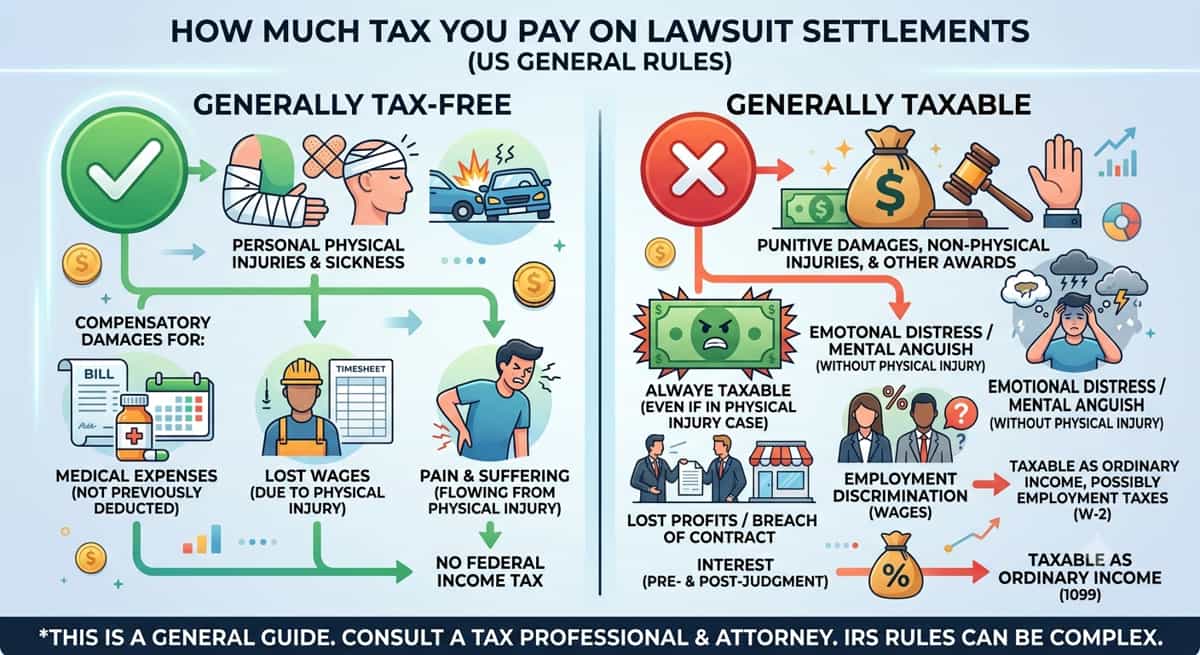
How Much Tax You Pay On Lawsuit Settlements
9 min read
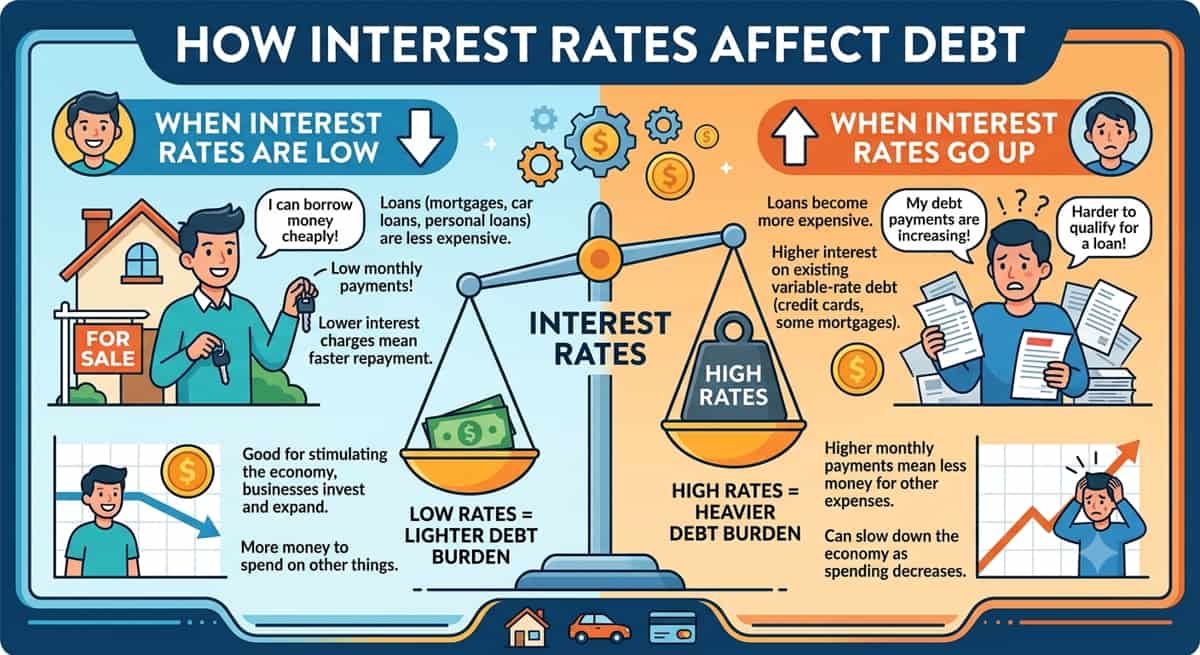
How Interest Rates Affect Debt
13 min read
Get Your Free Consultation
Speak with a certified debt consultant to explore your options.
Start NowNo obligation • Free consultation