Debt Settlement for $20,000 in Credit Card Debt: What to Expect

If your credit card balances have crept up to around $20,000 and the minimum payments barely move the number, you're not alone and you're probably already looking at "debt settlement" as an option. Before you sign anything, you deserve real numbers, not vague promises. How much will you actually pay? How badly will your credit score drop? Will the IRS come after you for the forgiven amount? And is it even the right move, or is there a better path for your situation?
This guide walks through what actually happens when you settle $20,000 in credit card debt: the timeline, the costs, the credit hit, the tax surprise almost nobody warns you about plus the alternatives worth comparing first. We'll also talk honestly about the parts of this decision that hit differently if you're part of a South Asian family in the U.S., where debt isn't just a number on a statement it can feel tangled up with family expectations, reputation, and obligations back home.
What Is Debt Settlement, Exactly?
Debt settlement means negotiating with your credit card company (or the collection agency that now owns the debt) to accept less than what you actually owe, usually as one lump-sum payment instead of the full balance over time. If you owe $20,000, a settlement might land somewhere between $10,000 and $14,000, paid in one shot.
It's easy to confuse this with other options, so here's the quick difference:
Debt consolidation combines your balances into one new loan, usually at a lower interest rate you still pay back the full amount.
A debt management plan (DMP), run through a nonprofit credit counseling agency, lowers your interest rate and combines payments, but you still pay 100% of what you owe.
Bankruptcy process that can wipe out or restructure debt through the courts, with more serious and longer-lasting consequences.
Debt settlement service is the only one of these where you're trying to pay back less than you borrowed which is exactly why it comes with real trade-offs.
One important thing to understand up front: most settlement programs require you to stop paying your creditors while you save up the lump sum. That single detail shapes almost everything else in this process, so let's walk through what it actually looks like month by month.
How Debt Settlement Works for a $20,000 Balance: A Realistic Timeline
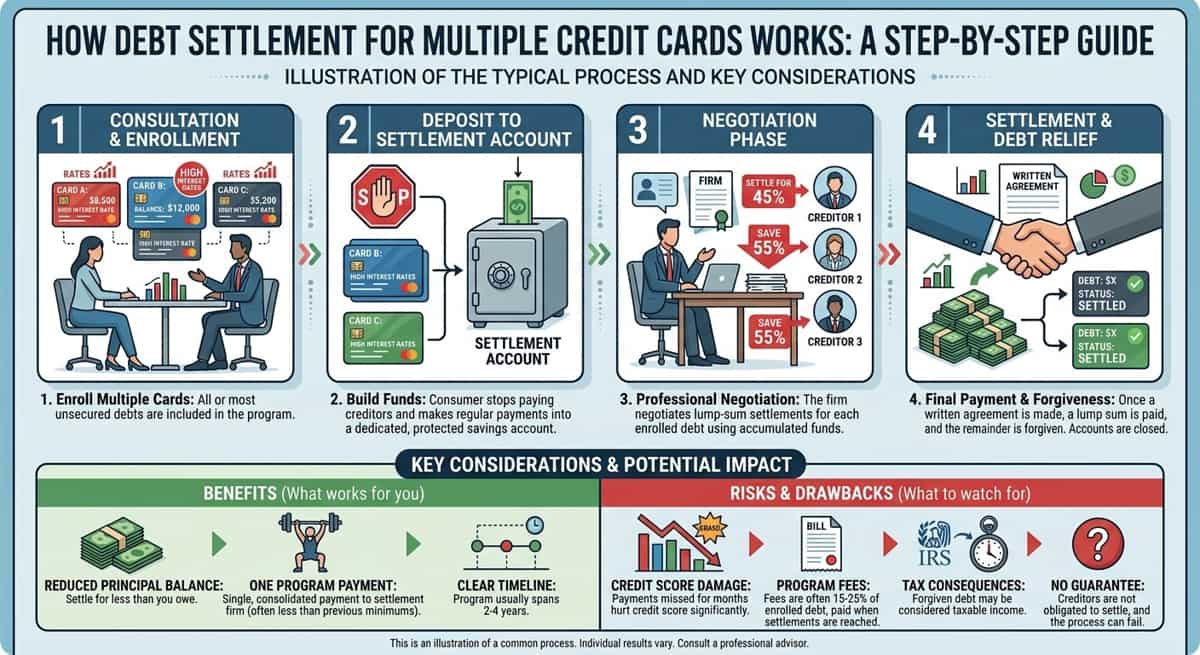
Here's the general path, assuming you enroll in a settlement program for $20,000 spread across three or four credit cards:
You enroll and open a dedicated savings account. Instead of paying your credit card companies, you deposit a set amount each month into this account.
Your creditors stop getting paid. This is intentional settlement companies negotiate once an account is seriously behind, because creditors are far more willing to accept less once they believe they might not get paid at all.
Your accounts go delinquent, then charge off typically around 90 to 180 days after you stop paying. This is also when your credit score takes its biggest hit.
Negotiations begin, usually account by account, once enough money has built up in your savings account to make a credible offer.
You (or the company) receive a settlement offer, often 40–60% of the original balance, though this varies by creditor, how old the debt is, and how much cash you can offer upfront.
You pay the lump sum, and that account is marked "settled for less than the full amount owed."
Here's roughly what that can look like for a $20,000 balance across four cards:
Month | What's Happening |
1–3 | You stop paying creditors; savings account starts building; collection calls begin |
4–6 | Accounts charge off; balances may be sold to collection agencies |
7–12 | First settlement offers on smaller accounts as savings grow |
13–24 | Remaining accounts settled as funds accumulate |
24–48 | Program completion (larger or more stubborn accounts can take longer) |
For a balance around $20,000 spread across a handful of cards, most programs run 24 to 48 months. That's longer than a lot of ads suggest. A single $20,000 balance on one card tends to settle faster than the same amount spread across four separate creditors, because each one negotiates separately and each one has to be convinced separately that a partial payment is their best option.
What You Can Expect to Pay: Fees, Settlement Percentage, and the Tax Surprise
This is the part most people underestimate, so let's put real numbers on it.
Settlement percentage: Creditors typically agree to somewhere between 40% and 60% of the balance, though this isn't guaranteed and depends heavily on the creditor, how far past due the account is, and how much cash you can offer at once.
Company fees: Debt settlement companies typically charge 15–25% of your enrolled debt or of the amount actually settled. Under FTC rules, these companies generally can't charge you a fee until they've actually settled at least one debt for you. If a company asks for money upfront before settling anything, that's a red flag we'll come back to.
Here's a simplified example for a $20,000 balance:
Item | Estimated Amount |
Original balance | $20,000 |
Settled amount (at ~50%) | $10,000 |
Company fee (at ~20% of enrolled debt) | $4,000 |
Total you actually pay out | ~$14,000 |
So you might save around $6,000 off the original balance but it's not the 50% savings the settled amount alone suggests, once fees are factored in.
The tax catch nobody mentions: When a creditor forgives $600 or more of debt, they're generally required to send you (and the IRS) a Form 1099-C, reporting the forgiven amount as income. If you settle $20,000 down to $10,000, that $10,000 difference could be treated as taxable income in the year it's forgiven which can mean an unexpected tax bill the following spring.
There's an exception: if you were "insolvent" (your total debts exceeded your total assets) at the time the debt was forgiven, some or all of that amount may not be taxable. This gets technical fast, so this is genuinely a moment to talk to a tax professional rather than guess, don't assume you're in the clear just because money feels tight.
How Debt Settlement Affects Your Credit Score
Here's what actually happens to your credit during this process, step by step:
Missed payments show up almost immediately once you stop paying, and these are heavily weighted in your credit score.
Charge-offs appear a few months in, marking the account as a loss to the lender.
"Settled for less than the full amount" notations appear once each account is resolved, and these stay on your credit report for up to 7 years from the date of the original delinquency.
In terms of the actual number, it's common to see credit scores drop significantly, often somewhere in the range of 100+ points depending on how strong your credit was. Recovery isn't instant, but it's also not permanent: many people see meaningful score improvement within 12 to 24 months after finishing the program, especially if they rebuild responsibly with on-time payments afterward.
One thing worth sitting with: if you're already behind on payments and struggling, some of this credit damage may already be happening before you even enroll in settlement. The question isn't always "settlement vs. no damage" sometimes it's "which path limits the damage that's already underway."
Why Debt Settlement Feels Different for South Asian Immigrant Families
Numbers only tell part of the story. For a lot of South Asian families in the U.S., debt carries weight that a spreadsheet can't capture.
The silence around money struggles. In many South Asian households, financial difficulty is something you don't talk about, not with extended family, sometimes not even between spouses. That sense of "izzat," or family honor, can make it genuinely hard to admit a $20,000 balance exists, let alone to ask for help. That silence often means people wait far longer than they should before exploring real options, which usually makes the situation harder to fix, not easier.
Debt rarely belongs to just one person. It's common for cards to be co-signed with a spouse, a parent, or a sibling, or for one household's finances to be tightly connected to relatives living under the same roof or supporting relatives back home through regular remittances. A settlement decision that seems purely personal on paper often isn't personal at all; it can affect a spouse's credit, a parent's peace of mind, or money that was earmarked for a family overseas.
Newer immigrants often start with a thin credit history. If you moved to the U.S. more recently on an H-1B, as an F-1 student who transitioned to work authorization, or while moving from an ITIN to an SSN you may have built credit relatively recently. That matters here because rebuilding after a settlement can take longer when you don't have years of established credit history to lean on for recovery.
Community lending is often the first stop, not settlement companies. Many families consider informal loans from relatives, or community savings arrangements sometimes called committees or chit funds, before ever looking at a formal debt relief company. There's nothing wrong with that path if it's manageable and doesn't strain family relationships but it's worth being just as clear-eyed about repayment terms and expectations as you would be with any lender.
If you're weighing this decision, it can help to involve a trusted family member without turning it into a conversation about blame or shame and if that feels impossible within the family, speaking with a culturally understanding debt specialist who offers support in South Asian languages can give you an outside, judgment-free perspective.
Is Debt Settlement Worth It for $20,000? Comparing Your Alternatives
Debt settlement isn't the only option, and for some people, it isn't even the best one. Here's how it stacks up:
Option | Typical Cost | Credit Impact | Timeline | Best Fit When... |
Debt settlement | ~60–75% of original balance (settlement + fees) | Significant, short-term drop; recovers over 1–2 years | 24–48 months | You genuinely can't keep up with payments and want to avoid bankruptcy |
Nonprofit debt management plan (DMP) | 100% of balance, lower interest | Mild, temporary dip | 3–5 years | You can afford full payments with a lower rate and more structure |
DIY negotiation | Varies widely | Similar to settlement if you fall behind first | Varies | You're comfortable negotiating directly and want to avoid company fees |
Chapter 7 bankruptcy | Court and filing fees | Severe, longest-lasting (up to 10 years) | A few months | Debt is unmanageable across multiple debt types, not just credit cards |
As a rough guide: $20,000 tends to sit in "settlement territory" when you're already missing payments, have limited savings, and paying the full balance simply isn't realistic. If you can still afford payments but the interest rate is what's crushing you, a debt management plan or a balance-transfer strategy often causes far less credit damage for a similar amount of relief.
Before committing to any settlement company, it's worth booking a free session with an NFCC-affiliated nonprofit credit counselor. They'll look at your full financial picture, not just push one product and can tell you honestly whether a settlement, a DMP, or something else fits your situation best.
Red Flags: How to Avoid Debt Settlement Scams
Debt settlement is a legitimate option, but the industry has real scam activity. Watch for:
Any request for payment before a debt is actually settled. Under FTC rules, most debt relief companies can't legally charge fees until they've settled at least one of your debts.
Guarantees of a specific result, like "we'll cut your debt in half" no legitimate company can promise a settlement percentage in advance.
Pressure to immediately stop talking to your creditors or to stop opening mail from them entirely.
Vague or verbal-only fee explanations. A legitimate company will put everything, fees, timeline, process in writing before you sign anything.
Before enrolling anywhere, check the company against the CFPB's consumer complaint database, confirm it's registered with your state's Attorney General office (many states require debt settlement companies to register), and look for NFCC membership as a sign of accountability.
Steps to Take Before You Sign Up
Pull your free credit report and list every balance, interest rate, and minimum payment in one place — you can't make a good decision without seeing the full picture.
Call your creditors directly first. Many card issuers have hardship programs, temporary rate reductions or payment pauses that cost nothing to ask about.
Book a free consultation with an NFCC-accredited nonprofit counselor. This step alone can save you from an unnecessary or poorly-fitted settlement program.
Get everything in writing — the exact fee structure, the estimated timeline, and what happens to each account — before you pay anyone anything.
Ask directly how the company reports to credit bureaus and whether they explain the 1099-C tax process, so you're not caught off guard later.
The Bottom Line
Settling $20,000 in credit card debt can genuinely save you money compared to paying the full balance but it comes with real costs: a meaningful, if temporary, credit score hit; company fees that eat into your savings; and a tax bill on the forgiven amount that catches a lot of people off guard. Results vary by creditor, by account age, and by your specific financial situation, so nothing here is a guarantee of what you'll experience.
Before you commit to any settlement company, it's worth scheduling a free confidential debt consultation. This step alone can save you from an unnecessary or poorly-fitted settlement program. . There's no pressure, no cost, and no sales pitch, just an honest look at whether settlement, a debt management plan, or another path fits your life best.
Ready to Get Started?
Get a free consultation with a certified debt consultant to see if debt settlement is right for you.
Get Free ConsultationAbout the Author
Bhupinder Bajwa
.
Related Articles
Which Debt Should I Pay Off First?
10 min read

How to Negotiate Your Credit Card Debt
11 min read

Does Debt Settlement Work? What to Know Before You Start
11 min read
What Ignoring Credit Card Debt Really Costs You
10 min read
What Debts Can Be Included in Debt Relief?
13 min read
Debt Settlement for Multiple Credit Cards: How Does It Work?
10 min read
Get Your Free Consultation
Speak with a certified debt consultant to explore your options.
Start NowNo obligation • Free consultation
Related Posts
- Which Debt Should I Pay Off First?
10 min read
- How to Negotiate Your Credit Card Debt
11 min read
- Does Debt Settlement Work? What to Know Before You Start
11 min read
- What Ignoring Credit Card Debt Really Costs You
10 min read