What Debts Can Be Included in Debt Relief?
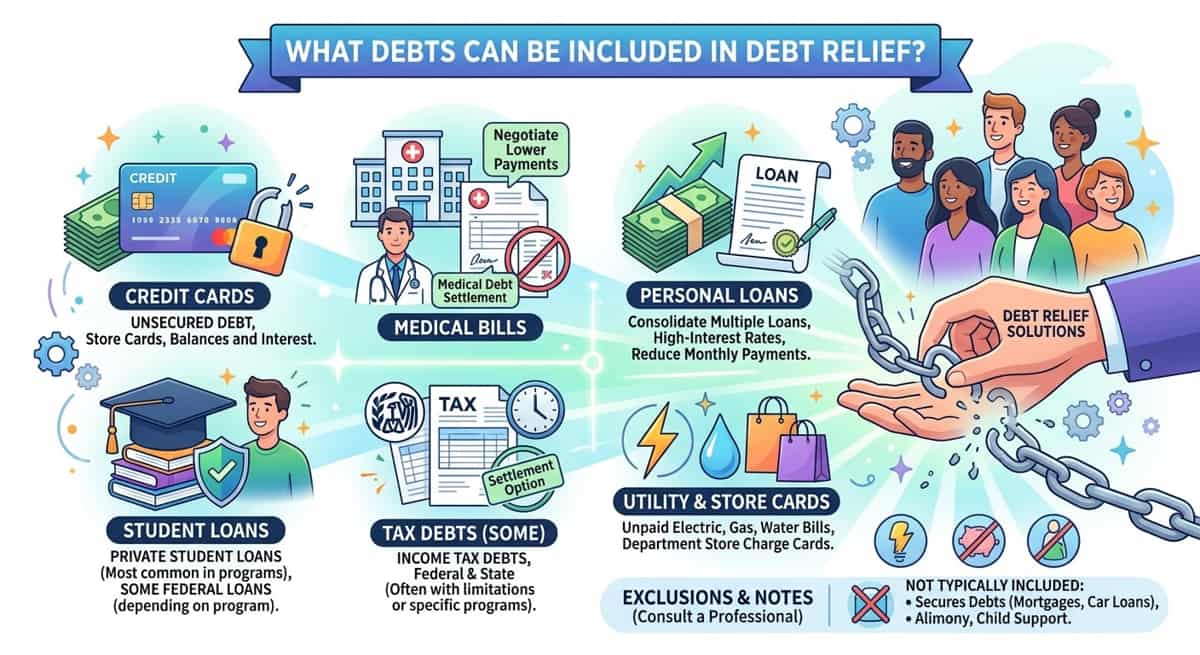
If you're staring at a stack of bills, credit card statements, medical invoices, maybe a personal loan you took out during a rough patch and wondering whether debt relief can actually help, you're not alone. One of the first questions people ask before they pick up the phone with a credit counselor is simple: "Does my debt even qualify?" It's a fair question, because not every dollar you owe is treated the same way. Some debts can be rolled into a relief program and significantly reduced or restructured. Others can't be touched no matter which company you talk to.
Most debt relief programs, debt management plans, debt settlement, and bankruptcy are built to handle unsecured debt: money you borrowed without putting up property as collateral. That includes credit card balances, medical bills, personal loans, some private student loans, and old collection accounts. Debts tied to an asset, like your mortgage or car loan, along with federal student loans, tax debt, child support, and court-ordered fines, are generally excluded. If most of what you owe falls into that first group, you likely have real options.
Types of Debt You Can Include in a Debt Relief Program
Every type of debt below shares one thing in common: there's no collateral backing it. If you stop paying a credit card, the company can't repossess anything; they can only pursue you for the money. That's why these debts are the ones debt relief programs are built around, whether that's a debt management plan, a debt settlement negotiation, or bankruptcy protection. Here's a closer look at what typically falls into this bucket.
Credit Card Debt
Credit card debt is the most common type of debt included in relief programs, and for good reason it's unsecured, it often carries high interest rates, and balances can balloon quickly once you're only making minimum payments. Whether you have one card or five, credit card balances (including store-branded cards) can usually be enrolled in a debt management plan, negotiated down through debt settlement, or discharged in bankruptcy. If you've been using one card to pay another, that's usually a sign this debt has outgrown what you can handle on your own.
Medical and Hospital Bills
Medical debt is unsecured, which means it typically qualifies for debt relief just like a credit card balance. This includes hospital bills, doctor's office charges, ambulance fees, and bills sent to collections after an insurance gap or an unexpected emergency. Providers are often willing to negotiate directly, sometimes before you even involve a third party but if the balance has already gone to collections, or you have several medical bills stacking up, rolling it into a broader plan can simplify things and stop the calls.
Personal Loans and Lines of Credit
Personal loans, the kind you might take out from a bank, credit union, or online lender for a home repair, a wedding, or to cover an emergency are unsecured as long as they weren't backed by collateral. These are generally eligible for debt relief, and the same goes for unsecured personal lines of credit. If you're unsure whether your loan is secured, check your original loan agreement: if you didn't pledge a car, savings account, or property against it, it almost certainly counts as unsecured and can be included.
Private Student Loans
Private student loans issued by a bank or private lender rather than the US Department of Education can sometimes be included in debt relief programs, though it depends on the lender. Debt settlement companies may be able to negotiate with some private lenders, and these loans can potentially be discharged in bankruptcy under certain circumstances, which is different from federal loans. Mention this debt specifically when you talk to a credit counselor, since not every program handles it the same way.
Collection Accounts and Charged-Off Debt
If a debt has already been sent to collections or written off by the original creditor as a "charge-off," it hasn't disappeared; it's simply changed hands. These accounts are still unsecured debt and are commonly included in debt relief programs, especially debt settlement, since collection agencies and debt buyers are often willing to accept a reduced lump-sum payment. A call from a number you don't recognize about an old bill is very likely a collection account, and a good candidate for negotiation.
Older Utility Bills, Store Cards, and Other Unsecured Debt
Past-due utility bills, old gym memberships, store credit cards, and similar smaller unsecured debts can usually be included too. On their own these might feel too minor to worry about, but they add up, and unpaid balances can eventually get sent to collections. Including them in the same plan as your larger debts means you're not juggling separate due dates and separate negotiations.
Payday Loans (With Caveats)
Payday loans are technically unsecured, but they're a bit more complicated. Some debt settlement companies and credit counseling agencies will include them, while others avoid them because payday lenders can be aggressive about collection and, in some states, have legal tools unsecured lenders don't. Be upfront about this debt when you first talk to a counselor they'll tell you honestly whether it can be included.
Debts That Debt Relief Programs Usually Cannot Touch
Just as important as knowing what qualifies is knowing what doesn't. Debt relief programs work by either negotiating with creditors or, in bankruptcy, legally discharging what you owe and neither tool can override certain protections built into how some debts work. Secured debts are tied to property the lender can take back, and some debts are protected by law specifically because letting people walk away from them would create bigger problems. Understanding this upfront saves you from expecting a program to fix something it was never built to fix.
Secured Debt: Mortgages and Car Loans
Your mortgage and your car loan are secured debts meaning if you stop paying, the lender can foreclose on your home or repossess your car. Because the lender already has a way to recover their money by taking the asset back, these debts generally aren't included in debt management plans or debt settlement, and even bankruptcy won't erase them without you giving up the property. If a mortgage or car loan is overwhelming you, the more realistic paths are loan modification, refinancing, or talking directly with your lender about a hardship program.
Federal Student Loans
Federal student loans follow a completely different set of rules than the rest of your debt. They can't be included in a debt management plan or debt settlement program, and they're very rarely discharged in bankruptcy. Instead, federal loans have their own relief tools built in income-driven repayment plans, deferment, forbearance, and loan forgiveness programs for specific professions. If these payments are a major source of stress, contact your loan servicer or the Department of Education directly, rather than expecting a private debt relief company to negotiate them down.
Tax Debt Owed to the IRS
Money you owe the IRS is not something a debt settlement or debt management company can negotiate on your behalf, despite what some ads promise. Tax debt has its own resolution process, including IRS payment plans, an Offer in Compromise for people who genuinely can't pay the full amount, and Currently Not Collectible status for serious hardship cases. If you owe back taxes, a tax professional or enrolled agent not a general debt relief company is the right person to help.
Child Support, Alimony, and Court Judgments
Child support, alimony, and most court-ordered judgments generally cannot be reduced or discharged through debt relief programs or bankruptcy. These obligations are treated differently by law because they involve a court order and, in the case of family support, another person's wellbeing. If you're behind on court-ordered payments, the better move is going back to the court that issued the order to request a modification based on your current financial circumstances, rather than trying to resolve it through a debt relief company.
Debt That Looks Different in South Asian Immigrant Households
Generic advice about "credit cards and medical bills" doesn't always capture the full picture for South Asian families living in the US. Many households are carrying debt that doesn't show up on a typical credit report at all, alongside the more familiar kind. Between building credit from scratch, navigating a health insurance system that looks nothing like back home, and the quiet expectation of sending money to family, the debt picture often looks different and so does the comfort level around discussing it out loud. Here's how that plays out, and what can and can't be addressed through formal debt relief.
Credit Card Debt Built Up While Establishing US Credit
If you moved to the US as a student, on a work visa, or through family sponsorship, you likely started with no US credit history at all. Getting approved for a secured card, then a regular one, then slowly building a usable limit, is a process and it's common to lean on those cards harder than intended while getting settled: a security deposit, a car, furniture, a flight home. That kind of credit card debt is fully eligible for debt relief, the same as anyone else's.
Medical Debt From Insurance Gaps
A period between jobs, a visa transition, or a plan that didn't cover a dependent can leave a gap in health coverage at exactly the wrong moment. Medical debt that builds up during one of these gaps is unsecured and eligible for debt relief just like any other medical bill. If an ER visit or a hospital stay during an uninsured stretch is part of what you're carrying, it's not a special case that disqualifies you, it's one of the most common and most negotiable debts there is.
Informal Loans From Family or Community
Money borrowed from a parent, an uncle, a family friend, or a community lending circle is real debt, and the obligation to repay it can weigh just as heavily as a bank loan, sometimes more, because of the relationship attached to it. But because there's no formal contract, no credit reporting, and no legal creditor to negotiate with, this kind of debt cannot be included in a debt management plan, debt settlement, or bankruptcy; it simply isn't part of the system those programs work within. The honest approach is treating it as a separate, personal repayment plan, while using formal debt relief to free up room in your budget for the debts that can be addressed.
Debt Linked to Supporting Family Back Home
Sending money home is often less of a choice and more of an expectation, and it's common for that support to quietly get funded through a credit card cash advance or a personal loan when a paycheck doesn't stretch far enough. The remittance itself isn't a debt, but the credit card balance or loan used to cover it is and it's fully eligible for debt relief. Recognizing this pattern matters, because it's often the real reason a balance keeps climbing even when spending otherwise looks reasonable.
Which Debt Relief Option Fits Which Type of Debt
Once you know which debts qualify, the next question is which program fits. There isn't one universal answer: a debt management plan makes sense for some people, debt settlement fits others, and for some, bankruptcy is the most responsible option. Here's a quick way to think about it:
Your Situation | Best-Fit Option |
Can afford monthly payments, just need a lower interest rate | Debt Management Plan |
Can't keep up, but could manage a reduced lump-sum payment over time | Debt Settlement |
Still have decent credit, want to combine debts into one loan | Debt Consolidation |
Debt is unmanageable regardless of income or budget changes | Bankruptcy |
Debt Management Plans
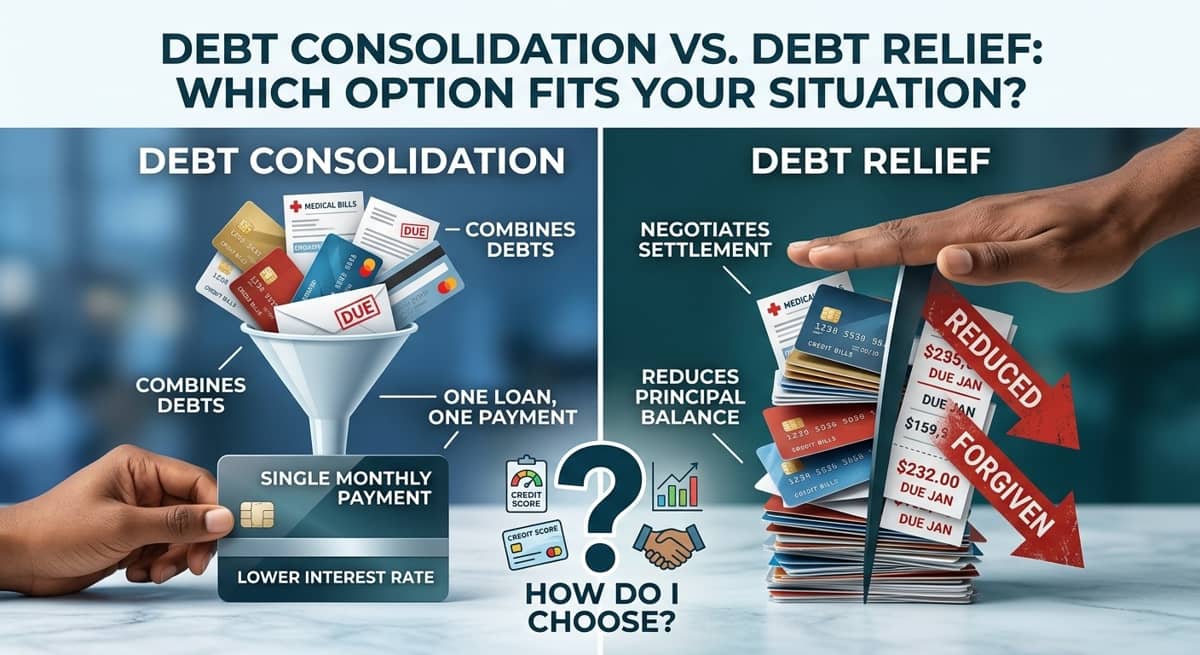
A debt management plan, usually set up through a nonprofit credit counseling agency, combines your unsecured debts into a single monthly payment, often at a reduced interest rate the agency has negotiated with your creditors.
You still pay back the full balance, just on better terms and one predictable schedule. It tends to work best if you can comfortably afford a monthly payment once the interest rate comes down it's a structured path, not a discount, and typically takes three to five years.
Debt Settlement
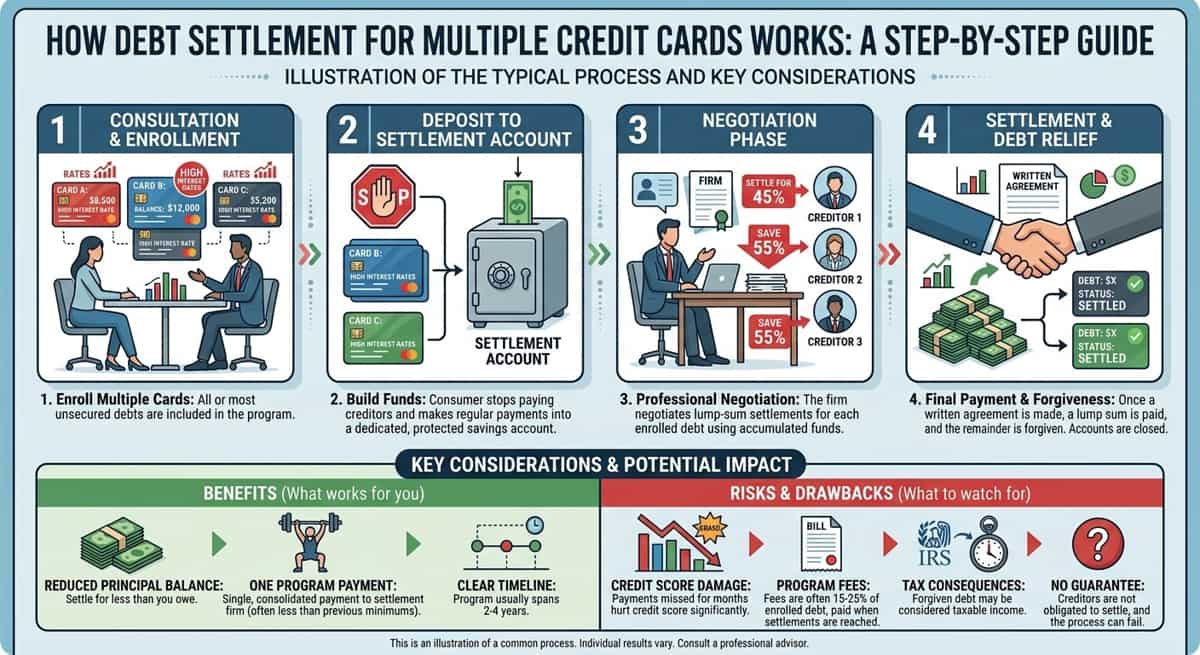
Debt settlement involves negotiating with creditors to accept less than the full balance owed, usually paid as a lump sum once you've saved enough through a dedicated account. It can significantly reduce what you owe, but usually means missing payments during the process, which affects your credit short-term. This route tends to fit people who are already behind, or who can't realistically pay the full balance even with better terms.
Debt Consolidation
Combining multiple debts with debt consolidation It generally requires decent credit, which makes it a better fit for people juggling multiple payments but haven't missed any yet. It doesn't reduce what you owe, it reorganizes it so it works best as an earlier step, before debt becomes unmanageable.
Bankruptcy: Chapter 7 vs. Chapter 13
Bankruptcy is a legal process, not a negotiation, and it comes in two common forms. Chapter 7 can discharge most unsecured debt relatively quickly but may require giving up certain non-essential assets, and it requires passing a means test based on income. Chapter 13 sets up a three-to-five-year repayment plan and often fits better if you have steady income and want to keep property like a car or home while catching up. Bankruptcy stays on your credit report for years and isn't right for everyone, but for genuinely unmanageable debt, Bankruptcy offers a legal structured way forward.
A Quick Checklist: Is Your Debt Eligible?
Before assuming a debt qualifies for relief, run it through these quick questions:
Is it unsecured meaning no property or asset backs it? (Credit cards, medical bills, personal loans, and most collections: yes. Mortgages and car loans: no.)
Is it in your name, backed by a real contract not an informal handshake agreement with a relative? Formal, contracted debt is eligible; informal family loans generally aren't.
Is it a private debt, not a government-owed balance like federal student loans or IRS tax debt?
Is it not court-ordered, like child support or a legal judgment tied to family court?
Has it been sitting unpaid or growing for a while, with no realistic way to pay it off within a year or two on your own?
If most of your answers land on the "yes, eligible" side, a debt relief program is worth exploring seriously.
What to Do Before You Enroll in a Debt Relief Program
Before signing up with any company, take a few simple steps. First, write out every debt you have, balance, interest rate, and who you owe so you're working from a complete picture rather than guessing. Second, book a free session with a certified nonprofit credit counselor (the National Foundation for Credit Counseling, or NFCC, is a good place to start); a real counselor will review your situation and tell you honestly what fits, without pressuring you into a program. Third, be cautious of any company asking for large upfront fees before doing any work legitimate providers are only paid once they've actually settled or restructured something on your behalf.
Conclusion
Knowing which debts actually qualify takes a lot of the guesswork and the anxiety out of deciding what to do next. If most of what you owe is unsecured, like credit card balances, medical bills, or personal loans, you have real, workable options. If you're also carrying informal family debt or remittance-related strain, that needs its own approach, separate from any formal program. The best next step is a conversation, not a decision: a free session with a certified nonprofit credit counselor can look at your full picture and tell you honestly what fits, with no pressure and no upfront cost.
Ready to Get Started?
Get a free consultation with a certified debt consultant to see if debt settlement is right for you.
Get Free ConsultationAbout the Author
Bhupinder Bajwa
.
Related Articles
Secured vs Unsecured Debt Consolidation: What's the Difference?
8 min read

Debt Settlement for $20,000 in Credit Card Debt: What to Expect
11 min read
What’s The Difference Between Debt Consolidation And Debt Settlement?
12 min read
Debt Consolidation vs. Debt Relief: Which Option Fits Your Situation?
10 min read
Can You Consolidate Debt With a Low Credit Score?
11 min read
Debt Settlement for Multiple Credit Cards: How Does It Work?
10 min read
Get Your Free Consultation
Speak with a certified debt consultant to explore your options.
Start NowNo obligation • Free consultation
Related Posts
- Secured vs Unsecured Debt Consolidation: What's the Difference?
8 min read
- Debt Settlement for $20,000 in Credit Card Debt: What to Expect
11 min read
- What’s The Difference Between Debt Consolidation And Debt Settlement?
12 min read
- Debt Consolidation vs. Debt Relief: Which Option Fits Your Situation?
10 min read