Before Filing for Bankruptcy: What You Need to Know

Bankruptcy is a legal process that can erase or reorganize many of your debts and stop most collection calls. It also affects your credit, can put some property at risk, and raises extra questions if you have an immigration case in progress. The smart move is to compare your options and talk to a licensed attorney before you file.
Maybe you lost your job and the credit card balances kept growing. Maybe a medical emergency left you with bills you never planned for. Maybe the store, motel, or gas station you run isn't earning enough to cover its loans. Or maybe you send money home to your family every month, and your own bills slowly fall behind.
Whatever brought you here, you're not alone, and you haven't failed. Many hardworking families in the U.S. end up with more debt than they can manage.
Key Takeaways
Chapter 7 is faster, Chapter 13 is a repayment plan. Which one fits depends on your income, property, and debts.
Some debts usually stay. Recent taxes, child support, and most student loans are hard to erase.
Have a visa or green card case? Ask an immigration attorney before you file.
Avoid common mistakes. Don't repay relatives first, move assets, or max out cards right before filing.
What Bankruptcy Actually Does and Doesn't Do
Bankruptcy is a federal court process. You list your debts, income, and property, and the court helps you either wipe out certain debts or set up a plan to repay them over time.
The moment you file, something called the automatic stay begins. It tells most creditors to stop. That means no more collection calls, no new lawsuits, and in most cases no wage garnishment while your case is open. For many people, securing bankruptcy assistance and legal guidance to initiate this automatic stay provides the first moment they can breathe in months.
Bankruptcy can usually wipe out:
Credit card balances
Medical bills
Personal loans
Some old court judgments
Bankruptcy cannot:
Work overnight. Cases take months, and sometimes years.
Guarantee a perfectly clean slate. Some debts survive.
Fix the habits or events that caused the debt. A budget still matters afterward.
One more thing worth saying plainly: bankruptcy is a legal tool, not a moral failure. It exists because the law recognizes that sometimes life goes wrong. If shame or worry about what your family or community will think is holding you back, you're not the first to feel that way.
Chapter 7 vs Chapter 13: Which Applies to You?
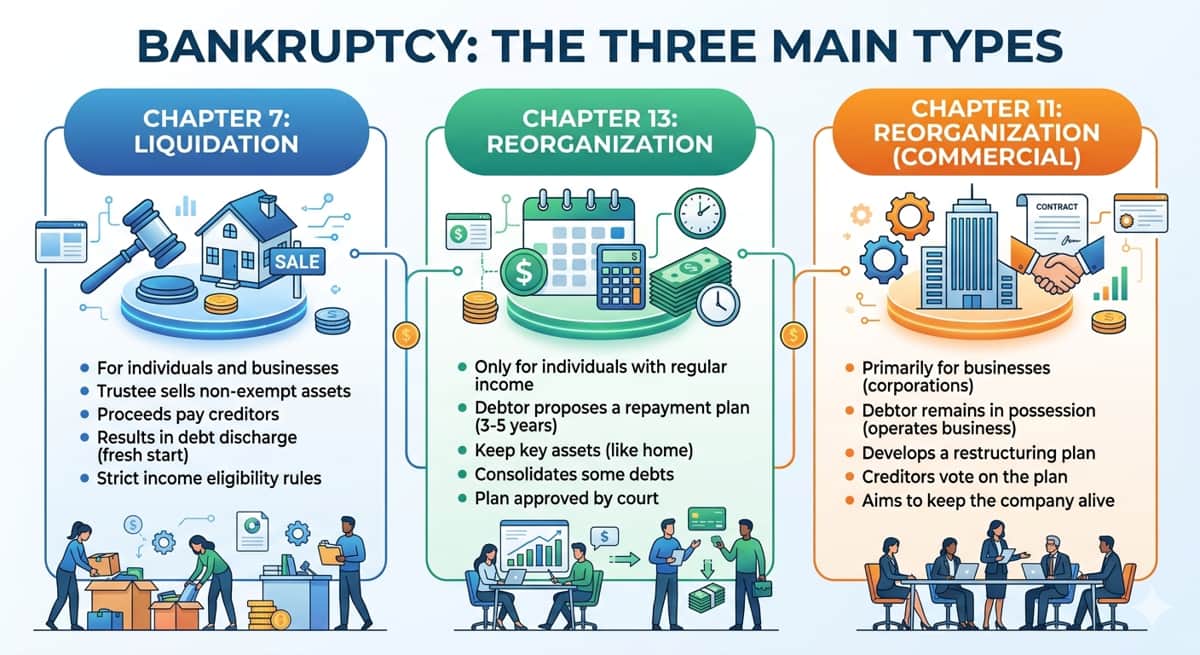
Most people filing for personal debt choose between two types of bankruptcy.
Chapter 7 (liquidation)
Chapter 7 is the faster option, often finished in about four to six months. Weighing the full benefits and drawbacks of Chapter 7 bankruptcy will help you decide if fast liquidation fits your finances.
Many unsecured debts, like credit cards and medical bills, are wiped out. To qualify, you must pass a means test, which compares your income to the median income for your state and household size. If your income is too high, Chapter 7 may not be available.
The trade-off is that the court can sell property that isn't protected. Most people with ordinary belongings, a modest car, and a retirement account lose very little, but you need an attorney to check your situation.
Chapter 13 (repayment plan)
Chapter 13 is for people who have steady income and want to keep property they might otherwise lose, such as a home they're behind on. Take time to evaluate whether Chapter 13 bankruptcy is right for your situation and your long-term budget. . You make monthly payments under a court-approved plan for three to five years. When you finish, the remaining eligible debt is wiped out.
Side by side
Chapter 7 | Chapter 13 | |
Timeline | About 4–6 months | 3–5 years |
Who qualifies | Must pass means test | Steady income needed |
Property at risk | Some unprotected items | Usually keep property |
Best fit | Lower income, little property | Behind on a home or car, higher income |
Income limits and filing fees change, so check the current numbers on uscourts.gov or ask your attorney.
What Bankruptcy Will Cost You: Credit, Assets, and Cosigners
Your credit report
A bankruptcy can stay on your credit report for up to seven years for Chapter 13 and up to ten years for Chapter 7. That sounds scary, but many people find their score begins to recover within a couple of years if they pay bills on time and keep balances low. For someone already buried in late payments and collection accounts, the score may already be low.
Your property and exemptions
Every state has exemptions, which are rules that protect certain property from being sold. These usually cover some equity in your home, a car, household items, and retirement accounts. If you own gold jewelry, which many families keep as savings or for weddings, ask your attorney how your state treats it. Limits on jewelry are often small, and the rules differ widely from state to state.
Filing and attorney fees
Court fees are a few hundred dollars. Attorney fees vary by city and case type, and many attorneys offer free first consultations and payment plans. Ask for the total cost in writing before you hire anyone.
What happens to cosigners
If someone cosigned a loan for you, such as a parent, sibling, or friend, bankruptcy may not protect them. In a Chapter 7 case, the lender can usually still go after the cosigner. Chapter 13 offers some protection for cosigners on certain consumer debts. If a relative cosigned for you, talk to your attorney about them before you file.
Debts Bankruptcy Usually Won't Erase
Not every debt goes away. These usually remain:
Recent income taxes
Child support and alimony
Most student loans. You must prove "undue hardship" to the court, and that is hard to do.
Court-ordered fines and penalties
Debts from fraud or false statements
Large luxury purchases or cash advances made shortly before filing
Your attorney can tell you which of your debts fall into these groups.
Is Bankruptcy Your Best Option? Alternatives to Consider First
Bankruptcy is a serious step, so it's worth checking whether something gentler can work. Here are the most common options.
Talk directly to your creditors
Many banks and card companies have hardship programs. They may lower your interest rate, pause payments for a few months, or set up a smaller monthly amount. Call and say clearly that you're struggling and ask what help is available. Keep notes on every call and get any agreement in writing.
Debt management plan through a nonprofit counselor
A nonprofit credit counseling agency can combine your card payments into one monthly payment, often with lower interest. You usually pay it off in about three to five years. Look for agencies approved by the U.S. Trustee Program.
Debt settlement
Through a professional debt settlement process, negotiators work directly with creditors to accept less than you owe, providing a viable alternative before taking extreme legal steps. Your credit can drop, fees can be high, and creditors can still sue you. Forgiven debt may also count as taxable income. Be careful with any company that promises to "erase your debt" or asks for large payments upfront.
Debt consolidation or balance transfer
You take one new loan or card with a lower rate to pay off several higher-rate debts. This helps only if you qualify for a better rate and can stop adding new debt.
Quick comparison:
Option | Best for | Credit impact | Main risk |
Hardship plan | Short-term trouble | Low | Creditor may refuse |
Debt management plan | Steady income, card debt | Moderate | Must stick to 3–5 years |
Debt settlement | Hard cases, some savings | High | Fees, lawsuits, taxes |
Consolidation | Good credit, one-time fix | Low | New debt piles up |
If you're not sure where to start, take time to compare your debt relief options with a trusted specialist or credit counselor before committing to a path.
Special Considerations for South Asian Families in the U.S.
Much of the advice online about bankruptcy ignores the realities many South Asian families live with. These are the questions we hear and see most often.
Bankruptcy and your immigration status
This is the biggest fear for many people, so let's be careful and clear. Filing for bankruptcy is generally not, by itself, a reason to be denied a green card or citizenship. Problems tend to come up around dishonesty, such as leaving out debts or income, giving false information, or hiding assets.
If you're on an H-1B or F-1 visa, or you have a green card or naturalization case pending, ask an immigration attorney before you file.
Every case is different. Good questions to ask are: How might this affect my pending application? What should I disclose? Is the timing important?
Money sent to family abroad and informal loans
Sending money to parents or relatives is a normal part of life for many families. In bankruptcy, though, the trustee reviews your recent money movements. Large transfers shortly before filing, repayments to relatives ahead of other creditors, and informal loans, such as money borrowed through a community lending circle or from friends, may be questioned.
The rule is simple: be honest and list everything. A trustee can handle an honest disclosure. Hidden information can cost you the whole case.
Cosigning, family businesses, and shared family money
Many families run small businesses like convenience stores, motels, gas stations, or rideshare and trucking work. If you signed a personal guarantee on a business loan, you may owe that debt personally. Bankruptcy for your business and bankruptcy for you are different, and the right path depends on how the debts are set up.
If you cosigned for a relative, remember that you're on the hook too. And if you sponsored a family member for immigration, ask your attorney how bankruptcy interacts with that financial promise.
No credit history, language barriers, and shame
If you came to the U.S. recently, you may have started with no credit and ended up with high-interest loans just to get by. That is not a sign of poor judgment. It's a common trap.
You deserve help in a language you're comfortable with.Work with multilingual debt relief specialists who offer assistance in Hindi, Punjabi, Urdu, Bengali, Gujarati, Tamil, Telugu, and other languages so you can discuss sensitive financial issues comfortably in your preferred language. And if it feels impossible to talk to your family about money trouble, start with one trusted person. Carrying this alone makes it heavier.
Your Pre-Filing Checklist
Take these steps before you file anything.
List what you owe, earn, and spend. Write down every debt with the balance, lender, and interest rate. Add your monthly income and expenses. This gives you and your attorney a clear picture.
Collect your documents. Gather recent tax returns, pay stubs, bank statements, and any lawsuit or collection letters you've received.
Take the required credit counseling course. Federal law requires one from an approved agency within 180 days before you file. It's usually short and can be done online or by phone. Choose a provider from the U.S. Trustee Program's approved list.
Check your state's exemptions. Find out what property is protected where you live. This affects what you might keep.
Talk to a bankruptcy attorney. Bring your list and ask about your options. If you have a visa or immigration case, also speak to an immigration attorney.
Plan for life after bankruptcy. Make a basic budget and think about how you'll rebuild credit, perhaps with a secured card and on-time payments.
Mistakes to Avoid Before You File
Small choices made in a panic can create big problems later.
Paying back relatives or friends first. It feels like the right thing to do, but payments to family shortly before filing can be undone by the court, and you may have to answer for them.
Moving or hiding assets. This includes property, accounts, or gold held abroad. Everything must be listed. Hiding assets can lead to your case being thrown out, or worse.
Running up cards right before filing. Large charges or cash advances just before bankruptcy may not be erased.
Emptying your retirement account to pay debt. Retirement savings are often protected in bankruptcy. Using them to pay credit cards can leave you with less for the future.
Using an unlicensed helper. Some "document preparers" or "consultants" offer cheap bankruptcy help but aren't attorneys. Mistakes can cost you your case, and some are scams. Check any attorney's license through your state bar's website.
Conclusion and Next Steps
Bankruptcy can be a fresh start, but it's a big decision, and you deserve to make it with full information. Start by looking at the alternatives, Compare Chapter 7 and Chapter 13 bankruptcy, know what it could cost you, and get advice from a licensed attorney who understands your situation.
You don't have to figure this out alone. Our team offers a free, confidential debt consultation to review your debts and explain your best non-bankruptcy choices. Take the first step today.
Ready to Get Started?
Get a free consultation with a certified debt consultant to see if debt settlement is right for you.
Get Free ConsultationAbout the Author
Bhupinder Bajwa
.
Related Articles
4 Reasons Why Filing for Bankruptcy Should Be Your Last Option
10 min read
What Debts Can Be Included in Debt Relief?
13 min read
How Much Tax You Pay On Lawsuit Settlements
9 min read

Filing For Business Bankruptcy? You Need To Know This First
10 min read
Is Bankruptcy Discharge Public Record?
9 min read
Bankruptcy: What Are The Three Main Types?
13 min read
Get Your Free Consultation
Speak with a certified debt consultant to explore your options.
Start NowNo obligation • Free consultation