What Is Debt-to-Income Ratio and Why Does It Matter?
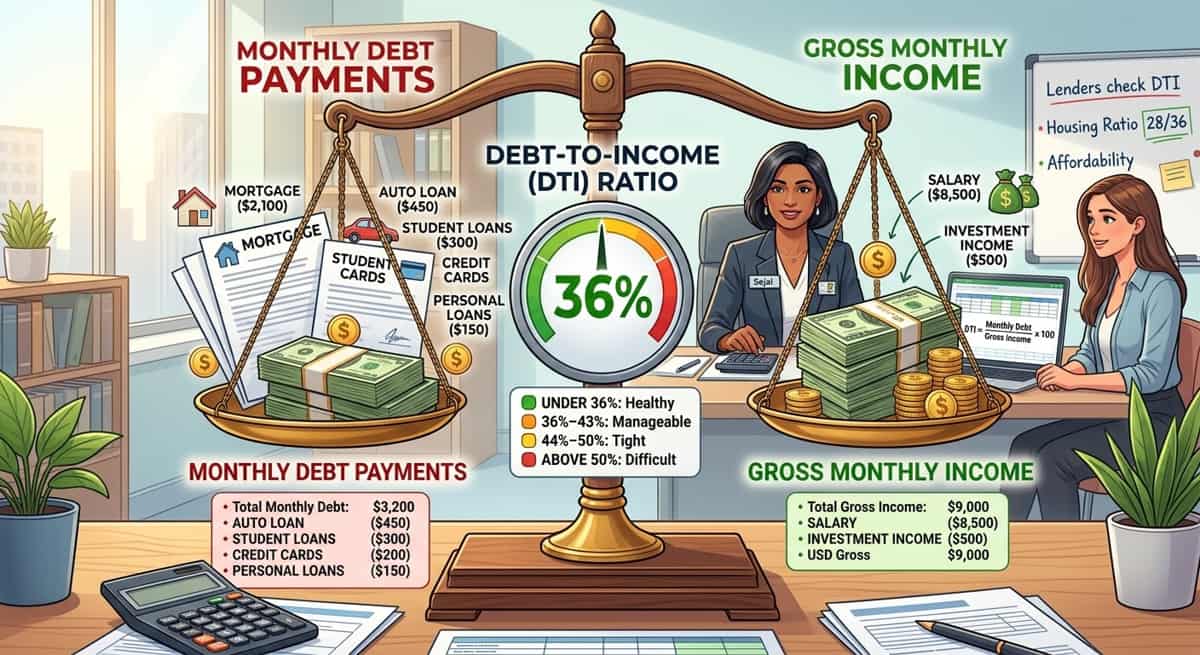
Your debt-to-income (DTI) ratio is the percentage of your gross monthly income that goes toward debt payments. Lenders use it to judge whether you can afford a new loan. Most prefer 36% or lower, and many stop approving loans somewhere between 43% and 50%.
Suppose a software engineer on an H-1B visa. She has a good salary, a car loan, student loans, and a monthly transfer to her parents in India. She applies for her first mortgage and gets denied. Her credit score is fine, so she can't work out what went wrong.
Very often, the answer is DTI. In many South Asian families, debt is private, even shameful. But DTI is just arithmetic, and once you understand it, you can change it.
What Is a Debt-to-Income Ratio (DTI)?
A debt-to-income ratio (DTI) shows how much of your monthly income goes toward paying your debts. Lenders use it to assess your ability to manage new debt and repay a loan.
The formula is:
Total monthly debt payments ÷ gross monthly income × 100
If you earn $6,000 a month and your debts cost $1,800 a month, your DTI is 30%.
What usually counts as debt:
Rent or mortgage payment
Auto loans
Student loans
Minimum credit card payments
Personal loans
Child support or alimony
What usually doesn't count: groceries, utilities, insurance, and phone bills. Money you send to family abroad typically isn't counted either, though we'll come back to that.
Think of DTI as the lender's way of asking, "After all your existing monthly obligations, can you comfortably add one more?" It isn't a judgment of you as a person. It's a snapshot of your numbers.
How Do I Calculate My DTI Ratio?
You don't need a special tool, just a calculator and your last few statements.
Add up your monthly debt payments (use minimum payments for credit cards).
Find your gross monthly income, which is your pay before taxes and deductions.
Divide your debts by your income, then multiply by 100.
A real-life example. An H-1B software engineer earns $9,000 a month before taxes. Her monthly debts are:
Rent: $1,800
Car loan: $450
Student loan: $300
Credit card minimums: $200
Her total is $2,750. Divided by $9,000, her DTI is about 31%, a healthy number.
Front-end vs back-end DTI. Lenders often look at two versions. The front-end ratio (or housing ratio) counts only your housing costs.
The back-end ratio includes everything. A common guideline is 28/36: housing at or below 28% of income, and total debt at or below 36%.
If you're self-employed. Many South Asians run motels, convenience stores, or gas stations, drive cabs, or freelance. Lenders usually look at your income after business deductions, as shown on your tax returns. The deductions that lower your tax bill also lower your qualifying income, which can push your DTI higher than you expected. If you plan to buy a home soon, talk to a tax professional early.
What Is a Good Debt-to-Income Ratio in the US?
Under 36% is generally considered good. A DTI of 37% to 43% is manageable, and above 43% to 50% often limits your options.
DTI Range | What It Usually Means |
35% or below | Strong. Lenders see room in your budget. |
36%–43% | Manageable. Most loans are still possible. |
44%–50% | Tight. Approval may need strong credit or savings. |
Above 50% | Difficult. Many lenders will decline. |
Limits vary by lender and loan type. For example, conventional loans often allow DTIs up to around 45% to 50% when other parts of your application are strong. FHA loans are somewhat flexible, and VA loans use their own guidelines. Auto and personal loan lenders set their own limits. Always check with your lender, because these rules change.
Lenders also weigh "compensating factors" such as savings reserves, a larger down payment, steady employment, and strong credit. A higher DTI isn't always a dealbreaker if the rest of your profile is solid. For current guidance, the Consumer Financial Protection Bureau (CFPB) is a reliable place to start.
Does My DTI Affect My Credit Score?
No. DTI is not reported to the credit bureaus, and it isn't part of your FICO score. But lenders look at both your DTI and your credit report when they decide.
The number that does affect your score is your credit utilization, the percentage of your available credit limits you're using. If you have a $10,000 limit and a $5,000 balance, your utilization is 50%.
Here's where the two connect. Carrying high credit card balances raises your utilization, which can lower your score, and it also increases your minimum payments, which raises your DTI. Paying down those cards helps both. If you're working on FICO score recovery, this is one of the most effective places to start.
How Does DTI Work If I'm New to the US or Have No Credit History?
This is one of the hardest parts of starting over in a new country. You may have an excellent credit history in India, Pakistan, Bangladesh, or Sri Lanka, but US lenders usually can't see it. A CIBIL score doesn't transfer on its own, so you may start with a "thin file" or no file at all.
When there's little credit history, your DTI and income carry more weight. Lenders have less to go on, so they lean on the numbers they can see.
Ways to start building credit:
A secured credit card, where your deposit becomes your limit
A credit-builder loan from a credit union or community bank
Keeping your balances well below your limits and paying on time, every time
Researching cross-border credit tools, such as Nova Credit, that some lenders accept
If you don't have a Social Security number, some lenders offer ITIN mortgages and use non-traditional credit records like rent and utility payments. These loans often come with higher rates and larger down payments, so compare offers carefully.
Be careful with "no credit needed" car loans and payday loans. They're easy to get, but their high interest rates and big payments can push your DTI up quickly. In our experience helping immigrant families, a first car loan at a very high APR is one of the most common reasons people feel stuck in their first few years here.
Does High Debt or DTI Affect My Visa, Green Card, or Citizenship?
Ordinary consumer debt, even with a high DTI, doesn't by itself make someone inadmissible or deportable. Owing money on credit cards, a car, or student loans is not an immigration violation.
Some money matters can come into play, though:
Unpaid taxes. Not filing or paying taxes can create problems, especially at the citizenship stage.
Willful non-payment of court-ordered obligations, such as child support, can affect the "good moral character" requirement for naturalization.
Fraud or misrepresentation, such as lying on a loan application, can have serious consequences.
Two things are often confused with DTI. Public charge is about reliance on certain government benefits, not about your debts. And the sponsor income requirement on Form I-864 uses its own income rules, separate from DTI.
One more thing to know: if a lender forgives or settles part of your debt, you may receive a Form 1099-C, and the forgiven amount can count as taxable income in some cases. Filing taxes correctly protects you.
Every situation is different. Before making decisions tied to your status, speak with a licensed immigration attorney.
Do Remittances Count in My DTI, and How Do I Balance Sending Money Home?
Lenders typically count documented debts, such as those on your credit report, rather than discretionary transfers. In most cases, money you send to family isn't added to your DTI. Policies vary, so confirm with your specific lender.
But "not counted" doesn't mean "not real." Sending $500 or $1,000 home every month reduces your cash flow, your savings, and the reserves lenders like to see. Large, regular transfers may also show up on bank statements, and underwriters can ask about them.
A practical step: put your remittances in your written budget as a fixed line item, just like rent. Supporting your family is a value worth honoring. A plan lets you do it without sacrificing your own stability.
How Can I Lower My Debt-to-Income Ratio? What Are the Safest Debt Relief Options?
There are only two levers: raise your income or lower your monthly payments. Here are the options, from safest to riskiest:
Budgeting and payoff methods. The snowball method pays the smallest balance first for quick wins. The avalanche method targets the highest interest rate first and saves more money.
Nonprofit credit counseling: A counselor can negotiate lower interest rates and combine your payments into one. Look for agencies affiliated with the National Foundation for Credit Counseling (NFCC).
Debt consolidation loan : These can lower your monthly payment, but watch for fees, and avoid running your cards back up.
Debt settlement process: This can reduce what you owe, but it can hurt your credit and create a tax bill. Avoid any company that charges fees before it settles a debt.
Legal Bankruptcy process: This is a last resort and should always involve a qualified attorney.
Option | Effect on DTI | Effect on Credit | Cost | Risk |
Budgeting/payoff | Lowers over time | Positive | Free | Low |
Credit counseling/DMP | Often lowers | Neutral to positive | Low fees | Low |
Consolidation loan | Often lowers | Mixed | Fees/interest | Medium |
Debt settlement | Lowers | Negative | High | High |
Bankruptcy | Lowers | Very negative | Legal fees | High |
Watch for these red flags. Scams targeting immigrant communities are common. Be wary of anyone who:
Guarantees a "visa-safe" or "immigration-safe" result
Asks for large upfront fees
Pressures you to decide immediately
Tells you to stop talking to your lenders, or acts like a notario offering legal advice without being a lawyer
The FTC and CFPB both publish guidance on spotting debt relief scams. If you'd like to talk through your options, a free, no-obligation consultation can help you compare paths without pressure. Our company may be compensated for consultations, and you're never required to sign up.
Why Do So Many South Asian Families Avoid Talking About Debt?
For many of us, money is a quiet subject. There's pressure to save face, to look successful, and to support parents, siblings, and extended family. Admitting you're struggling can feel like letting everyone down.
But money stress is common, and it takes a real toll on sleep, relationships, and mental health. Managing your DTI is not a failure. It's an ordinary, responsible skill, like learning to drive.
You don't have to figure this out alone. Talking with a trusted family member, a community organization, or a nonprofit credit counselor can lift a huge weight. The first conversation is usually the hardest.
Conclusion and Next Steps
Your DTI is one of the simplest and most useful numbers in your financial life. Calculate it today, aim for under 36%, and explore professional debt relief options starting with low-risk solutions like budgeting and credit counseling before considering anything more drastic. Whether you're on an H-1B, a green card, or are a new citizen, small steps now can open doors later.
Keeping your debt manageable can make it easier to qualify for better loan terms and handle unexpected expenses. If debt becomes difficult to manage, debt relief through Ooraa can help you explore practical options based on your financial situation. Review your DTI regularly as your income, debts, and financial goals change so you can make informed decisions with greater confidence.
Ready to Get Started?
Get a free consultation with a certified debt consultant to see if debt settlement is right for you.
Get Free ConsultationAbout the Author
Bhupinder Bajwa
.
Get Your Free Consultation
Speak with a certified debt consultant to explore your options.
Start NowNo obligation • Free consultation