What’s The Difference Between Debt Consolidation And Debt Settlement?
It usually starts small. A wedding you helped pay for. A parent's medical bill that couldn't wait. A credit card you opened because your cousin co-signed for you when you had no credit history at all. Then one day, the minimum payments stop being enough, the calls from collections start, and you see an ad in a WhatsApp family group promising to "erase your debt fast."
At that point, most people hear two words thrown around a lot: consolidation and settlement. They sound similar. They are not the same thing, and choosing the wrong one can cost you thousands of dollars or years of credit repair.
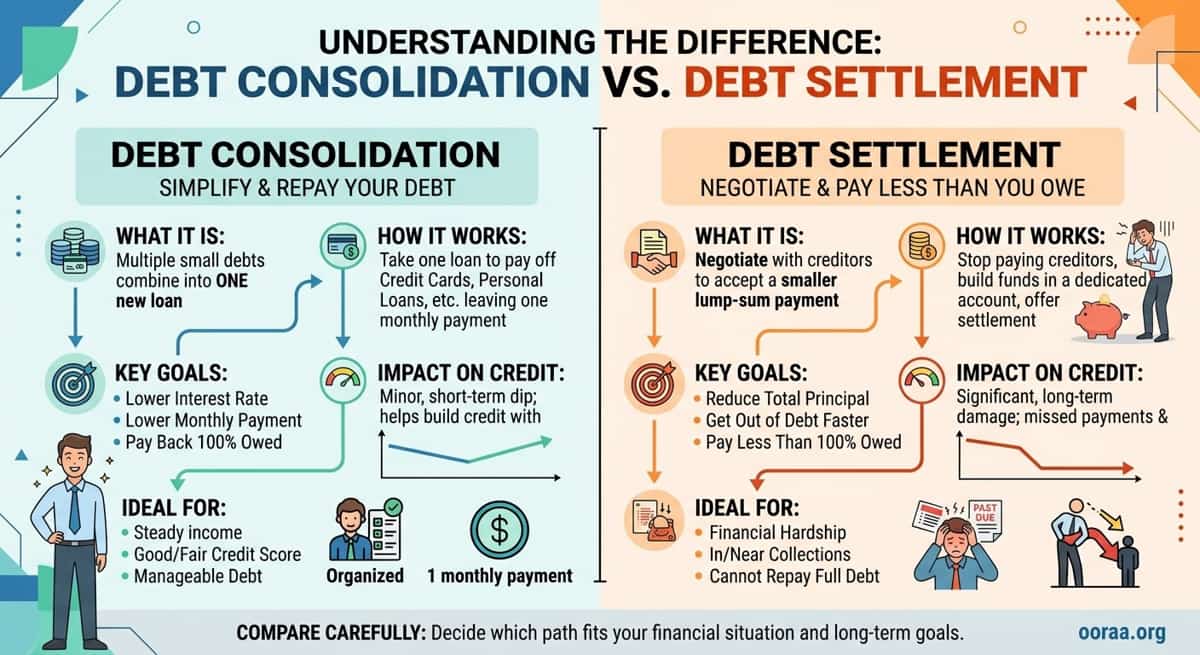
Debt consolidation combines what you owe into one loan so you pay it all off, just more simply and usually at a lower interest rate.
Debt settlement means negotiating to pay less than what you actually owe but it comes with real trade-offs.
What Is Debt Consolidation?
Debt consolidation means taking several debts, say, three credit cards with different due dates and interest rates and rolling them into one new loan through a structured debt consolidation program. Instead of juggling multiple payments, you make one payment a month, ideally at a lower interest rate than what you were paying before.
There are a few common ways people do this:
A personal consolidation loan from a bank, credit union, or online lender, used to pay off your existing debts, leaving you with just the one loan.
A balance transfer credit card, which moves your card balances onto a new card, often with a low or 0% introductory interest rate for a set period.
A home equity loan or HELOC, which uses your home as collateral to pay off other debts is powerful, but risky, since your home is now tied to that debt.
A nonprofit debt management plan (DMP), where a credit counseling agency negotiates lower interest rates with your creditors and you make one monthly payment to them, who then pays your creditors.
Consolidation generally works best if you have a reasonably steady income and decent credit. Most personal loans and balance transfer cards want to see a credit score in the low-to-mid 600s or better. That's worth keeping in mind, because it's exactly where things get complicated for a lot of newcomers to the US, which we'll get into shortly.
Say you have three credit cards $3,000, $5,000, and $7,000 all at 22% to 27% interest. You take out a $15,000 personal loan at 12% interest and use it to pay off all three cards. Now you have one payment, one due date, and a lower rate. You still owe the full $15,000, but you're paying much less in interest to get there.
What Is Debt Settlement?
Debt settlement means negotiating with your creditors either yourself or through professional debt settlement services to accept a lump sum that's less than what you actually owe. "
Here's how it typically plays out when you go through a settlement company:
You stop making payments to your creditors and instead deposit money into a dedicated savings account each month.
As that account builds up, the settlement company reaches out to your creditors and negotiates a lump-sum payoff for less than the full balance.
Once a creditor agrees, the account gets paid off using your savings, and it's marked on your credit report as "settled for less than the full amount."
This repeats debt by debt until every enrolled account is settled, a strategy that works especially well when managing settlement for multiple credit cards.
You can also negotiate settlements yourself, without paying a company to do it. It takes more time and confidence handling those calls, but it saves you the fee. If you do use a for-profit settlement company, expect to pay somewhere around 15% to 25% of your enrolled debt in fees. The Federal Trade Commission (FTC) specifically regulates this: settlement companies are not allowed to charge you a fee before they've actually settled at least one of your debts.
It's worth saying clearly: debt settlement is generally something to consider as a later-stage option, once you're genuinely unable to repay debts in full, not a first move.
Which One Hurts Your Credit More?
Consolidation usually causes a small, short-term dip in your credit score mostly from the hard inquiry when you apply for a new loan or card. After that, your score tends to move in a positive direction as your balances go down and your credit utilization improves.
Settlement is a bigger hit, for a simple reason: to get a creditor to agree to a settlement, you typically have to fall behind on payments first. Those missed payments show up on your credit report, and once an account settles, it's marked as "settled for less than owed" a notation that can stay on your credit report for up to seven years.
That damage isn't just a number on a screen. It can affect your ability to rent an apartment, get approved for a car loan, or for some readers provide the kind of clean financial documentation that comes up during visa or green card sponsorship processes. If any of that applies to you, it's worth talking to an immigration attorney about your specific situation before assuming either path is "safe."
Why This Decision Hits Differently for South Asian Families in the US.
You may have no US credit history at all. Credit doesn't transfer across borders. If you moved from India, Pakistan, Bangladesh, Sri Lanka, or Nepal as an adult even with years of responsible financial behavior back home you often start from zero here. That "credit invisibility" can quietly rule out the better consolidation loans and lower interest rates, and push people toward settlement companies simply because they seem to ask for less upfront. That's often the wrong default, not the right one. It's worth exploring consolidation options built for thin credit files before assuming settlement is your only path.
Debt is often shared, even when it doesn't feel like it. A credit card opened with a parent as an authorized user. A car loan co-signed for a younger sibling. A joint account used to run a household together. Settling a jointly held account doesn't just affect your credit, it can quietly damage a family member's credit too, sometimes without them realizing it happened.
Sending money home adds a layer most guides ignore. Many people are managing US debt while also supporting family abroad, a parent's medical costs, a sibling's education, a wedding contribution. That ongoing obligation can push people toward high-interest credit cards or "buy now, pay later" apps just to keep up, debt that later needs consolidating in the first place.
Debt often carries shame instead of being treated as a normal financial event. The fear of "log kya kahenge" what will people say keeps a lot of people quiet about debt until it's already a crisis, instead of reaching out early for free help. A nonprofit, HUD-approved credit counselor (some affiliated with the National Foundation for Credit Counseling) can review your full situation for free and, in some areas, offer counseling in Hindi, Urdu, Bengali, or Punjabi. It's worth asking when you call, since availability varies by agency. That's a very different starting point than the for-profit settlement ads that specifically target immigrant communities online.
What Each Option Actually Costs You
Consolidation costs typically include:
An origination fee on the loan, often 0% to 8% of the loan amount
Interest over the life of the loan (though usually much lower than your original credit card rates)
A balance transfer fee if you use a transfer card, usually 3% to 5% of the amount moved
Settlement costs typically include:
A fee to the settlement company, often 15% to 25% of your enrolled debt
Continued late fees and interest that pile up on your accounts while you're not paying creditors directly
The risk that a creditor sues you for the unpaid balance before a settlement is reached
A quick side-by-side, using $15,000 in debt as an example (numbers are illustrative estimates, not guarantees your actual costs will vary):
Consolidation | Settlement | |
Amount owed | $15,000 | $15,000 |
Typical outcome | Repay full $15,000, but at lower interest | Might settle around $9,000–$10,500 (varies widely) |
Fees | Loan origination, ~0–8% | Settlement fee, ~15–25% of enrolled debt |
Credit impact | Mild, short-term | Significant, longer-lasting |
Typical timeline | 2–5 years | 2–4 years |
Pros and Cons of Each Option
Debt Consolidation
You keep your full credit standing intact over time
One simple monthly payment instead of several
Usually a lower interest rate than credit cards
You still owe every dollar no reduction in principal
Requires decent credit to get a good rate
A home equity loan puts your house at risk if you can't repay
Debt Settlement
You may end up owing less than your original balance
Can offer real relief when repayment in full genuinely isn't possible
Noticeable, lasting damage to your credit score
Forgiven debt can be taxed as income
Creditors can still choose to sue you while you're not paying them
Not guaranteed creditors don't have to agree to settle
Which One Fits Your Situation?
Ask yourself a few honest questions:
What's my current credit score range?
What percentage of my monthly income goes toward debt payments?
Are my accounts still current, or already past due?
Do I have any US credit history or a cosigner who does?
Can I realistically repay what I owe in full, even if it takes a few years?
As a general starting point: if your accounts are still current and your credit score is around 640 or higher, evaluating debt consolidation or debt relief can help you decide if keeping your credit score intact is your top priority. . If you're already behind on payments and genuinely can't repay the full amount even with a longer timeline, settlement (or in more serious cases, bankruptcy) may be the more honest option.
You don't have to work this out alone or guess. A nonprofit credit counselor can run these numbers with you for free and tell you, realistically, which path fits before you commit to either one.
Tax Implications of Debt Settlement
Here's something a lot of settlement ads don't mention: forgiven debt can count as taxable income. If a creditor forgives $600 or more, they're generally required to send you (and the IRS) a Form 1099-C, and that forgiven amount may need to be reported as income on your tax return.
There is an exception if you were insolvent (your debts exceeded your assets) at the time of settlement, you may be able to exclude some or all of that forgiven amount using IRS Form 982. But that requires documentation and is genuinely worth handling with a tax professional not guessing on your own. This is one area where getting it wrong can cost you later, so don't skip this step.
Other Debt Relief Options Worth Knowing
Consolidation and settlement aren't the only paths. A few others worth knowing about:
Nonprofit Debt Management Plans (DMPs) — a credit counseling agency negotiates lower interest rates with your creditors, and you make one monthly payment through them.
Professional Credit Counseling Service — often free, and a good first step regardless of which path you eventually choose.
Bankruptcy (Chapter 7 or Chapter 13) — a more serious legal step that can discharge or restructure debt, but with long-term consequences that really need to be discussed with a bankruptcy attorney, not decided from an article.
Direct hardship programs — many creditors have their own hardship or forbearance programs if you contact them directly, especially before you've missed payments.
An Illustrative Example: Two Paths, Two Outcomes
Imagine a couple in their early 30s who moved to the US on work visas five years ago. When her father was hospitalized back home, they put $12,000 on a joint credit card to cover it, on top of an existing $6,000 balance from setting up their first apartment. Combined, that's $18,000 at over 24% interest, and minimum payments were barely covering the interest.
They looked at settlement first, because a company's ad promised to "cut their debt in half." But because the card was joint, settling it would have hit both of their credit files. Instead, they spoke with a nonprofit credit counselor, who helped them get a consolidation loan at 13% interest based on the credit history they'd built over five years. Their payment dropped, both of their credit scores stayed intact, and they had a clear 4-year payoff timeline instead of an uncertain settlement negotiation with tax consequences waiting at the end.
Not everyone's numbers will work out this way for someone genuinely unable to repay in full, settlement can be the more realistic choice. The point isn't that one option is always right; it's that running the numbers with someone who isn't selling you something changes the outcome.
How to Get Started
Pull your credit reports for free at AnnualCreditReport.com so you know exactly where you stand.
List every debt you have balance, interest rate, and whether it's current or past due.
Book a free session with a nonprofit credit counselor (look for NFCC-member or HUD-approved agencies) before contacting any for-profit company.
If consolidation looks right, compare at least two loan or balance transfer offers before choosing one.
If you're considering a settlement company, verify them against the FTC and CFPB complaint databases before signing anything.
The Bottom Line
Debt consolidation repays what you owe in full through one simpler, usually cheaper loan; debt settlement reduces what you owe but comes with real credit and tax trade-offs. The right choice depends on your credit standing, your income, and how far behind your accounts already are not on which ad you saw first. Before you sign up with any company, a free session with a nonprofit credit counselor can help you see your real numbers and make this decision with actual clarity, not pressure.
Ready to Get Started?
Get a free consultation with a certified debt consultant to see if debt settlement is right for you.
Get Free ConsultationAbout the Author
Bhupinder Bajwa
.
Related Articles
Which Debt Should I Pay Off First?
10 min read

How to Negotiate Your Credit Card Debt
11 min read
How to Settle SBA Loan Debt: Complete Guide to Debt Relief Options
11 min read
What to Know Before Getting a Debt Consolidation Loan
10 min read
Low Income Debt Relief Programs And Options
14 min read
4 Common Debt Consolidation Mistakes to Avoid
10 min read
Get Your Free Consultation
Speak with a certified debt consultant to explore your options.
Start NowNo obligation • Free consultation