Debt Consolidation vs. Debt Relief: Which Option Fits Your Situation?
Money trouble rarely shows up all at once. It creeps in through a missed payment here, a maxed-out card there, until you're juggling several due dates and wondering how it got this out of hand. If that sounds familiar, you've likely come across two terms that seem to promise the same thing: debt consolidation and debt relief.
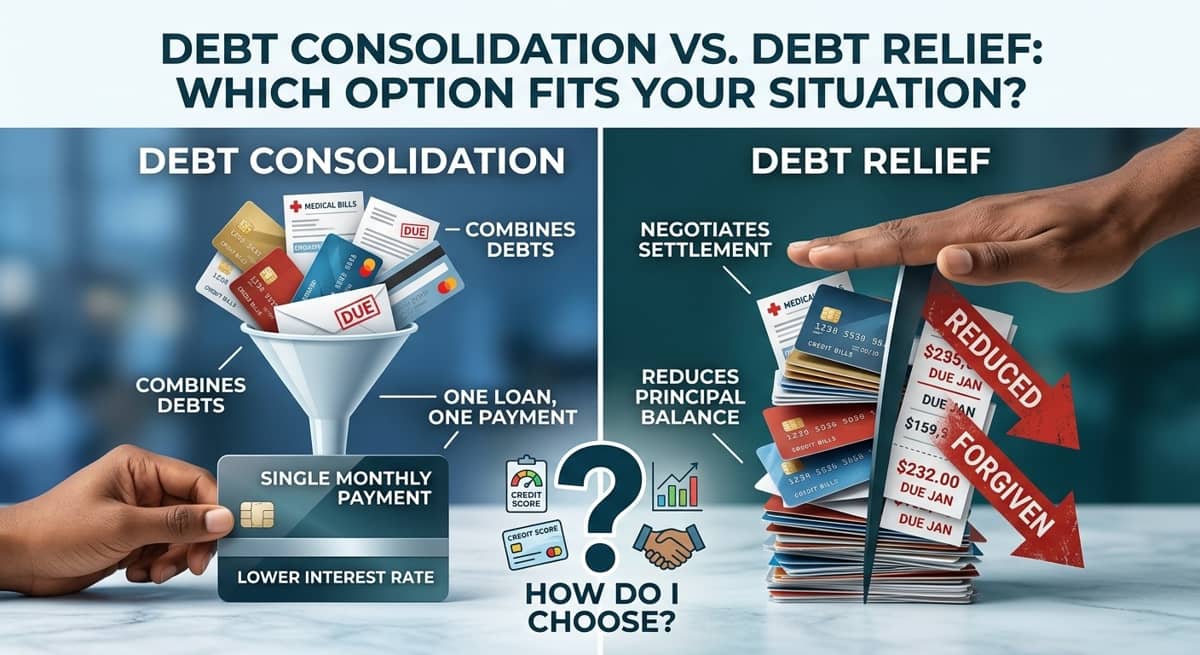
They're often used interchangeably, but they work very differently. Consolidation rolls your existing debts into one manageable payment, usually through a new loan or balance transfer. Relief takes a different approach, aiming to reduce what you actually owe through negotiation or, in some cases, legal protection.
Combine several debts into one loan with debt consolidation or credit line, usually with a lower interest rate, so you pay less in interest and have just one monthly payment but you still owe the full amount.
Debt relief through a debt management plan or debt settlement aims to reduce what you actually owe or make it easier to pay off, often at some cost to your credit score in the short term.
Which one fits depends on where you're starting from your credit score, how much you owe, and whether you're dealing with inconvenience or genuine inability to pay. Here's how to tell the two apart.
What Is Debt Consolidation?
Debt consolidation means rolling several debts, say, three credit cards and a medical bill into a single new loan or credit line, ideally at a lower interest rate. Instead of juggling four due dates and four interest rates, you make one payment a month.
Here's the important part: consolidation doesn't reduce how much you owe. If you owe $15,000 across four cards, you'll still owe roughly $15,000 after consolidating just to one lender instead of four, and hopefully at a lower rate that saves you money over time.
The most common ways to consolidate debt are:
A personal consolidation loan from a bank, credit union, or online lender, used to pay off your existing debts, leaving you with one fixed monthly payment.
A balance-transfer credit card, which often comes with a low or 0% introductory interest rate for a set period.
A home equity loan or line of credit, which uses your home as collateral, can offer a lower rate, but it also puts your home at risk if you can't keep up with payments.
Consolidation tends to work best if your credit score is decent (generally mid-600s or higher) and your core issue is interest rates eating into your budget, not an amount you fundamentally can't pay back.
What Is Debt Relief?
"Debt relief" is a broader term, and it usually means one of two different things. Confusing the two is one of the most common and most costly mistakes people make, and it's also where a lot of predatory companies take advantage of people who are already stressed.
Debt management plans (DMPs). These are run through nonprofit credit counseling agencies, often affiliated with the National Foundation for Credit Counseling (NFCC). A counselor works with your creditors to lower your interest rates and combine your payments into one monthly amount sent through the agency. You still pay back everything you owe, just on friendlier terms, usually over three to five years.
Debt settlement. This is different and riskier. A debt settlement company (usually for-profit) negotiates with your creditors to accept less than the full amount you owe. To do this, they often tell you to stop paying your creditors directly and instead put money into a separate account until there's enough to offer a lump-sum settlement. This can genuinely reduce your debt, but it also tends to hurt your credit score more, may involve real fees, and any forgiven debt over $600 is typically reported to the IRS as taxable income.
Neither of these is automatically "better" than the other; they're built for different levels of financial hardship.
Debt Consolidation vs. Debt Relief: The Key Differences
Debt Consolidation | Debt Management Plan | Debt Settlement | |
What happens to the amount owed | Stays the same, just at a lower rate | Stays the same, with reduced interest | Often reduced, but not guaranteed |
Effect on credit score | Minimal, if you keep payments current | Small dip initially, recovers over time | Bigger, longer-lasting dip |
Typical timeline | 2–5 years, depending on loan terms | 3–5 years | 2–4 years |
Cost | Interest + possible origination fee | Small monthly fee to the agency | Settlement fees, often 15–25% of enrolled debt |
Tax implications | None | None | Forgiven debt may be taxable income |
Best fit for | Good credit, manageable total debt, high interest rates | Fair credit, struggling with rates but can repay full balance | Severe hardship, genuinely unable to repay in full |
If your main frustration is watching most of your payment disappear into interest every month, consolidation is usually the more straightforward fix. If you've done the math honestly and the total amount is simply more than you can realistically pay back, debt relief starting with a nonprofit counselor, not a settlement ad you saw online is worth exploring.
How Each Option Affects Your Credit Score
Both paths can affect your score, just differently.
With debt consolidation, the impact is usually small. There's a brief dip from the credit check when you apply for a new loan or card, but if you consolidate and keep making on-time payments, your score often improves over the following months, partly because your credit utilization (how much of your available credit you're using) goes down.
With a debt management plan, your score may dip slightly at first, especially since some credit accounts get closed as part of the plan. But because you're still paying your full balance and payments are reported as current, most people see their score recover and often improve over the life of the plan.
With debt settlement, the credit impact tends to be more significant. Because the plan typically involves missing payments on purpose to build up settlement funds, those missed payments get reported to credit bureaus and can stay on your report for up to seven years. The Consumer Financial Protection Bureau (CFPB) has specifically warned that settlement can cause deeper, longer-lasting credit damage than other options; it's not something to walk into assuming your score will "bounce back quickly."
What South Asian Households in the U.S. Should Weigh Before Choosing
This is the part that generic financial advice usually misses, but it's often the most important part of the decision.
Money you send home. If you're regularly sending money to parents, siblings, or other family abroad, that's a real, ongoing expense even though it doesn't show up on your credit report or get counted in a standard debt-to-income calculation. Before choosing consolidation or relief, be honest with yourself about this number. A lender or counselor can only work with what you tell them, and leaving out remittances often leads to a repayment plan that looks fine on paper but doesn't survive contact with real life.
Thin or no U.S. credit history. If you're a newer immigrant, you may have little or no U.S. credit file, even if you had a strong financial track record in your home country credit history generally doesn't transfer across borders. This can limit which consolidation loans or balance-transfer cards you actually qualify for, since most require an established credit score. In that case, a nonprofit credit counseling agency, which doesn't rely on your credit score the same way a lender does, may be more accessible than a consolidation loan.
Privacy and stigma. For many families, financial difficulty carries a weight that goes beyond the money, a fear of being judged, or word getting back to relatives. If this is a concern for you, ask any counseling agency directly how they handle confidentiality, and look for one that lets you manage everything privately online or by phone, without involving anyone else.
Immigration status. To be clear: unpaid debt is a civil financial matter, not an immigration matter, and simply owing money does not by itself affect your visa or immigration status. That said, immigration law is its own specialized area, and if you have specific questions about how your finances intersect with your status, that's a conversation for an immigration attorney, not something to guess based on financial forums.
Which Option Fits Your Situation?
Instead of a vague "it depends," here's a straightforward way to think it through:
Start with your credit score.
670 or above - Consolidation is likely accessible to you, often at a competitive rate.
580–669 - You may still qualify for consolidation, but a debt management plan is worth comparing since it doesn't depend on your score the same way.
Below 580 - A nonprofit credit counseling agency is usually the more realistic starting point.
Then ask what's actually broken.
If you can afford your monthly payments but interest is eating up most of it - consolidation.
If you can almost keep up, but barely, and mainly need lower rates and structure - a debt management plan.
If, after being honest about your full picture including remittances and any community obligations you genuinely cannot repay the full balance in a reasonable time - debt settlement may be worth exploring, but only through a legitimate, accredited provider.
Finally, check your debt-to-income ratio (your total monthly debt payments divided by your monthly income). Generally, a ratio under 36% suggests consolidation is manageable; well above that, and relief options deserve a serious look.
Choosing Between the Two
Consider a household with $22,000 across two credit cards and a personal loan, a credit score around 690, and a steady habit of sending $300 a month to parents overseas. On paper, a debt consolidation calculator suggested a loan that would "save" $180 a month but that number didn't account for the $300 in remittances, which weren't showing up anywhere in the lender's math.
Once that $300 was added into the real monthly budget, the original consolidation loan payment was too tight to sustain. Rather than walking away from consolidation altogether, the fix was choosing a longer loan term with a slightly higher total interest cost but a lower monthly payment one that actually left room for the remittances every month. The lesson wasn't that consolidation was the wrong tool; it was that the numbers only work if every real monthly obligation is on the table, including the ones that don't show up on a credit report.
How to Get Started Safely (and Avoid Debt Relief Scams)
Debt relief is unfortunately a common target for scams, and immigrant communities are often specifically targeted. A few checks before you sign anything:
Verify accreditation. Look up any credit counseling agency through the NFCC (nfcc.org) to confirm it's a legitimate nonprofit.
Be wary of upfront fees. By law, debt settlement companies cannot charge you a fee before they've actually settled at least one of your debts.
Watch for guarantees. No legitimate company can promise a specific percentage reduction before reviewing your full situation and treat guarantees as a red flag.
Be cautious of pressure tactics. Legitimate counselors will give you time to think; scam operators often push you to sign immediately.
Know where to report problems. If something feels off, you can file a complaint with the Consumer Financial Protection Bureau , the Federal Trade Commission, or your state attorney general's office.
A free initial session with an NFCC-affiliated nonprofit counselor is a safe, no-obligation way to get an honest read on your options before committing to anything.
When Neither Option Is Enough: Considering Bankruptcy
If your debt is significantly larger than your income can realistically address, even with consolidation or relief, bankruptcy (Chapter 7 or Chapter 13) may be a more appropriate path. This is a legal process, not a financial product, and it comes with real, lasting consequences that deserve proper guidance. If you're at this point, the right next step is a conversation with an attorney or an NFCC-certified counselor, who can walk you through whether it's actually necessary in your case; this isn't something to decide alone based on articles online.
Where to Go From Here
The real difference between debt consolidation and debt relief comes down to this: consolidation makes your existing debt easier to manage, while relief is for when the amount itself has become genuinely unmanageable. Before deciding, take an honest look at your full monthly picture remittances, community obligations, and all and consider starting with a free session with an NFCC-accredited nonprofit counselor, who can help you see your real options clearly before you commit to anything.
Ready to Get Started?
Get a free consultation with a certified debt consultant to see if debt settlement is right for you.
Get Free ConsultationAbout the Author
Bhupinder Bajwa
.
Related Articles
What to Know Before Getting a Debt Consolidation Loan
10 min read
Low Income Debt Relief Programs And Options
14 min read
4 Common Debt Consolidation Mistakes to Avoid
10 min read
Can Debt Consolidation Really Help?
13 min read
What Debts Can Be Included in Debt Relief?
13 min read
Secured vs Unsecured Debt Consolidation: What's the Difference?
8 min read
Get Your Free Consultation
Speak with a certified debt consultant to explore your options.
Start NowNo obligation • Free consultation
Related Posts
- What to Know Before Getting a Debt Consolidation Loan
10 min read
- Low Income Debt Relief Programs And Options
14 min read
- 4 Common Debt Consolidation Mistakes to Avoid
10 min read
- Can Debt Consolidation Really Help?
13 min read