4 Common Debt Consolidation Mistakes to Avoid
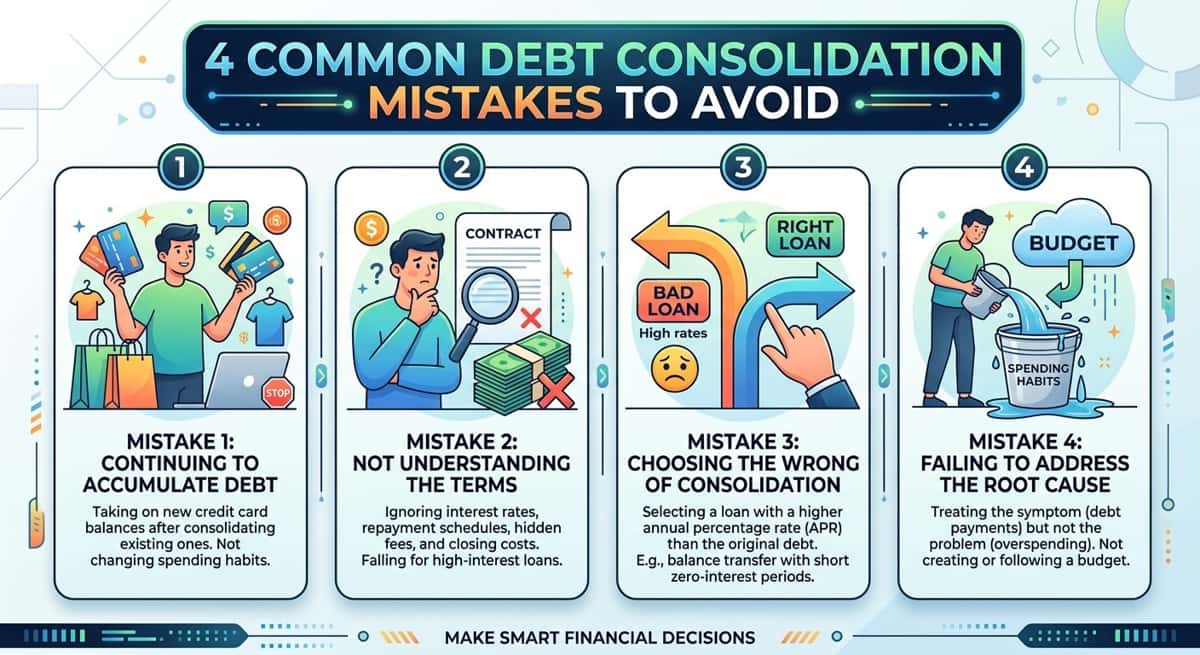
Debt consolidation can make managing multiple debts easier by combining them into one payment. It may help simplify your finances, but it does not automatically solve every debt problem. Choosing the wrong loan, overlooking fees, or taking on new debt can leave you in a tougher financial position. Many people focus only on getting a lower monthly payment without considering the total interest or repayment period. Understanding the common mistakes before consolidating your debts can help you make a more informed decision. I
Debt consolidation can work, but these four mistakes turn it into a trap:
Looking only at the monthly payment instead of the total cost.
Putting your home or retirement savings at risk to pay off credit cards.
Trusting the wrong lender or debt relief company.
Consolidating without changing what caused the debt in the first place.
What Debt Consolidation Actually Makes Sense
Combining several debts into one new loan or payment, ideally with a lower interest rate or a simpler way to pay. Instead of juggling five due dates, you handle one.
There are a few common ways to do it:
Personal loan: You borrow a lump sum, pay off your cards, then repay the loan in fixed monthly amounts.
Balance transfer card: You move card balances to a new card that charges little or no interest for a set period, often 12 to 21 months.
Home equity loan or HELOC: You borrow against the value of your home.
Debt management plan: A nonprofit credit counseling agency negotiates with your creditors and collects one monthly payment from you.
Consolidation tends to work best for people with steady income, a clear picture of what they owe, and a real plan to stop adding new debt. It tends to work poorly for people whose income is unpredictable or who are already falling behind.
It also affects your credit score. Applying usually causes a small, temporary dip. Paying off cards can lift your score over time, but only if you keep those balances low afterward.
Mistake #1: Focusing on the Monthly Payment Instead of the Total Cost
A lower monthly payment feels like relief, but it can mean you pay thousands more by the end.
Why it's easy to fall into
When money is tight, the first question is usually, "What can I afford each month?" Lenders know this. Many will happily stretch your loan over a longer period to make the payment look small. A longer loan means more months of interest.
Fees can also hide in the fine print. Some loans charge an "origination fee," taken out of the money you receive, so you may get less than you borrowed. Some balance transfer cards charge a transfer fee, and the low introductory rate can jump sharply when the promotion ends.
For many South Asian families, the monthly squeeze is real. Rent, car payments, school costs, and money sent to parents or siblings all come due at once. A smaller payment can feel like the only choice. But a payment that's easy this month can cost you for years.
This is a made-up example to show how this works:
Rahul owes $15,000 across three credit cards. He gets two loan offers, both at 12% APR:
Offer A: 5 years, about $334 a month. Total paid: roughly $20,000.
Offer B: 7 years, about $265 a month. Total paid: roughly $22,250.
Offer B saves him about $69 a month, which feels great. But it costs him around $2,250 more overall. If Offer B also charged an origination fee, the gap would be even bigger.
Neither offer is "wrong." The point is to make the choice knowing what it costs.
How to avoid it
Before you sign, run through this short checklist:
Compare the APR, not just the interest rate. APR includes most fees, so it's a fairer way to compare offers.
Ask what fees apply. Origination, transfer, late, and prepayment fees all count.
Multiply the monthly payment by the number of months. That's your total cost.
Ask if you can pay the loan off early without a penalty. If you can, extra payments save you interest.
If a lender won't give you these numbers in writing, that tells you something.
Mistake #2: Putting Your Home or Retirement Savings on the Line
Using your house or your 401(k) to pay off credit cards turns a money problem into a much bigger one if things go wrong.
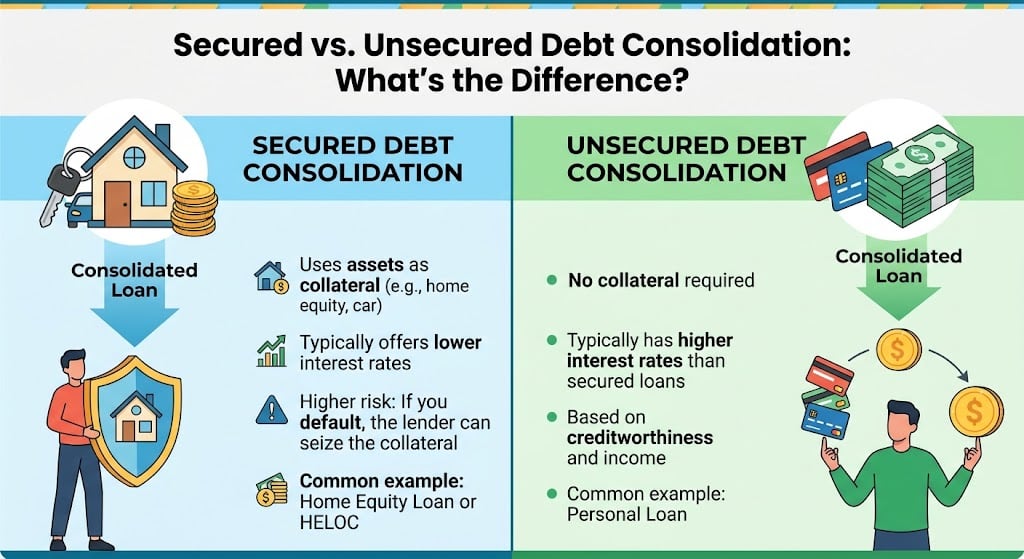
Credit card debt is "unsecured," which means the bank can't take your property if you can't pay. It can hurt your credit and lead to collections, but your home isn't directly at stake.
A home equity loan or HELOC is different. It's secured by your house. If you can't keep up with payments, you could lose the home.
For many families, the house is the biggest thing they own. It may also hold years of sacrifice, a place for aging parents, or the base for a family business. That's a lot to risk to clear card balances.
Borrowing from your 401(k) has its own catch. If you leave or lose your job, the remaining loan balance generally has to be repaid by your tax filing deadline for that year. If you can't, the unpaid amount may be treated as a withdrawal. That can mean income taxes and, if you're under 59½, an extra 10% penalty. Job changes happen, so this risk is bigger than it looks.
Ask yourself these questions first:
If my income dropped by a third, could I still make this payment?
Am I okay with my home being the backup if I can't pay?
Is there an option that doesn't put an asset at risk?
Unsecured options, like a personal loan or a debt management plan, are often safer, even if the rate is a bit higher. If you have a lot of equity and a very stable income, a home loan may still make sense, but go in with your eyes open, and talk to a nonprofit credit counselor before you decide.
Mistake #3: Trusting the Wrong Lender or "Debt Relief" Company
When you're stressed and short on time, it's easier to fall for a bad offer. Scammers and predatory lenders count on that.
Bad actors know that people in debt want fast answers. Some also know how trust works inside communities. An offer that comes through a friend, a WhatsApp group, a community event, or someone who speaks your language can feel safe. Sadly, that's exactly how some scams spread. This is often called affinity fraud: someone uses a shared background to earn trust they haven't earned.
Newcomers can be especially exposed. If you have a thin credit file, no Social Security number yet, or an ITIN, you may feel you have fewer choices though comparing verified debt relief options can help protect you from predatory practices.
It's also worth knowing that federal rules limit when companies selling debt relief services over the phone can charge you. In general, they can't collect fees before they've actually settled or reduced at least one of your debts. A company asking for big money upfront is a red flag.
Warning signs
Be careful if a company or lender:
Guarantees approval or guarantees you'll erase your debt.
Pushes you to decide today.
Asks for payment before doing any work.
Tells you to stop paying your creditors and send money to them instead.
Is vague about fees, terms, or how the process works.
Won't give you anything in writing.
How to check a provider
Look for a nonprofit credit counseling agency.
Check your state. Many states require debt relief companies and lenders to be licensed. Your state attorney general or banking regulator can tell you.
Search the CFPB complaint database. The Consumer Financial Protection Bureau lets you look up complaints against companies.
Read everything before signing. Ask for the contract in writing and take your time. Someone you trust, or a different counselor, can read it with you.
A good provider won't mind you taking time.
Mistake #4: Consolidating Without Fixing What Caused the Debt
If the reason you got into debt hasn't changed, a consolidation loan can just give you more room to fall back in.
When you pay off your cards with a consolidation loan, those cards suddenly have zero balances. It's tempting to start using them again. Then you have the loan and new card balances, and you're worse off than before.
Most debt doesn't come from carelessness. It often comes from irregular income, such as a small business, gig work, or seasonal hours. It comes from medical bills or a family emergency. And for many South Asian households, it also comes from regular financial support for families abroad, which often isn't written into any budget.
There's nothing wrong with supporting a family. It's a value and a responsibility many people are proud of. But if the money you send each month isn't part of your plan, something else has to give, and that something is often a credit card.
How to avoid it :
Write a real budget that includes the money you send to family. Seeing it on paper makes it easier to plan around.
Build a small emergency fund. Even $500 to $1,000 can keep a surprise from landing on a credit card.
Decide what to do with the paid-off cards. You can keep them but leave them at home, or set a low limit. Closing old cards can lower the average age of your credit, which may hurt your score, so think it through first.
Look at the cause, not just the balance. If income is irregular, build the plan around your lowest-income months, not your best ones.
Is Consolidation Right for You? Comparing Your Options
Debt consolidation can simplify multiple payments, but it may not be the right choice for everyone. Compare interest rates, fees, repayment terms, and other options to find an approach that fits your financial situation. Every option has trade-offs. Here's a simple side-by-side view:
Option | How it works | Often a fit when | Main risk | Effect on credit |
Consolidation loan | One new loan pays off your cards | You have decent credit and steady income | Fees and long terms can raise total cost | Small dip at first, can improve with on-time payments |
Balance transfer card | Moves balances to a low-interest card for a set time | You can pay it off before the promo ends | Rate jumps after the promotion; transfer fees | Small dip at first; depends on utilization |
Debt management plan | A nonprofit negotiates lower rates and you make one payment | You're struggling but can still make payments | Usually closes your cards; a monthly fee applies | Mixed; improves with steady payments |
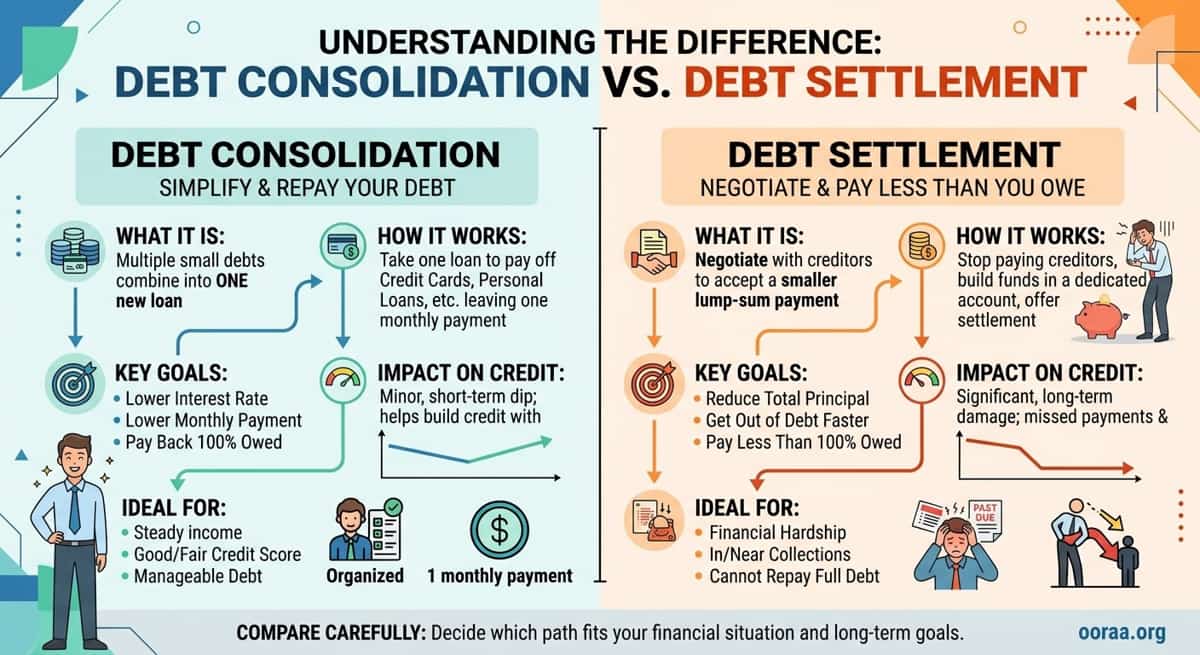
Settlement or bankruptcy | Pay less than you owe, or legally restructure or clear debt | Debt is truly unmanageable | Serious, long-lasting credit damage; fees and legal effects | Significant negative impact |
If you're unsure where you fit, talk to a nonprofit credit counselor first. Many offer free or low-cost first sessions. If you're considering bankruptcy or settlement, speak with a licensed attorney before you decide.
A Safer Step-by-Step Approach
If you want to move forward, take it one step at a time:
List every debt. Write down the balance, interest rate, and minimum payment for each.
Check your credit reports. You can get free reports from all three credit bureaus at AnnualCreditReport.com. Look for errors.
Compare the total cost of each option. Don't compare monthly payments alone.
Verify the provider. Use the checks from Mistake #3.
Set a budget that includes everything. That means family support, emergencies, and a little breathing room.
Conclusion and Next Steps
Debt consolidation isn't good or bad. It's a tool, and it works when you use it carefully. To recap, watch out for these four mistakes:
Choosing based on the monthly payment alone.
Risking your home or retirement savings.
Trusting a lender or company you haven't checked.
Skipping the work of fixing what caused the debt.
If you're feeling worried or embarrassed, you're not alone, and asking for help is a normal, smart step. Many people in your situation have found a way forward by taking things one decision at a time.
If you'd like to talk through your options, book a free consultation.
Ready to Get Started?
Get a free consultation with a certified debt consultant to see if debt settlement is right for you.
Get Free ConsultationAbout the Author
Bhupinder Bajwa
.
Related Articles
Can Debt Consolidation Really Help?
13 min read
What Debts Can Be Included in Debt Relief?
13 min read
Secured vs Unsecured Debt Consolidation: What's the Difference?
8 min read
What’s The Difference Between Debt Consolidation And Debt Settlement?
12 min read
Debt Consolidation vs. Debt Relief: Which Option Fits Your Situation?
10 min read
Can You Consolidate Debt With a Low Credit Score?
11 min read
Get Your Free Consultation
Speak with a certified debt consultant to explore your options.
Start NowNo obligation • Free consultation