How Much Should I Offer In Compromise To The IRS?

For many South Asian individuals and families residing in the USA, the pressure to uphold family honor and maintain financial stability is immense. Managing significant IRS tax debt can feel like a private crisis, threatening both your hard-earned security and peace of mind. You've established a life here, perhaps supporting multiple generations or launching a successful business, only to face the crushing stress of back taxes, penalties, and interest. The good news is that the IRS recognizes that not everyone can pay their full tax liability.
This is where the Offer in Compromise (OIC) becomes a critical tool for financial redemption. The OIC is an IRS program that allows certain taxpayers to settle their tax debt for a lower amount than what they originally owe. Essentially, it’s a legally binding agreement between you and the Internal Revenue Service that resolves your tax liability. It offers a tangible pathway out of overwhelming debt and back toward financial freedom.
However, the OIC is not a simple negotiation. It is a highly complex application process, formalized through Form 656, that requires precision, expert financial calculations, and a complete disclosure of your assets and income. The IRS scrutinizes every detail, and even a minor error can lead to a rejection, costing you time, money, and emotional energy. Therefore, understanding exactly "how much to offer" is the single most important, and often most challenging, step. The minimum acceptable amount is determined not by what you wish to pay, but by a strict, non-negotiable formula set by the IRS. With a professional understanding of the rules, you can navigate this process with confidence, ensuring your application has the best chance for approval and securing the relief you deserve.
The Golden Rule: Your Offer Must Equal Your Reasonable Collection Potential (RCP)
If you are asking, "How much should I offer the IRS to settle my debt?" the answer is absolute: Your offer cannot be a random number, a guess, or simply the amount you feel you can afford. To be considered for an Offer in Compromise (OIC), your minimum offer must equal your Reasonable Collection Potential (RCP).
The RCP is the IRS’s official measure of the maximum amount of money they believe they could collect from you through enforced collection actions. This figure acts as the non-negotiable floor for any offer you submit. If your proposed settlement is even one dollar less than your calculated RCP, your OIC will be summarily rejected.
The IRS will calculate your RCP by meticulously analyzing your full financial situation, including both your current assets and your future earning capacity. Think of the RCP as the sum of all your financial resources that are legally available to satisfy your tax debt. Therefore, the essential first step in preparing a successful OIC is not filling out the paperwork, but accurately and professionally determining your own RCP. You must demonstrate that your offer represents the maximum amount the government could reasonably expect to collect. This calculated approach is the only way to move from simply wishing for debt relief to actually achieving a viable IRS debt settlement.
What is Reasonable Collection Potential (RCP)? Defining the IRS's Calculation
The Reasonable Collection Potential (RCP) is the cornerstone of the entire Offer in Compromise process. It is a precise, two-part formula used by the IRS to determine the lowest dollar amount they will accept to settle your tax liability. By breaking down the RCP, you gain clarity on what the IRS truly cares about: your available resources.
The RCP calculation is defined as:
$$ ext{RCP} = ( ext{Equity in Assets}) + ( ext{Future Income Potential})$$
Equity in Assets: This component accounts for the net equity you hold in all your property, including real estate, vehicles, bank accounts, investments, and business equipment. It answers the question: If the IRS seized and sold your assets, how much cash would be left over to pay the debt?
Future Income Potential: This component is an estimate of your ability to generate income in the near future that could be used to pay down the debt. It answers the question: How much cash could you realistically contribute toward the debt over a defined period (12 or 24 months)?
A common mistake in the OIC process is understating this figure or failing to properly account for all assets according to IRS guidelines. To submit a successful OIC, you must accurately calculate both of these components, presenting the IRS with a transparent and defensible final figure that aligns with their internal calculation rules. Understanding these two foundational elements is key to securing an IRS debt settlement under the Offer in Compromise guidelines.
Component 1: Determining Your Equity in Assets
The first major element of the RCP is determining your equity in all your assets—everything you own that has monetary value. This includes, but is not limited to, your home, any investment properties, cars, boats, mutual funds, stocks, and even the cash in your bank accounts. This calculation demonstrates your financial capacity to make a lump-sum payment.
The IRS uses a specific approach for valuing these items:
Quick Sale Value vs. Fair Market Value
When valuing an asset like a home or a business, the IRS does not use the Fair Market Value (FMV), which is the price the asset would fetch in a perfect sale environment. Instead, they use the Quick Sale Value (QSV). The QSV is defined as the amount that could be realized from the sale of an asset in a situation where financial pressures dictate a quick sale, typically within 90 days. The IRS typically assigns a 20% reduction to the Fair Market Value to arrive at the QSV.
Example: If your house's FMV is $$500,000$, the QSV might be calculated as $$500,000 imes 80% = $400,000$. Your equity is then the QSV minus any secured loans (like your mortgage).
Allowable Exemptions: Protecting Retirement Funds and Necessary Assets
Crucially, the IRS does not expect you to liquidate everything. Certain assets are partially or fully protected from collection and are therefore excluded from the RCP calculation. These are vital protections for your future stability.
Retirement Funds: Most qualified retirement funds (like 401(k)s, IRAs, and employer-sponsored pension plans) are fully exempt. This is especially important for preserving your long-term security.
Necessary Personal Items: There are statutory allowances for the value of necessary household goods, personal effects, and a minimal amount of equity in a vehicle. These exemptions ensure you retain the necessities of modern life.
A successful OIC requires documenting the appraised value of assets, subtracting the relevant debt (liens), and applying all allowable exemptions to arrive at a low, but defensible, net asset equity figure.
Component 2: Calculating Your Future Income Potential
The second, and often more subjective, component of the RCP is your Future Income Potential. This determines how much cash flow the IRS believes you could contribute to your tax debt over the next one to two years. It focuses on your ongoing capacity to pay.
Disposable Monthly Income (DMI) and the National & Local Standards
Your Future Income Potential is calculated by first determining your Disposable Monthly Income (DMI). This is your average gross monthly income minus your necessary monthly living expenses.
The IRS does not simply accept your actual spending figures for all expense categories. Instead, they require the use of their published limits: the National and Local Standards.
National Standards cover necessities like food, clothing, and out-of-pocket healthcare.
Local Standards cover housing, utilities, and transportation.
The challenge is that if your actual necessary expenses (for housing, healthcare, or family support) exceed the IRS standard for your region, you must provide extensive documentation and justification for a Deviation from the standard. For many South Asian American families living in high-cost metro areas (like New York, San Francisco, or Chicago), local housing costs often exceed the IRS's allowance, making a justifiable deviation request a critical part of lowering the DMI and, subsequently, the RCP. The lower your calculated DMI, the lower your required offer will be.
The Multiplier: 12-month vs. 24-month Payment Terms
Once your DMI is calculated, it is multiplied by a factor based on your chosen payment option:
Lump Sum Cash Offer: You propose to pay the agreed-upon settlement amount in five or fewer payments within 90 days of acceptance. The IRS multiplies your DMI by 12 months.
Periodic Payment Offer: You propose to pay the settlement amount in 6 to 24 monthly installments. The IRS multiplies your DMI by 24 months.
The Impact: Choosing the Periodic Payment offer will double the income-based portion of your RCP, which often significantly increases the minimum required offer. For this reason, many taxpayers aim to qualify for the Lump Sum Cash Offer, even if it requires borrowing the funds, to minimize the overall settlement amount.
Special Considerations for South Asian Americans in the OIC Process
For South Asian American families, navigating the Offer in Compromise (OIC) process often involves financial layers that go beyond the typical application, requiring careful planning to avoid rejection.
Navigating Family Financial Structures and Shared Assets
It's common for families in this community to maintain shared or commingled finances, often with assets held in joint names with a spouse, parent, or adult child. When applying for an OIC, the IRS will scrutinize these joint accounts and properties. You must be able to clearly delineate which portion of a shared asset—like a family home or a joint investment account—is truly your equity versus the share belonging to a non-liable third party. Failing to properly document the ownership split can lead the IRS to include the entire asset's equity in your Reasonable Collection Potential (RCP), dramatically inflating your required offer.
Reporting Income and Assets from Abroad (India, Pakistan, Bangladesh, etc.)
A significant consideration is the truthful and complete reporting of foreign assets and income, particularly those held in countries like India, Pakistan, or Bangladesh. The IRS is vigilant about compliance with U.S. tax laws, including the requirement to report foreign financial accounts via FBAR (FinCEN Form 114) and specified foreign financial assets through FATCA (Form 8938). Even if these assets are considered inaccessible or illiquid, their existence must be disclosed in your OIC application. If undisclosed foreign assets are discovered during the OIC review, the IRS can immediately reject your offer and potentially pursue civil and criminal penalties for non-compliance. Transparency and adherence to all foreign asset reporting rules are non-negotiable for a successful OIC.
Non-Negotiable: IRS OIC Eligibility Requirements You Must Meet First
Before you dedicate time and resources to calculating your Reasonable Collection Potential (RCP) and assembling a complex Offer in Compromise (OIC) package, you must first confirm that you meet the IRS's fundamental eligibility criteria. These are absolute requirements; failure to meet even one will result in an immediate return or rejection of your offer without review.
Your compliance history must be impeccable:
Current on All Filings: You must have filed all required federal tax returns up to the current date. The IRS will not consider an OIC if you have unfiled tax years.
Current on Estimates and Deposits: If you are self-employed or operate a business, you must be current with all federal tax deposits and have paid all required estimated tax payments for the current year.
No Open Bankruptcy: You cannot be a debtor in an open bankruptcy proceeding. The IRS considers OIC proposals only after a bankruptcy case has been finalized.
If you fail the initial eligibility screening, the IRS will not evaluate the merits of your offer amount. Therefore, bringing your tax filings and payments into full compliance is the essential first step before attempting to settle your tax debt.
The Three Paths to Compromise: Doubt as to Collectibility, Liability, or Effective Tax Administration
To be eligible for an Offer in Compromise (OIC), you must demonstrate to the IRS that your case fits into one of three specific categories, or "grounds for compromise." Identifying the correct category is crucial for structuring your application and supporting documentation.
Doubt as to Collectibility (DATC): This is the most common path. It means the IRS agrees that you cannot pay the full amount of the tax liability. This is the category where your Reasonable Collection Potential (RCP) calculation is paramount. By demonstrating that your RCP is less than the total debt, you establish DATC.
Doubt as to Liability (DATL): This applies if you genuinely believe you do not legally owe the tax debt. This path is used when there is a question about the accuracy of the tax assessment itself, such as an incorrect income calculation or misapplication of tax law. To pursue a DATL OIC, you must provide substantial evidence proving the IRS's assessment is wrong.
Effective Tax Administration (ETA): This path is reserved for exceptional circumstances. It applies when you have the financial ability to pay the full debt, but requiring you to do so would cause a significant economic hardship or would be considered unfair or inequitable. This is typically used when the debt payment would impair your ability to meet basic living expenses or would harm public interest.
While the majority of successful OICs fall under the DATC category, understanding all three grounds ensures you select the one that best and most accurately reflects your specific situation.
Step-by-Step: Submitting Your Offer and Avoiding Common Pitfalls
Once your Reasonable Collection Potential (RCP) is meticulously calculated, the final step is formally presenting your offer to the IRS. Precision and completeness are key to a successful submission.
Completing Form 656 and Form 433-A (OIC) or 433-B (OIC)
The primary documents required for any Offer in Compromise are:
Form 656, Offer in Compromise: This is the contract where you state your proposed offer amount and the grounds for compromise (e.g., Doubt as to Collectibility). You must clearly select either the lump-sum or periodic payment option here.
Form 433-A (OIC), Collection Information Statement for Wage Earners and Self-Employed Individuals, OR Form 433-B (OIC), Collection Information Statement for Businesses: These forms document every detail of your financial life. Every calculation used to determine your RCP (assets, income, expenses) must be supported by verifiable documents attached to these forms, such as bank statements, pay stubs, mortgage statements, and appraisals. A common pitfall is inconsistency between the numbers reported on the forms and the supporting documentation, which will prompt an immediate rejection.
The Offer Fee and Initial Payment: What is Required Upfront?
Your submission must include two mandatory financial items:
A Non-Refundable Application Fee: This fee must be paid unless you qualify for the low-income certification.
An Initial Payment: The required amount depends on your chosen payment term:
Lump Sum Cash Offer: 20% of the total proposed offer amount.
Periodic Payment Offer: The amount of your first proposed installment.
Failure to include the correct forms, fee, and initial payment will prevent the IRS from even opening your case for review.
The Waiting Game
After mailing your OIC package, be prepared for a long waiting period. The IRS will place a temporary hold on most collection activity, but the review process itself typically takes six to twelve months, or sometimes longer. Your case will be assigned to a Settlement Officer, who will review your application, verify your reported income and assets, and determine if your calculated RCP is accurate. They may request additional financial documentation or schedule an in-person or telephone interview. It is vital to respond promptly and thoroughly to all IRS inquiries during this review period to keep your offer under consideration.
Final Verdict
The Offer in Compromise is a powerful debt relief tool, but it is also one of the most complex and scrutinized processes the IRS offers. Given the high stakes involving your entire financial future, a professional's expertise is often the difference between success and rejection.
Why a Tax Attorney or CPA is Essential for Complex OICs?
The nuances of asset valuation, calculating allowable expense deviations, and navigating the reporting requirements for foreign holdings (especially relevant for South Asian Americans) are highly specialized tasks. A licensed tax professional—such as a Tax Attorney, CPA, or Enrolled Agent—can prepare a robust, defensible application that minimizes your RCP while satisfying IRS guidelines, significantly increasing your chances of acceptance.
Disclaimer: The calculations and information provided here are for educational purposes only. You must consult a licensed CPA, Enrolled Agent, or Tax Attorney before submitting an Offer in Compromise. Tax law is complex, and professional advice is essential for your unique financial situation.
Ready to Get Started?
Get a free consultation with a certified debt consultant to see if debt settlement is right for you.
Get Free ConsultationAbout the Author
Bhupinder Bajwa
Bhupinder Bajwa is a Certified Debt Specialist and Financial Counselor with over 10 years of experience helping families overcome financial challenges. Having worked extensively with the South Asian community in the U.S., he understands the cultural nuances and unique financial hurdles they may face. He is passionate about offering clear, compassionate, and actionable guidance to help individuals and families achieve their goal of becoming debt-free.
Related Articles
How Much Tax You Pay On Lawsuit Settlements
9 min read
Commercial Debt Management: What Business Owners Should Know
11 min read
How Interest Rates Affect Debt
13 min read
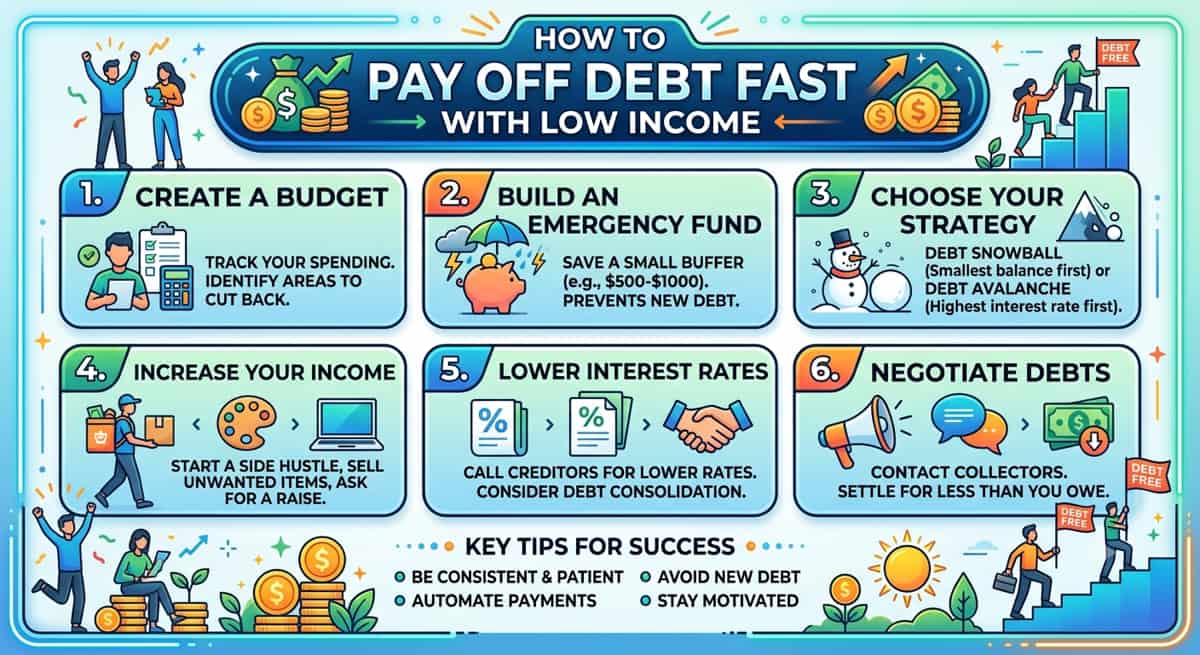
How To Pay Off Debt Fast With Low Income
11 min read
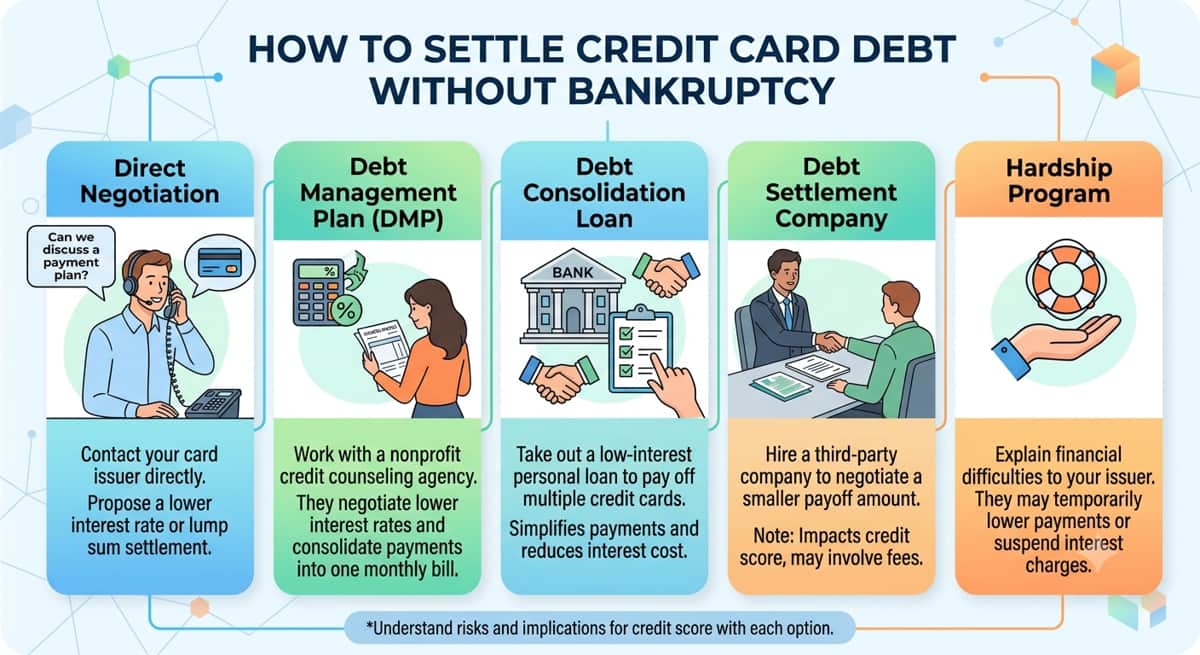
How Can You Settle Credit Card Debt Without Bankruptcy?
12 min read

Credit Card Debt Forgiveness For Disabled: Do You Qualify?
11 min read
Get Your Free Consultation
Speak with a certified debt consultant to explore your options.
Start NowNo obligation • Free consultation
Related Posts
- How Much Tax You Pay On Lawsuit Settlements
9 min read
- Commercial Debt Management: What Business Owners Should Know
11 min read
- How Interest Rates Affect Debt
13 min read
- How To Pay Off Debt Fast With Low Income
11 min read