
Federal Tax Liens: What They Are And How To Resolve Them Fast

Receiving notification of a Federal Tax Lien from the Internal Revenue Service (IRS) is arguably one of the most serious financial crises an individual or business can face. This is not just a bill; it is the most severe legal claim the government can place against your assets outside of criminal proceedings. The presence of a tax lien signals an absolute urgency, requiring immediate, informed action to protect your home, investments, and financial future.
For many South Asian individuals residing in the USA, the impact of such a legal claim is magnified. Financial stability is often paramount, tied closely to complex long-term goals like achieving permanent residency or citizenship, securing sponsorship, and managing financial support for family both locally and abroad. A tax lien jeopardizes this foundation, threatening to derail years of careful financial planning and potentially damaging the reputation associated with sound financial management. Resolving this issue swiftly is not just about saving money; it is about preserving your U.S. financial standing and personal peace of mind.
The goal of this expert guide is to provide a transparent, legally grounded breakdown of what a tax lien means and, most importantly, the actionable steps you must take to get it resolved quickly. While this information is designed to empower you with knowledge, please note that federal tax issues are complex. This article is for educational purposes only and is not a substitute for direct counsel from a qualified tax attorney or Certified Public Accountant (CPA). Your immediate action, informed by professional advice, is mandatory.
What is a Federal Tax Lien, and How Does the IRS Establish It?
A Federal Tax Lien is a potent legal tool used by the IRS to secure a tax debt when an individual or business fails to pay a legally required tax liability.1 It is the government's claim against your property, including assets acquired after the lien is filed.2 Importantly, the lien is not a physical seizure; it is a public legal announcement that the U.S. government has a vested, prioritized interest in all your property.3
The Lien vs. The Levy: Understanding the Critical Difference
It's common to confuse a tax lien with a tax levy, but understanding the distinction is crucial for knowing your rights and the immediate threat level.
Tax Lien: Think of the lien as a cloud on your title or a permanent lock on your assets. It is a legal claim against all of your current and future property—real estate, vehicles, bank accounts, and business assets. The lien secures the government's priority over other creditors.5 Its primary effect is to prevent you from selling or refinancing property without paying the IRS first. The lien is the warning.
Tax Levy: The levy is the physical execution of the lien. It is the actual seizure of your property to satisfy the debt.6 This is the moment the IRS takes action, such as draining your bank accounts, garnishing your wages, or seizing and selling your home or car.7 The levy is the final action. While a lien makes it difficult to transfer property, a levy takes the property away.8 The IRS must first establish a lien before it can generally move forward with a levy.
The IRS Notification Process and Timeline
The IRS cannot immediately file a lien without following specific procedures designed to give the taxpayer due process and time to respond. The process begins with the establishment of the tax debt and escalates through two formal steps:
Notice and Demand for Payment: This is the initial bill sent to the taxpayer detailing the assessed amount of tax, penalties, and interest owed.9 A lien automatically comes into existence after the taxpayer neglects or refuses to pay this liability within 10 days of receiving the notice. This is the government's internal claim, though it is not yet public.
Notice of Federal Tax Lien Filing: This is the public declaration of the lien.10 The IRS files this formal notice with the appropriate state or local county recorder's office (or Secretary of State). This public filing immediately impacts your credit score and financial life because it is now visible to all potential lenders, title companies, and creditors.11 By law, the IRS must mail you a copy of this notice no more than five business days after the notice has been filed. This is the point where the crisis becomes fully public and requires immediate, professional intervention.
Devastating Consequences: The Impact on Credit, Assets, and Livelihood
The damage caused by a Federal Tax Lien extends far beyond the amount of the original tax debt.1 Because the lien is a public filing, it acts as a massive red flag across your entire financial life, complicating borrowing, asset transfer, and even future employment opportunities.2 Mitigating these consequences is the primary goal of resolving the lien fast.
The Direct Hit to Credit and Loan Qualification
While the three major credit bureaus (Equifax, Experian, and TransUnion) removed federal tax liens from consumer credit reports in 2018 due to data reliability issues, the impact on your creditworthiness remains severe.
Public Record Visibility: The lien is filed with state and county authorities, making it a matter of public record.4 Lenders, title companies, and mortgage brokers routinely search these public records or request tax transcripts directly from the IRS during the underwriting process.
Guaranteed Denial or High Rates: The existence of a public tax lien signals to any financial institution that the borrower has a serious, unresolved debt with the highest priority creditor (the U.S. government).6 This virtually guarantees denial for major credit applications, including conventional or FHA mortgages, car loans, and business financing. If a loan is approved, it will be at the highest possible interest rates, eliminating any chance of favorable refinancing.
Lasting Negative Perception: Even after a lien is released (paid off), the memory of its existence lingers.7 Lenders view it as evidence of profound financial mismanagement, complicating your ability to secure the best loan terms for years to come.
Threat to Property, Business Assets, and Future Sales
The lien's most chilling effect is its claim over your tangible assets, disrupting your ability to manage or sell property.
Attachment to All Property: A Federal Tax Lien attaches to all property and rights to property—both those you currently own (like your primary residence, investment properties, and personal vehicles) and those you acquire while the lien is active.10 For business owners, the lien attaches to all business assets, including accounts receivable, inventory, and equipment.
The Sales Obstacle: You cannot sell or refinance your home or business property without first satisfying the tax lien or obtaining IRS approval.12 Why? A title company will flag the lien and refuse to issue a clear title, meaning a buyer's lender will not release funds for the purchase. The IRS must approve one of three actions related to the sale:13
Release (paid in full).
Discharge (removing the lien from that specific property).14
Subordination (allowing the new mortgage to take priority).
The Threat of Levy: If the lien remains unresolved, it serves as the necessary legal prerequisite for the IRS to issue a tax levy, which means the government can legally seize and auction your property, garnish wages, or freeze bank accounts to satisfy the debt.
How to Resolve a Federal Tax Lien FAST: 4 Expert Strategies
The most immediate priority upon discovering a Federal Tax Lien is to move from panic to a structured resolution strategy. The fastest way to mitigate the devastating consequences is through one of the four mechanisms offered by the IRS. Selecting the right path often requires professional guidance but must be initiated without delay.
Strategy 1: Full Payment (Release of Lien)
The most direct and immediate route to resolving a Federal Tax Lien is simply paying the tax debt in full, including all accrued penalties and interest. This action instantly eliminates the underlying tax liability that created the lien. Once payment is confirmed, the IRS is legally required to issue a Notice of Release of Federal Tax Lien within 30 days. This document proves the debt is satisfied and must be filed with the same public office where the original lien notice was recorded. While this method requires immediate liquidity, it offers the fastest way to remove the legal encumbrance on all your assets and begin the process of repairing your credit standing.
Strategy 2: Discharge of Property (Selling Specific Assets)
If you need to sell a specific asset—such as your home or a piece of investment real estate—but lack the funds to pay the entire tax debt, you can apply for a Certificate of Discharge of Property from Federal Tax Lien. This is a targeted remedy. A discharge removes the lien from only that single, specific piece of property, allowing the sale to close and clear title to the buyer. The IRS grants this only if the sale proceeds are sufficient to satisfy the federal tax liability in full, or if the government's interest in the property is protected. This is the mechanism used when a time-sensitive sale is essential to generate the funds needed for lien resolution.
Strategy 3: Subordination (Refinancing or Borrowing)
Subordination is a critical strategy when refinancing existing property to secure funds for paying the tax debt. A lien secures the IRS’s position as the primary or senior creditor against your property. Subordination allows a new lender (like a new mortgage provider) to step into the first position of priority, even before the IRS. This is necessary because lenders will not issue a new loan unless they are the primary lienholder. By subordinating its position, the IRS makes it possible for you to complete a refinance, secure a new loan at a lower interest rate, and use those proceeds to pay off the tax lien. This is often the best financial move for property owners seeking to lower their overall borrowing costs while resolving the tax issue.
Strategy 4: Withdrawal (Negotiating Removal)
The highest level of relief is the Withdrawal of the Notice of Federal Tax Lien. A withdrawal actually removes the public notice as if the lien had never been filed, offering the best outcome for credit repair. You must file Form 12277, Application for Withdrawal of Filed Notice of Federal Tax Lien. This relief is typically granted only after the tax liability has been fully satisfied, usually through an approved arrangement like an Installment Agreement or an Offer in Compromise (OIC). The IRS may also grant a withdrawal if the filing was premature or if withdrawal facilitates collection of the tax. Since withdrawal offers superior relief over a mere release, it should be pursued once the debt is paid.
Tax Liens and the South Asian American Financial Context
For South Asian Americans, the financial turmoil caused by a Federal Tax Lien extends into areas of life that are critical for long-term integration and family security in the United States. The implications of unresolved tax debt can be far-reaching, affecting immigration status and the integrity of commonly shared financial structures.
Impact on Immigration Status and Green Card Applications
While a tax lien itself is generally not an immediate ground for deportation or the rejection of a visa, the underlying failure to comply with U.S. tax laws carries significant weight during naturalization and permanent residency processes.
Good Moral Character: A key requirement for obtaining a Green Card or U.S. citizenship is demonstrating "Good Moral Character" to U.S. Citizenship and Immigration Services (USCIS).1 Flagrant or prolonged failure to pay federal taxes—the issue that leads to the lien—can be interpreted as evidence of a lack of good moral character, complicating the process.
Affidavit of Support: Many individuals in the community rely on affidavits of support from sponsors. If a sponsor faces a substantial, unresolved tax lien, their ability to demonstrate the required financial stability for sponsoring a relative may be compromised.
Legal Complexities: Tax liens represent unresolved issues with a federal authority. The most important action is to resolve the debt quickly and demonstrate to immigration officials that you are in compliance with a payment plan (like an Installment Agreement) or that the debt has been fully satisfied. Prompt resolution minimizes legal scrutiny and protects your long-term goal of stable residency.
Threat to Family-Owned Businesses and Jointly Held Assets
It is common within the South Asian American community for family members to pool resources, co-sign loans, or jointly own assets, including residential properties or small businesses. A tax lien can severely compromise these structures.
Attachment to Joint Property: A Federal Tax Lien attaches to the taxpayer's interest in all property.3 If a business or a home is owned jointly with a spouse, sibling, or parent, the IRS lien targets only the interest of the taxpayer who owes the debt. However, this still creates a major encumbrance on the entire asset.
Jeopardizing Business Operations: If the lien is attached to a family-owned business, it makes selling or borrowing against the business's assets impossible without IRS intervention. This can freeze operations or prevent necessary investment, jeopardizing the livelihood of all family members dependent on that business.
Need for Documentation: When dealing with joint assets, immediate action with a tax professional is critical to clearly establish the portion of the asset that belongs to the non-liable parties, helping to protect them from unnecessary complications during the resolution process.
Prevention and Long-Term Compliance: Never Face an IRS Lien Again
Resolving a current Federal Tax Lien is a huge achievement, but the most important step is ensuring you never face one again. Long-term financial security and freedom from IRS scrutiny rely entirely on proactive planning, meticulous record keeping, and knowing when to delegate complex legal matters to a professional.
Expert Tips for Tax Planning and Record Keeping
Tax liens are almost always a result of delayed payment or unfiled returns due to poor planning. Implementing these expert strategies can dramatically reduce your risk:
Consistent Estimated Tax Payments: For individuals with income not subject to standard W-2 withholding—such as small business owners, consultants, or those with significant investment income—making quarterly estimated tax payments is mandatory. Failure to pay throughout the year is a primary driver of large, unexpected year-end tax bills that lead to liens. Use the IRS Form 1040-ES to calculate and remit these amounts on time.
Embrace Cloud-Based Accounting: Move away from paper receipts and spreadsheets. Utilizing cloud-based accounting software (like QuickBooks or Xero) allows for real-time categorization of income and expenses.1 This simplifies end-of-year calculations, minimizes errors, and ensures you have a reliable, easily accessible ledger for audit preparedness.
Meticulous Documentation: Maintain clear, dedicated documentation for all income sources and deductions, especially for business expenses.2 Store digital copies of receipts, invoices, and bank statements immediately upon transaction. Proper documentation not only maximizes legal deductions but provides the necessary proof to easily defeat any IRS inquiry before it escalates to a lien notice.
When and How to Hire a CPA or Tax Attorney
A Federal Tax Lien is a legal crisis, and managing it successfully exceeds the capacity of do-it-yourself tax software. Professional intervention is non-negotiable for both resolution and long-term compliance.
Certified Public Accountant (CPA): A CPA is an expert in tax preparation, financial statements, and general tax planning.3 They are essential for ensuring your returns are filed accurately and on time, thereby preventing the tax liability from accruing in the first place. Hire a CPA for ongoing preparation, financial reporting, and complex tax compliance.
Tax Attorney or Enrolled Agent (EA): Once the IRS issues a Notice of Federal Tax Lien, you need a professional specialized in tax resolution. A Tax Attorney (licensed lawyer specializing in tax law) or an Enrolled Agent (EA—a federally authorized tax practitioner who can represent taxpayers before the IRS) is necessary for:
Representation: Communicating directly with the IRS on your behalf.
Negotiation: Filing complex documents like Form 12277 (Withdrawal) or the Offer in Compromise (OIC).
Legal Guidance: Advising on the legal consequences of the lien and ensuring you select the resolution strategy (Discharge, Subordination, etc.) that best protects your assets.
Conclusion and Immediate Next Steps
The most critical takeaway regarding a Federal Tax Lien is that it demands immediate professional intervention. This is not a debt that can be managed by simply ignoring it or relying on DIY tax software. A lien is a legal claim on your entire financial life, and its swift resolution is the only way to preserve your credit score, prevent asset seizure, and protect your standing for major life events like home financing and immigration processes.
The severity of a tax lien is defined by its ability to attach to virtually all your property and to publicly damage your financial reputation for years. While the ultimate goal is the Withdrawal of the lien from public record, the first step must focus on satisfying the underlying debt as quickly and efficiently as possible, utilizing strategies like full payment, discharge, or subordination where appropriate. The path you choose—and the speed at which you execute it—will determine the longevity of the damage to your credit and financial security.
Your 3-Step Immediate Action Plan
Do not let the fear of dealing with the IRS lead to procrastination. Your immediate response should be structured, calm, and professional:
Do Not Panic, But Do Not Delay: Acknowledging the problem is the first step. Do not ignore the IRS notices. Delaying action is the single most costly mistake you can make, as interest and penalties accrue daily, and the threat of a tax levy (asset seizure) increases.
Gather All IRS Notices and Documentation: Collect every piece of correspondence received from the IRS regarding the unpaid tax debt, including the Notice and Demand for Payment and the Notice of Federal Tax Lien Filing. Gather proof of income, asset lists, and any attempts you have already made to resolve the debt.
Immediately Contact a Tax Professional: You must seek counsel from a specialist. Immediately consult with a Tax Attorney or a certified Enrolled Agent (EA). These professionals are federally authorized to represent you before the IRS and can quickly assess your situation to determine the best resolution strategy (Full Payment, Discharge, Subordination, or Withdrawal) that offers you the fastest path to compliance and the most protection for your assets.
Ready to Get Started?
Get a free consultation with a certified debt consultant to see if debt settlement is right for you.
Get Free ConsultationAbout the Author
Bhupinder Bajwa
Bhupinder Bajwa is a Certified Debt Specialist and Financial Counselor with over 10 years of experience helping families overcome financial challenges. Having worked extensively with the South Asian community in the U.S., he understands the cultural nuances and unique financial hurdles they may face. He is passionate about offering clear, compassionate, and actionable guidance to help individuals and families achieve their goal of becoming debt-free.
Related Articles
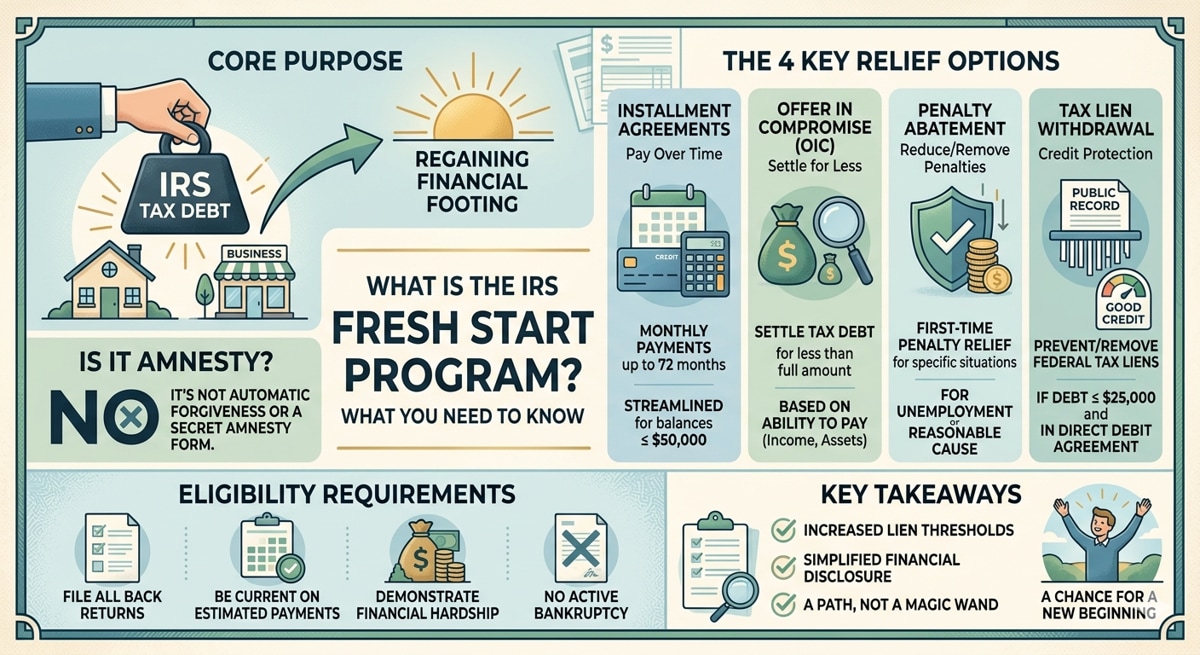
What Is The IRS Fresh Start Program? What You Need To Know
11 min read
Does IRS Debt Show On Your Credit Report?
8 min read
What Is An IRS Partial Payment Plan?
14 min read
Understanding Tax Settlement: The Offer In Compromise
12 min read
The IRS Partial Payment Installment Agreement: Do You Qualify?
21 min read
IRS Payment Plan: How It Works & How To Apply
20 min read
Get Your Free Consultation
Speak with a certified debt consultant to explore your options.
Start NowNo obligation • Free consultation