
What Is the Difference Between Tax Fraud and an Honest Tax Mistake?
Receiving an IRS audit notice or official letter has a way of making your stomach drop before you've even opened the envelope. Maybe you just noticed you forgot to report a small freelance payment from two years ago. Maybe your parents sent money to help with a down payment and you're suddenly not sure if that was supposed to show up on a tax form somewhere. For a lot of South Asian families in the U.S., especially first-generation immigrants juggling income here with financial ties back home, tax season already feels complicated. An error real or imagined can feel like the beginning of something much bigger than it usually is.
The IRS draws a very clear line between someone who made an honest mistake and someone who could face civil penalties or be charged with tax fraud . That line comes down to one thing: what you meant to do. This guide walks through exactly where that line sits, what typically trips up immigrant families specifically, and what steps to take depending on which side of the line you're on.
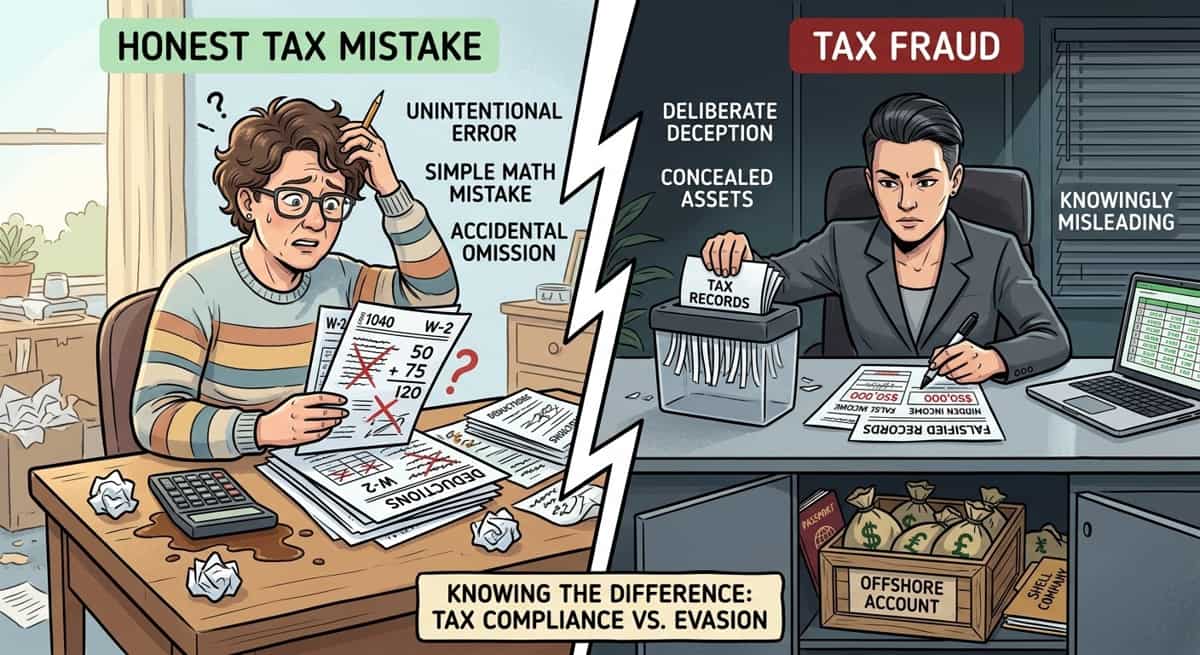
An honest tax mistake is an unintentional error, a wrong number, a missed form, a misunderstanding of the rules. Tax fraud is when someone knowingly and deliberately provides false information to reduce what they owe. The IRS has to prove intent to call something fraud, and it has to prove it with strong evidence. A mistake, even an expensive one, does not become fraud just because it's large or because you didn't catch it right away.
What Counts as an Honest Tax Mistake?
An honest mistake is simply an error made without any intention to deceive the IRS. It happens because tax rules are genuinely confusing, because paperwork gets lost, or because life gets busy. The IRS deals with these constantly, and there's a well-worn process for fixing them.
A few everyday examples:
Forgetting a 1099. You did some freelance design work or drove for a rideshare app on the side, and the tax form for that income never made it to your mailbox, so it never made it onto your return.
A math or transcription error. You typed $4,500 instead of $5,400, or added a column wrong. The IRS actually catches most of these automatically and sends a notice to correct it with no drama involved.
Filing under the wrong status. Maybe you filed as single the year you got married because you weren't sure how the rules worked, or claimed a parent as a dependent without realizing they didn't meet the support test.
Missing a deduction or credit you were entitled to. This isn't even something the IRS penalizes, it just means you may have overpaid, and you can usually still claim it by amending your return.
None of these involve deception. They involve confusion, oversight, or simply not knowing something and the tax code is genuinely one of the most complicated systems most people ever have to interact with.
What Is Tax Fraud, Legally Speaking?
Tax fraud is a different animal entirely. Legally, it requires willfulness meaning the person knew what the correct thing to do was and chose to do something else in order to pay less tax or avoid paying at all. This could look like inventing expenses that never happened, hiding income in an account you don't report, or keeping two sets of books one real, one for the IRS.
There are two tracks fraud can take:
Civil tax fraud results in a steep financial penalty. Under the tax code, the IRS can charge 75% of the portion of your underpayment that's tied to the fraud on top of the tax you already owe, plus interest. This is a civil matter, not a criminal one, so it doesn't come with jail time on its own.
Criminal tax evasion is a separate, more serious track that can lead to prosecution by the Department of Justice, with real criminal penalties including fines and prison time. This is reserved for the most deliberate, well-documented cases of fraud.
Importantly, the IRS carries the burden of proof here. It's not on you to prove you didn't commit fraud, the IRS has to show "clear and convincing evidence" that you did. That's a meaningfully high bar, higher than what's required in most civil disputes.
The Real Dividing Line: Intent, Not the Size of the Error
This is the part that surprises a lot of people: the size of the mistake has almost nothing to do with whether it's fraud. A $50,000 error can be completely innocent. A $500 one can be fraud. What matters is whether you knew the number was wrong and reported it anyway on purpose.
Picture two people who both underreport $10,000 in income. The first genuinely didn't realize cash tips count as taxable income; nobody ever explained it to them, and they reported everything they thought they were supposed to. The second kept a separate notebook tracking cash sales specifically so it wouldn't show up on the books. Same dollar amount, completely different outcome, because the IRS is looking at intent, not just the number on the page.
This is why two people can make the exact same-sized error and walk away with two very different results: one gets a bill and a chance to fix it, the other gets a fraud investigation.
Tax Mistakes Common in South Asian Immigrant Households
Some errors show up more often in immigrant communities simply because of how families here stay connected to relatives and finances back home, not because anyone is trying to hide anything. Here are the ones worth knowing about.
Confusion Over Remittances and Gifts from Family Abroad
Sending money to parents in India or receiving help from relatives in Bangladesh or Pakistan is just normal family life for a lot of households; it's not automatically a taxable event. But there's a specific reporting requirement that trips people up: if you receive more than $100,000 in gifts total in a year from a foreign individual (or a smaller amount from a foreign business), you're generally required to file Form 3520 to report it, even though you don't owe tax on the gift itself. A lot of families never hear about this form, assume any money crossing borders must be taxable (and panic), or assume the opposite that personal gifts are invisible to the IRS. Neither assumption is quite right, and the mismatch is almost always confusion, not concealment.
Unreported Foreign Bank Accounts (FBAR/FATCA)
If your family kept a bank account back home before you moved to the U.S. for your parents, for a property, for a business and the combined value of all your foreign accounts ever crossed $10,000 at any point in the year, there's a separate filing (FBAR) required, on top of your regular tax return. Many people genuinely don't know this rule exists, since it isn't tied to whether the account earns interest or whether you ever touch the money. It's simply about having signature authority over it.
Cash-Heavy Family Businesses
Restaurants, grocery stores, gas stations, and salons run by South Asian families often deal in a lot of cash. Bookkeeping in a small, busy family business can get messy: a shoebox of receipts, a spouse handling the register without formal training, income that doesn't always make it into the ledger the same day it comes in.
This usually reflects informal recordkeeping, not an intent to hide income. Still, the IRS can't tell the difference between "the books are a mess" and "the books were made messy on purpose" just by looking at the numbers which is exactly why clean records matter so much for a family business.
Informal Loans Between Relatives Treated as Gifts (or Vice Versa)
It's common to lend a sibling or cousin money to help with a first home, or to receive support without any formal paperwork behind it. When these transactions aren't documented, it can become genuinely unclear even to the people involved whether something was a loan that should eventually be repaid or a gift that has separate reporting rules. This ambiguity usually causes confusion on a tax return rather than any attempt to deceive anyone.
Red Flags That Make the IRS Suspect Fraud Instead of Error
The IRS looks for what's sometimes called "badges of fraud" patterns that suggest deliberate deception rather than a slip-up. None of these alone proves fraud, but together they shift how an examiner reads a return:
A consistent pattern of underreporting income year after year, rather than a one-time slip
Keeping two sets of financial records, or altering documents after the fact
Using a false Social Security number or someone else's identity on a return
Hiding assets, income, or accounts specifically so they won't be found
Giving an explanation during an audit that just doesn't add up given the facts on hand
If none of these apply to your situation, a single honest error, even a costly one is very unlikely to be treated as fraud.
Penalties: Honest Mistake vs. Tax Fraud at a Glance
The financial gap between an honest mistake and proven fraud is enormous, which is exactly why the IRS is careful about which label it applies.
Honest Mistake (Accuracy Penalty) | Tax Fraud (Civil Fraud Penalty) | |
Penalty amount | 20% of the underpaid tax | 75% of the underpaid tax |
What triggers it | Negligence, careless errors, understating tax owed | Proven intentional deception |
Who has to prove what | IRS just shows the understatement exists | IRS must show "clear and convincing evidence" of intent |
Can it lead to jail? | No | Not on its own but can lead to a separate criminal referral in serious cases |
Can it be reduced or removed? | Often, if you can show reasonable cause or good recordkeeping | Rarely, once proven |
The two penalties don't stack; the IRS applies one or the other for a given portion of tax owed, never both.
What to Do If You Just Found an Error on a Past Return
If you've spotted a mistake yourself, the path forward is refreshingly simple: file an amended return using Form 1040-X. You generally have three years from when you filed the original return (or two years from when you paid the tax, whichever is later) to amend it and claim any refund you might be owed.
For small, straightforward corrections, a missing form, a simple miscalculation many people handle this themselves or with basic tax software.
For anything involving foreign accounts, a business, or a larger dollar amount, it's worth bringing in a CPA or enrolled agent before you file, since amending can sometimes open up other questions you'll want to have already thought through. The important thing is that catching your own mistake and fixing it voluntarily, before the IRS ever comes looking, is about the strongest position you can be in.
What to Do If You're Being Accused of Tax Fraud
This is a very different situation, and it calls for a different response. If you receive correspondence suggesting the IRS suspects fraud, not just a routine audit notice, but language pointing toward intentional wrongdoing the most important thing is to stop and get professional representation before you say anything else to the IRS.
A regular audit letter asking you to substantiate a deduction is not the same thing as a fraud referral. Understanding your fundamental rights as a taxpayer can help you properly handle either situation before assuming the worst. Either way, anything you say to an IRS agent can become part of the record against you, which is why tax attorneys generally advise against explaining yourself informally once fraud is even suggested. This is educational information, not legal advice. If you're in this position, a tax attorney (not just an accountant) should be your first call, since attorney-client privilege can protect those conversations in a way that conversations with an accountant generally don't.
How to Protect Your Family Going Forward
Most of what separates a stressful-but-manageable mistake from a real problem is documentation. A few habits go a long way:
Keep a simple written record of significant money that moves between family members even a basic note of the date, amount, and purpose can matter later
If your family business runs on cash, set up a consistent, even if simple, system for logging income daily rather than relying on memory
Work with a CPA or enrolled agent who has specific experience with cross-border finances remittances, foreign accounts, and family businesses all have rules that a generalist preparer may not know to ask about
When in doubt about whether something needs to be reported, ask before filing rather than after
None of this requires expensive tools or complicated systems just enough of a paper trail that, if a question ever comes up, the honest explanation is easy to show.
Getting Help Moving Forward
Whether you've found an old mistake sitting on a past return or you're staring down a letter that feels a lot more serious, you don't have to sort it out alone and figuring out which situation you're actually in is often the hardest part. If you'd like a second set of eyes on a notice, a past return, or a plan for cleaning things up before they become bigger problems, explore our professional tax and financial resolution services to see how we help families regain peace of mind every day.
Ready to Get Started?
Get a free consultation with a certified debt consultant to see if debt settlement is right for you.
Get Free ConsultationAbout the Author
Bhupinder Bajwa
.
Related Articles
Tax Return Accepted vs Approved: What the Difference Really Means
9 min read
IRS Tax Fraud: Types, Penalties, Warning Signs, and What to Do
11 min read
Can You Be Charged With Tax Fraud for Not Filing Taxes?
10 min read
How Much Should You Pay Per Month on an IRS Installment Agreement?
10 min read
What Is a Reasonable Cause for IRS Penalty Relief
12 min read
Can the IRS Seize a Small Business Bank Account for Unpaid Taxes?
11 min read
Get Your Free Consultation
Speak with a certified debt consultant to explore your options.
Start NowNo obligation • Free consultation