
IRS Bank Levy vs. Wage Garnishment: What's the Difference?
If you've just opened a letter from the IRS and your stomach dropped, you're not alone. Every year, thousands of people find out about their tax debt the hard way through a notice that mentions words like "levy" or "garnishment." These two terms get used interchangeably a lot, but they are not the same thing, and knowing the difference can help you react the right way instead of panicking.
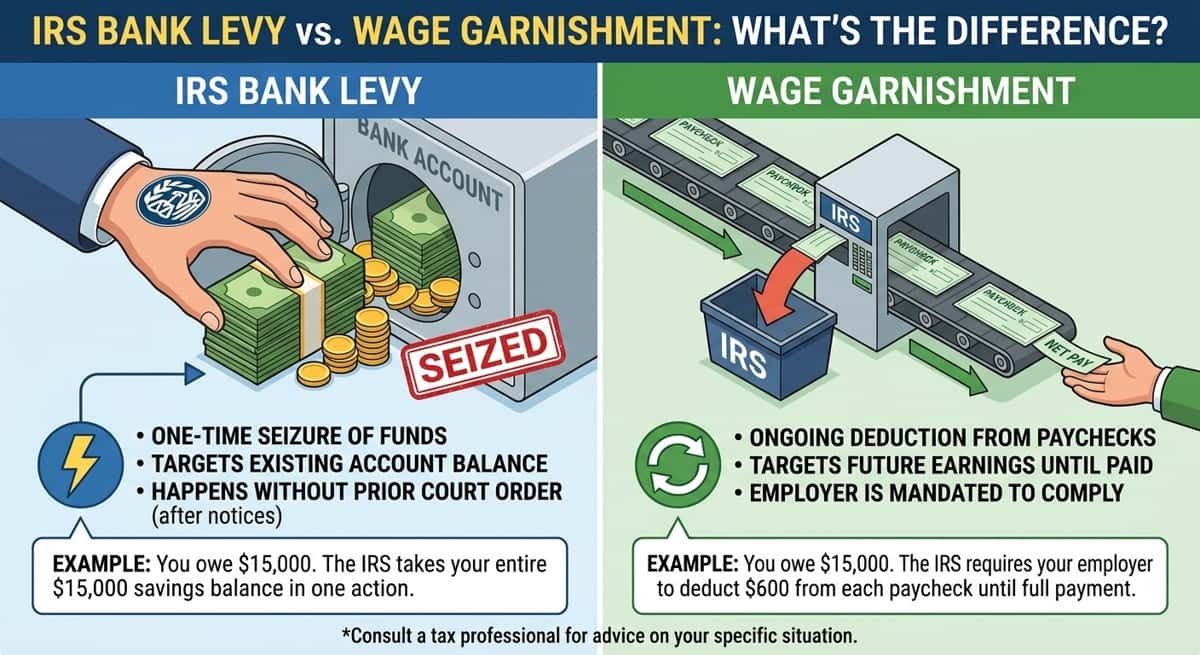
In short: a bank levy takes money that's already sitting in your account, in one lump sum. A wage garnishment takes a portion of your paycheck, again and again, until your debt is paid off or resolved. Both are legal tools the IRS uses to collect unpaid taxes, but they work differently, follow different notices, and are stopped in different ways.
What Is an IRS Bank Levy?
A bank levy is when the IRS reaches into your bank account and takes money directly to cover unpaid taxes. Unlike garnishment, which happens over time, a levy is usually a one-time event. The IRS takes what's available in your account up to the amount you owe, and that's it (for that account, at that moment).
How the IRS Freezes and Takes Bank Funds
Here's what actually happens: the IRS sends an official notice to your bank instructing it to freeze the funds in your account. Your bank has to comply, it's not optional for them. Once your account is frozen, you typically can't withdraw, transfer, or use that money, even for something urgent like rent or payroll.
This can feel like it happens overnight, and in some ways it does. But it's not random. It comes after the IRS has already tried to get your attention through mail more on that in a minute.
The 21-Day Holding Period Banks Must Honor
The detail most people don't know, and it can genuinely help you: banks are legally required to hold the frozen funds for 21 days before sending the money to the IRS. This holding period exists specifically to give you a window to act. You can try to get the levy released, prove a financial hardship, or work out an agreement with the IRS before the money is actually gone for good. If you miss this window, the bank sends the funds to the IRS automatically.
What Type of Accounts Can Be Levied
A levy isn't limited to a personal checking account. Savings accounts, joint accounts, and business accounts including merchant or payment processing accounts can all be levied if they're linked to the taxpayer who owes the debt. This matters a lot if you run a family business, which we'll get into later.
What Is IRS Wage Garnishment?
Wage garnishment, sometimes called a wage levy, is when the IRS contacts your employer directly and requires them to withhold a portion of your paycheck every pay period and send that money straight to the IRS instead of to you.
How the IRS Calculates How Much It Can Take
Unlike a bank levy, which can wipe out your available balance, the IRS doesn't take your entire paycheck. It leaves you a set amount based on your filing status, number of dependents, and pay frequency, using a published exempt-amount table. What's left after that exempt amount is taken by the IRS. For a lot of people, this still ends up being a significant chunk of their income sometimes uncomfortably large.
Why an IRS Garnishment Is Different From a Court-Ordered One
If you've ever heard of wage garnishment for something like a lawsuit or child support, you might assume the IRS needs a court order too. It doesn't. The IRS can start garnishing your wages without ever going to court, because tax debt collection works under its own set of federal rules. This surprises a lot of people, and it's one of the reasons IRS garnishment can feel like it comes out of nowhere if you haven't been keeping up with your mail.
How Long Garnishment Continues
A wage garnishment isn't a one-time hit; it continues with every single paycheck until the debt is paid in full, you set up an agreement with the IRS, or the garnishment is otherwise released. This is very different from a bank levy, and it's often the detail that makes garnishment feel more disruptive to day-to-day life, since it affects your income continuously rather than a single account balance.
IRS Bank Levy vs. Wage Garnishment: Side-by-Side Comparison
Bank Levy | Wage Garnishment | |
What's taken | Funds already in your bank account | A percentage of each paycheck |
Frequency | Usually one-time per levy notice | Ongoing, every pay period |
Who's contacted | Your bank | Your employer |
Amount taken | Up to the full balance available, up to what's owed | Set by an exempt-amount table based on your situation |
Response window | 21-day hold before funds are sent | Starts with the next paycheck after your employer receives the notice |
Ends when | Funds are released, or the hold period passes | Debt is resolved, or an agreement/release is granted |
The biggest difference to remember: a bank levy hits your savings, a wage garnishment hits your income. Depending on your situation, one may hurt more than the other. We'll talk about that shortly.
How Each Wage GarnishmentAction Begins: Notices to Watch For
The IRS doesn't jump straight to a levy or garnishment. By law, it has to notify you first, in writing, more than once. The problem is that many people don't recognize how serious these letters are until it's too late.
CP504 and the Final Notice of Intent to Levy
A CP504 notice is typically one of the earlier warnings it tells you that you have a balance due and that the IRS may seize your state tax refund. Later, you'll usually receive a Final Notice of Intent to Levy (often Letter LT11 or Letter 1058). This is the letter that matters most, because it starts the clock. After this notice, the IRS is legally allowed to move forward with a levy or garnishment if you don't respond.
Your Right to a Collection Due Process (CDP) Hearing
Here's something important: that Final Notice also gives you the right to request a Collection Due Process hearing. This is a formal way to pause collection action while you dispute the debt, propose a payment plan, or explain a hardship. Requesting this hearing within the deadline listed on your notice can buy you real time and options. It's one of the most underused protections people have.
Why South Asian Business Owners Often Miss These Notices
A pattern that shows up a lot in South Asian households and small businesses: these notices go to whatever address the IRS has on file, which isn't always the address you're actually checking. If you've moved, or if your business mail goes to a registered agent, a P.O. box, or a store address that isn't checked daily, it's easy to miss these letters entirely especially if a family member manages the mail and doesn't realize how urgent it is. By the time the notice is found, weeks or months may have already passed. Keeping your address updated with the IRS and having one person responsible for checking tax-related mail can prevent this.
Can You Stop an IRS Bank Levy or Wage Garnishment?
Yes, both can be stopped or reduced, but the process and timing are different for each.
How to Request a Bank Levy Release
Because of the 21-day hold, speed matters. You can seek professional IRS bank levy release assistance to demonstrate immediate financial hardship and unfreeze your accounts before the 21-day window closes. For example, you can't cover rent, payroll, or essential bills. If you act within the hold period and qualify, the IRS can instruct the bank not to send the funds.
How to Stop or Reduce Wage Garnishment
For wage garnishment, you generally need to resolve the underlying issue by setting up a payment plan, proving financial hardship, or otherwise reaching an agreement with the IRS. Once that happens, the IRS sends a release notice directly to your employer, and the garnishment stops going forward.
Options That Address Both: Installment Agreements, Offer in Compromise, and CNC Status
A few paths can resolve either type of collection action:
Installment Agreement — a monthly payment plan that, once approved, generally stops active levies and garnishments.
Offer in Compromise — A tax settlement for less than the full amount owed. Review the Offer in Compromise requirements to see if your current income and assets qualify you for a reduced settlement.
Currently Not Collectible (CNC) Status — if you genuinely can't pay right now, the IRS can pause collection entirely until your situation improves.
Fresh Start Program — a broader set of IRS initiatives designed to make it easier for people to get back into good standing, including more flexible installment terms.
None of these happen automatically — you generally have to request them, with documentation to back up your situation.
Which One Is Worse for Your Finances?
Honestly, it depends on your life. If you're an employee living paycheck to paycheck, wage garnishment can hurt the most, because it chips away at your income every single pay period — it's the difference you feel every two weeks. If you're a business owner and your operating or merchant account gets levied, a bank levy can be worse in the moment, because it can freeze the cash you need to make payroll, pay vendors, or keep the doors open all at once.
Neither one is "better." They're just different kinds of pressure one is a slow squeeze, the other is a sudden shock.
What This Means for South Asian Families and Small Business Owners
Joint Bank Accounts and Family Financial Exposure
In a lot of South Asian households, it's common for bank accounts to be shared between spouses, or even across generations, with parents and adult children on the same account. If one person on that account owes back taxes, a levy can freeze money that technically belongs to everyone on the account, even if only one person is responsible for the debt. This is one of the more painful surprises families run into, and it's worth reviewing how your accounts are structured if someone in the household has outstanding tax debt.
Protecting Payroll and Merchant Accounts in Family-Run Businesses
Family-run businesses, motels, restaurants, retail stores, gas stations, and similar operations often run payroll and vendor payments out of a single business account. A levy on that account doesn't just affect the owner; it can delay employee paychecks and vendor payments too. If your company owes back payroll or income taxes, consulting with small business tax resolution specialists can protect your operating accounts before the IRS issues a freeze, since business accounts often have less flexibility to absorb a sudden freeze than personal accounts do.
Addressing the Stigma Around Debt and Tax Notices Within the Community
There's often a real reluctance to talk about tax debt or financial trouble. It can feel embarrassing, or like something to handle quietly and alone. But IRS notices don't go away if they're ignored, and waiting usually narrows your options rather than protecting you. Reaching out for help early to a licensed professional, or even just to understand your notice isn't a failure. It's the fastest way to protect your family's finances and get back to a stable place.
Step-by-Step: What to Do If You Receive an IRS Levy or Garnishment Notice
Confirm the notice is legitimate. IRS letters have specific notice numbers (like CP504 or LT11) you can verify these on IRS.gov.
Check the amount owed and how it was calculated. Make sure it matches your records, or note any discrepancies.
Find the response deadline. This is the most important detail on the letter: it determines how much time you have to act.
Gather your financial documents. Recent pay stubs, bank statements, and a basic list of monthly expenses will be needed for almost any resolution option.
Contact the IRS or a licensed representative. Don't wait until the deadline is close the earlier you reach out, the more options are usually available.
Request a hold or release if you qualify. If you're within the 21-day window on a bank levy, or if you can show hardship, ask about it directly.
When to Work With a Tax Professional
Some situations are manageable on your own for example, if you owe a small amount and can simply set up a standard payment plan. But there are times when it's genuinely worth bringing in an Enrolled Agent, CPA, or tax attorney:
Your business operating account has been levied
You owe taxes across multiple years
Your wage garnishment amount seems higher than it should be
You're unsure whether you qualify for an Offer in Compromise or CNC status
You've already missed a notice deadline and aren't sure what happens next
A professional can also represent you directly with the IRS, which takes a significant amount of pressure off you and your family during an already stressful time.
Key Takeaways
A bank levy takes money already sitting in your account, usually as a one-time action.
A wage garnishment takes a portion of every paycheck, on an ongoing basis, until resolved.
Both start with written IRS notices; the Final Notice of Intent to Levy is the one that matters most.
You have real options to stop or reduce either one, including payment plans, hardship relief, and settlement programs but timing matters.
If a levy or garnishment affects a shared account or a family business, it's worth getting professional guidance early rather than waiting.
If you've received a notice and aren't sure what it means for you, talking to a licensed tax professional can help you understand your exact options before a deadline passes.
Ready to Get Started?
Get a free consultation with a certified debt consultant to see if debt settlement is right for you.
Get Free ConsultationAbout the Author
Ooraa Team
Our team of certified debt consultants has over 10 years of experience helping families become debt-free. We specialize in debt settlement strategies and financial education.
Related Articles
IRS Tax Fraud: Types, Penalties, Warning Signs, and What to Do
11 min read
What Is the Difference Between Tax Fraud and an Honest Tax Mistake?
11 min read
Can You Be Charged With Tax Fraud for Not Filing Taxes?
10 min read
How Much Should You Pay Per Month on an IRS Installment Agreement?
10 min read
What Is a Reasonable Cause for IRS Penalty Relief
12 min read
Can the IRS Seize a Small Business Bank Account for Unpaid Taxes?
11 min read
Get Your Free Consultation
Speak with a certified debt consultant to explore your options.
Start NowNo obligation • Free consultation