Tax Return Accepted vs Approved: What the Difference Really Means
After filing your tax return, seeing an update from the IRS can feel like a relief. But what does it mean when your tax return is marked as “accepted”? Does that mean your refund is on the way? Not necessarily. Understanding the difference between an accepted and an approved tax return can help you know what to expect and avoid unnecessary stress while waiting for your money.
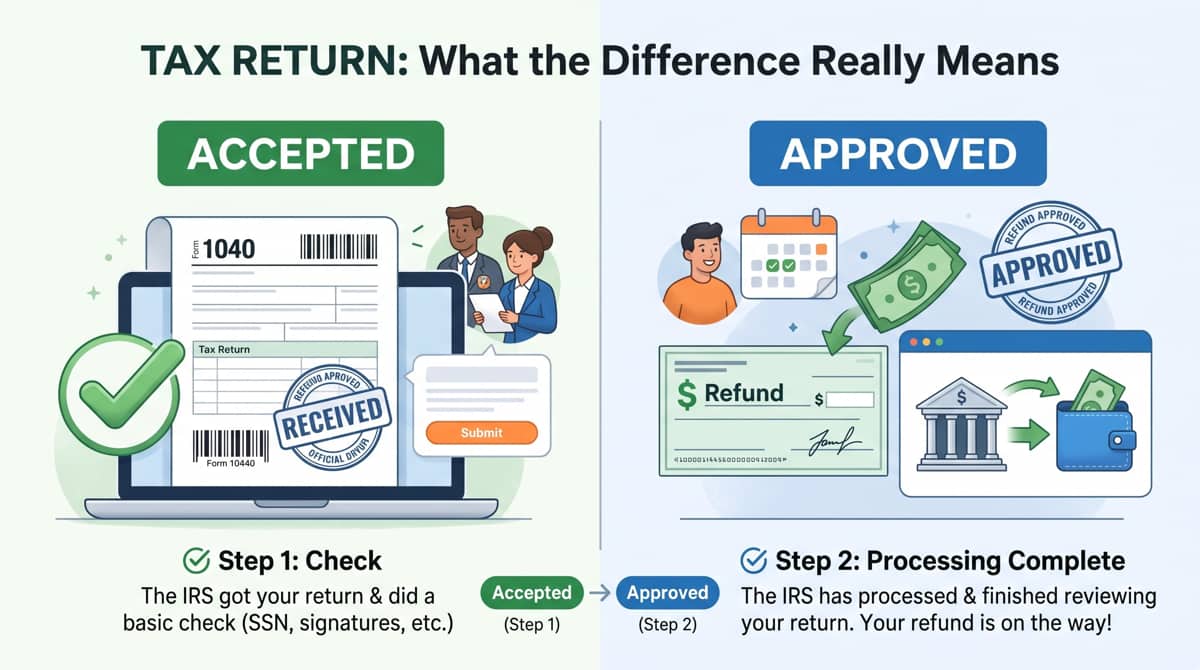
When the IRS accepts your tax return, it means the agency has received your filing and it has passed the initial checks for processing. However, your return still needs to go through further review before your refund can be approved. Once the IRS approves your refund, it means the agency has authorized the payment, although your money may take additional time to reach your bank account.
Accepted vs Approved at a Glance
Status | Who says it | What it means | What happens next | Refund guaranteed? |
Rejected | Your tax software or preparer | The IRS could not take your return because of an error | Fix the error and send it again | No |
Accepted | Your tax software or preparer | The IRS received your return and it passed basic checks | The IRS starts processing it | No |
Approved | IRS “Where’s My Refund?” tool | The IRS processed your return and confirmed your refund | The IRS schedules your payment | Almost, but it can still be reduced |
Sent | IRS “Where’s My Refund?” tool | Your refund has been released | Money arrives by direct deposit or check | Yes, it is on its way |
If your return was rejected, fix the problem first and then come back to this guide.
What Does “Tax Return Accepted” Actually Mean?
Accepted is the first green light. It tells you the IRS got your e-filed return and that it passed a set of automatic checks. These checks look at simple things: Is the Social Security number (SSN) or ITIN valid? Do the names match IRS records? Is the return in the right format?
That is all. At this point, the IRS has not reviewed your income, credits, or deductions. It has not confirmed your refund amount, either.
You will usually see this message in your tax software, such as TurboTax, H&R Block, or FreeTaxUSA, or from your tax preparer. It often appears within 24 to 48 hours of filing.
A common mistake is to think “accepted” means “checked and cleared.” It does not. Think of it like handing your documents to a clerk who says, “Yes, we got them.” Nobody has read them yet.
What Does “Refund Approved” Mean on the IRS Website?
The IRS has a free tool called Where’s My Refund? It shows three stages: Return Received, Refund Approved, and Refund Sent.
Refund Approved means the IRS has processed your return and confirmed your refund amount. It will also show a date when your money should be sent. Outside the IRS tool, many people and software companies use the word “approved” more loosely, so always trust what the IRS tool says.
How long does it take? The IRS says most e-filed refunds are issued in less than 21 days, but some take longer. The tool updates about once a day, so checking it ten times a day will not help.
To check, go to the IRS and search “Where’s My Refund?” You will need:
Your SSN or ITIN
Your filing status
The exact refund amount on your return
After approval, direct deposit is usually faster. Paper checks take longer because they travel by mail.
Rejected, Accepted, Approved, Sent: The Full Timeline
Here is the path your return follows:
File: You send your return.
Accepted: The IRS got it. Save your confirmation.
Processing: The IRS reviews your numbers. Wait.
Approved: Your refund amount and date are confirmed. Check your bank details.
Sent: The IRS released your money. Watch your account.
In your bank: Direct deposit often takes a few days to show up. Check your account.
Paper-filed returns do not get an “accepted” message and take much longer, often several weeks or more.
Why Your Return Was Accepted but You Still Have No Refund
This is the part that worries people most. A return can be accepted and still wait a long time. Here are the common reasons:
Early-season holds. By law, refunds that include the Earned Income Tax Credit or Additional Child Tax Credit cannot go out until mid-February.
Identity or fraud checks. The IRS may hold your return to confirm it is really you.
Math errors or mismatched forms. Your W-2, 1099, or 1099-K may not match what your employer or a payment app reported.
Incomplete or amended returns. These take longer to process.
Banking mistakes. One wrong digit in a routing number can delay a deposit.
A refund offset. The government may take part of your refund to pay a debt. More on that below.
When to wait and when to call: If it has been less than 21 days since you e-filed and the tool shows no problem, be patient. If it has been longer, or the tool tells you to contact the IRS, call them. Also watch your mailbox. The IRS sends letters when it needs something, and ignoring a letter can slow things down for months.
When an Approved Refund Gets Reduced: Refund Offset and Your Debts
Here is something many people do not know: an approved refund is not always the amount you receive.
Through the Treasury Offset Program, the government can take some or all of your refund to pay certain debts. These include:
Past-due federal taxes
Defaulted federal student loans
Past-due child support
State income tax debt and some other state debts
What about credit cards and medical bills? In general, credit card, medical, and personal loan companies cannot simply take your refund. A creditor would usually need to win a court judgment first and then follow legal steps. speak with a licensed attorney.
How will you know? You will get a notice from the Bureau of the Fiscal Service explaining who took the money and why. The IRS tool may also show that your refund was adjusted.
A simple example: Your refund is approved for $2,800. You have a defaulted federal student loan, and $1,500 is taken. You receive $1,300. The tool said “approved,” but the bank deposit is smaller.
Married and only one of you owes? If you filed jointly and your spouse owes the debt, you may be able to protect your share by filing Form 8379 (Injured Spouse Allocation).
If you owe, you have options:
For student loans, ask about rehabilitation or consolidation to get out of default.
For IRS debt, set up an IRS payment plan.
Contact the agency that is owed money before your next filing season.
A common question is, “Can I protect my refund from debt collectors?” Private collectors usually cannot take it without a court order, but government debts can. Knowing which type of debt you have is the first step.
Special Considerations for South Asian Taxpayers in the U.S.
Many of us have tax situations that look different from the standard example. Here are four that come up often.
Filing with an ITIN or Mixed-Status Households
If you file with an ITIN instead of an SSN, your return may involve more paper filing, longer processing, or problems if your ITIN expires. In a family where some members have SSNs and others have ITINs, the type of number can change which credits you can claim. A qualified preparer offering professional tax filing services can help you avoid costly mistakes and ensure your household claims the correct credits.
Foreign Accounts, Family Property, and Remittances
If you have bank accounts or property in India, Pakistan, Bangladesh, Nepal, or Sri Lanka, you may need to report them. Two forms to know about are the FBAR (FinCEN 114) and Form 8938. Mistakes or missing forms can lead to notices and delays.
Sending money to help a family is different from earning income overseas. Gifts and support you send are usually not the same as foreign income you must report, but the rules depend on your situation. Ask a professional who understands cross-border finances.
Community Preparers, Ghost Preparers, and Refund Scams
Some preparers are wonderful. Others are not. Be careful if someone:
Charges a fee based on the size of your refund
Will not sign your return or share a PTIN
Promises a “bigger refund” than anyone else
Also beware of texts, emails, or WhatsApp messages saying, “Your refund is approved, click here.” The IRS does not start contact with you by text, email, or social media to ask for personal details. When in doubt, go directly to IRS
Refund Advance Loans and High-Fee Products
A refund advance gives you money now, based on your expected refund. It can feel like a lifesaver, but fees and interest add up, especially when you are already carrying debt. Remember, an “accepted” return does not mean your refund is certain, so borrowing against it can leave you owing more.
What to Do at Each Stage: A Practical Checklist
Stage | What to do |
Rejected | Read the error, fix it, and file again |
Accepted | Save your confirmation and check Where’s My Refund in 24 hours |
Approved | Confirm your deposit date and bank account details |
Delayed or adjusted | Read the IRS notice and reply before the deadline |
Sent | Watch for the deposit and keep your records |
Red flags that need a professional: an IRS letter asking for identity proof, a notice about foreign accounts, a refund taken for a debt you do not recognize, or a preparer who will not give you a copy of your return.
Turning Your Tax Refund into a Debt and Money Plan
When the refund finally arrives, a plan helps it go further. Here is a simple order many families find helpful:
Build a small cushion. Even $500 in savings can stop the next surprise bill from going on a credit card.
Pay down your highest-interest debt. Usually that is a credit card.
Deal with expensive loans. Payday loans and refund advances cost a lot.
Plan for family needs. Travel, remittances, and emergencies are real. Set aside money for them so you do not need to borrow.
Example: If you put $1,000 toward a credit card with a 24% APR, you could save roughly $240 a year in interest, if you stop adding new charges.
If debt feels heavy, you do not have to figure it out alone. Speak with a licensed tax professional, he can review your budget for free or at low cost.
Some also offer help in languages like Hindi, Urdu, Bengali, Punjabi, and Gujarati. Be wary of anyone who guarantees results or pressures you to sign quickly.
Conclusion and Next Steps
Accepted means the IRS received your return. Approved means your refund is confirmed. Neither means the money is in your account until it is sent.
Your next step is simple: check Where’s My Refund today and read any IRS letters that have arrived. If your refund was reduced or you are worried about overwhelming debt, reach out to the team for a free consultation to create a personalized strategy to get out of debt faster.
Ready to Get Started?
Get a free consultation with a certified debt consultant to see if debt settlement is right for you.
Get Free ConsultationAbout the Author
Bhupinder Bajwa
.
Related Articles
IRS Tax Fraud: Types, Penalties, Warning Signs, and What to Do
11 min read
What Is the Difference Between Tax Fraud and an Honest Tax Mistake?
11 min read

Can You Be Charged With Tax Fraud for Not Filing Taxes?
10 min read
IRS Bank Levy vs. Wage Garnishment: What's the Difference?
11 min read
Self-Employed and Owe Taxes? A Guide for 1099 Workers
11 min read
Unfiled Tax Returns: What Should You Do?
11 min read
Get Your Free Consultation
Speak with a certified debt consultant to explore your options.
Start NowNo obligation • Free consultation