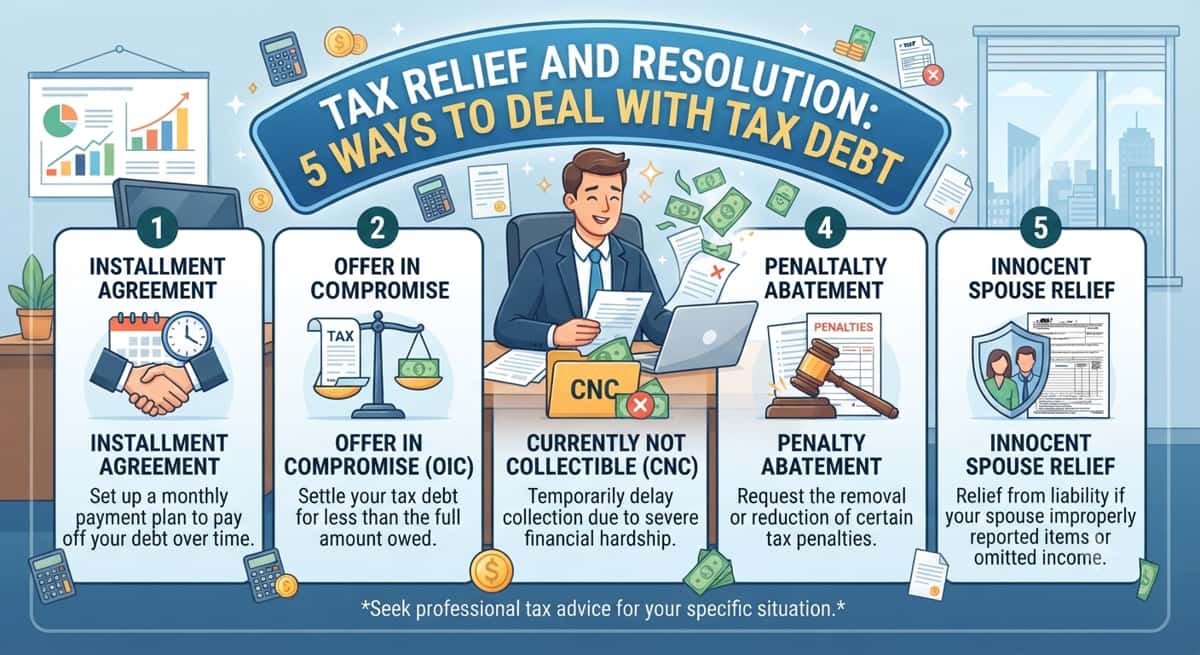
Tax Relief And Resolution: 5 Ways To Deal With Tax Debt
Facing tax bills that cannot be paid off, one can feel miserable. A lot of people are afraid that tax debt would automatically trigger wage garnishments, bank levies or some other drastic collection actions. The IRS has broad collection authority but offers tax relief and resolution options for taxpayers who cannot pay in full. The important thing is to know your options and act on it before this gets worse.
Tax debt can arise for different reasons self-employment taxes, a windfall reversal, financial hardship, mistakes on a form or simply getting behind after a tough year. No matter the reason for unmanageable debt, ignoring it almost always does not make the problem go away. Interest and penalties keep mounting, pulling the balance owed ever higher.
The ideal situation is there is no one size solves every thing. Payment plan, penalty relief, an Offer in Compromise, temporary collection relief or any other resolution strategy may be available based on financial condition. These come with varying eligibility, benefit levels and some cons.
Understanding Tax Debt and Why It Happens
Tax debt just means you owe the IRS more than you've already paid via withholding, estimated payments or other credits.
And it happens for a variety of reasons, and most of them completely unrelated to doing anything wrong. Businesses that generate cash, such as restaurants or motels, and businesses with irregular income patterns like gas stations or convenience stores often struggle to save up enough throughout the year to make their tax payments in April. Those earning their money from many different paychecks, such as those working multiple jobs or who are in gig work, may have insufficient citizenship withholding on any one check for the total to add up. Most new arrivals simply do not know how U.S. filing requirements work, as every country handles taxes differently. Also, those who use an Individual Taxpayer Identification Number (ITIN), which is used for people who do not have a Social Security number, may experience additional headache from more complex administrative work that could even result in errors or missed payment deadlines.
And none of that means you're stuck in a place you can never leave. It means there is something wrong with anything specific, and there are solutions for anything specific problem.
Many South Asian families are burdened with the weight of debt beyond dollars and cents. Owing money carries a particularly potent breeze of shame, then, and confessing you're behind on your taxes isn't just admitting that you let the household budget down it feels like a confession, even to close relatives.
They also fear that tax debt could jeopardise any future plans to gain permanent residency or citizenship. Allow me to clarify: owing money to the IRS for back taxes is NOT an immigration issue, its a civil financial matter. The IRS and USCIS are different agencies that have different processes. However, immigration cases can be complicated and every situation is unique, so if you have specific questions about how tax history may tie into a visa application, green card process, or naturalization, it's worth talking with an attorney so the full picture of your circumstances can be assessed.
Language is another real barrier. Even at the best of times, IRS notices are written in tortuous legalese which is inherently difficult to follow for native speakers let alone someone who speaks Hindi, Urdu, Bengali, Punjabi, Gujarati or Tamil at home. Plus, in many South Asian families where the business is run together over generations or a household enterprise, it can be truly confusing to know who owes what and how that should be rectified collectively.
Take a breath. These challenges are not permanent and do not mean you have run out of opportunities. Every year, thousands of people in similar situations to the one you're facing now, use these five methods.
5 Ways to Deal With Tax Debt
Every situation is different, so not every option below will fit your circumstances. Here's an overview of the main paths people use to get back on track with the IRS.
1. Set Up an IRS Installment Agreement
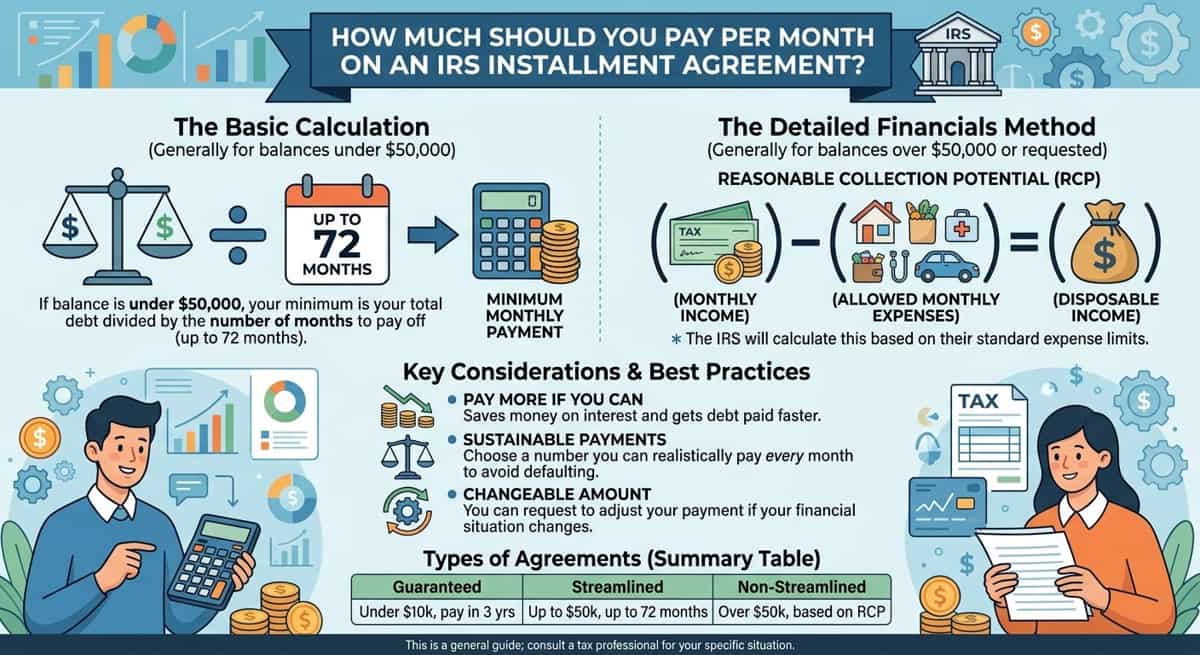
With an installment agreement, you can pay what you owe to the IRS in monthly payments rather than one lump.
The majority of taxpayers who owe a reasonable sum and can demonstrate they will permanently remain capable of making consistent monthly payments should qualify. Short-term plans are designed to be paid off during a shorter timeframe, while long-term plans extend the payments out over a longer time period. For many balances, you can use the IRS Online Payment Agreement or for more complex situations, mail in Form 9465.
Sure, the flip side is that it does provide some predictability: you in fact know what you need to pay every month and it halts further steps to collect more. The downside is that interest and some penalties continue to accrue on the unpaid balance until you have paid it in full, so you will pay more than what was originally owed.
This option works best for those with a consistent income (like most salaried H-1B holders or two-income households) since the monthly payment is typically built into the family budget.
2. Apply for an Offer in Compromise (OIC)
An Offer in Compromise is a deal for you to pay less than the full amount of tax debt that you owe.
The IRS does not just approve these. They examine your income, essential living costs and whether any assets such as a home, car or business equipment have equity to apply a KCP (or reasonable collection potential) which is the maximum amount they think they could actually collect from you. Your offer will be given a fair shot at acceptance if it is close to that number (or higher).
The normal process includes filing Form 656, a non-refundable application fee, and extensive financial documents. The various Offer types depend on whether you're a person who claims: ability to pay, doubt the debt owed and that paying full could create economic hardship.
Watch out for ads that say they can help you settle your debt - for "pennies on the dollar." An OIC can actually decrease what you owe, but is only accepted by the IRS for a fraction of applicants, and results vary wildly based on your actual financial situation rather than some predetermined formula.
This route generally makes the most sense for small business owners that have experienced one year or more of impaired earnings, or actual financial loss, in which case paying off the full amount is nothing short of an impossible loan.
3. Request Currently Not Collectible (CNC) Status
Currently Not Collectible status is a temporary hold on IRS collection activity because paying your tax obligation would leave you unable to afford basic living expenses.
In order to qualify, you usually have to demonstrate that your necessary monthly costs housing, food, utilities and a few similar needs eat up all or most of your income, leaving nothing left over for the debt.
Now, before we explore what CNC status does provide safety for, it will be useful to understand just a little about what it doesn't mainly do. Your debt doesn't disappear. The interest and penalty continue to rack up in the background, and the IRS can turn around and look into your finances again down the road to see if you are in a better position to begin collection efforts.
This is a particularly good solution for families that have just arrived and haven't yet managed to gather their feet, those who recently lost a job or homes with one breadwinner who are at the effective point of functioning without grim financial pressure.
4. Seek Penalty Abatement (First-Time or Reasonable Cause)
Penalty abatement lowers or completely removes penalties that are added onto your tax bill. It will not cut the actual tax that you owe, only the additional penalties stacked on top for failing to file or pay in a timely fashion.
First-Time Abatement is for anyone who has been compliant for the last three years prior to this that means you had no penalties or overdue filings and payments prior to this. For many, that's the easiest penalty relief available.
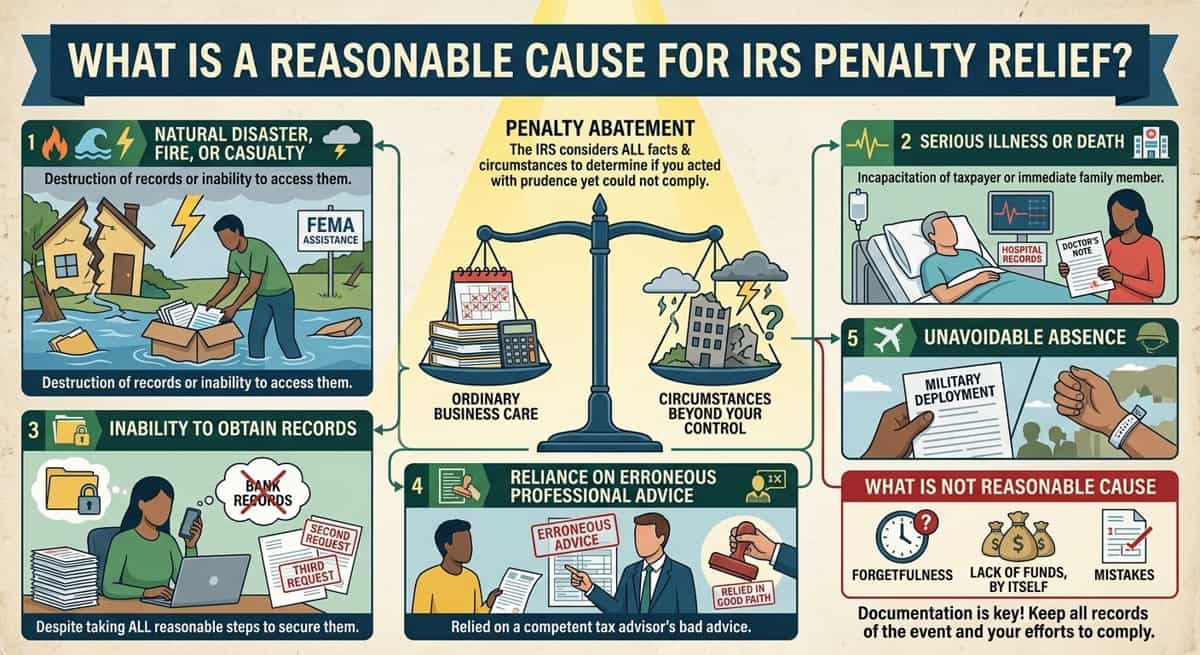
If you don't qualify for first-time relief, you can still waive the penalty due to "reasonable cause." This includes things like a serious illness, a natural disaster, the first year running a new business or not knowing the ins and outs of U.S. tax rules due to being new to the country (with appropriate documentation). The operative word is documented as in the IRS wants to see proof, not an explanation.
You can request penalty abatement via Form 843 or, in some situations, simply call the IRS and ask for penalty relief particularly if you are eligible for first-time relief.
5. Work With a Licensed Tax Professional or Tax Resolution Firm
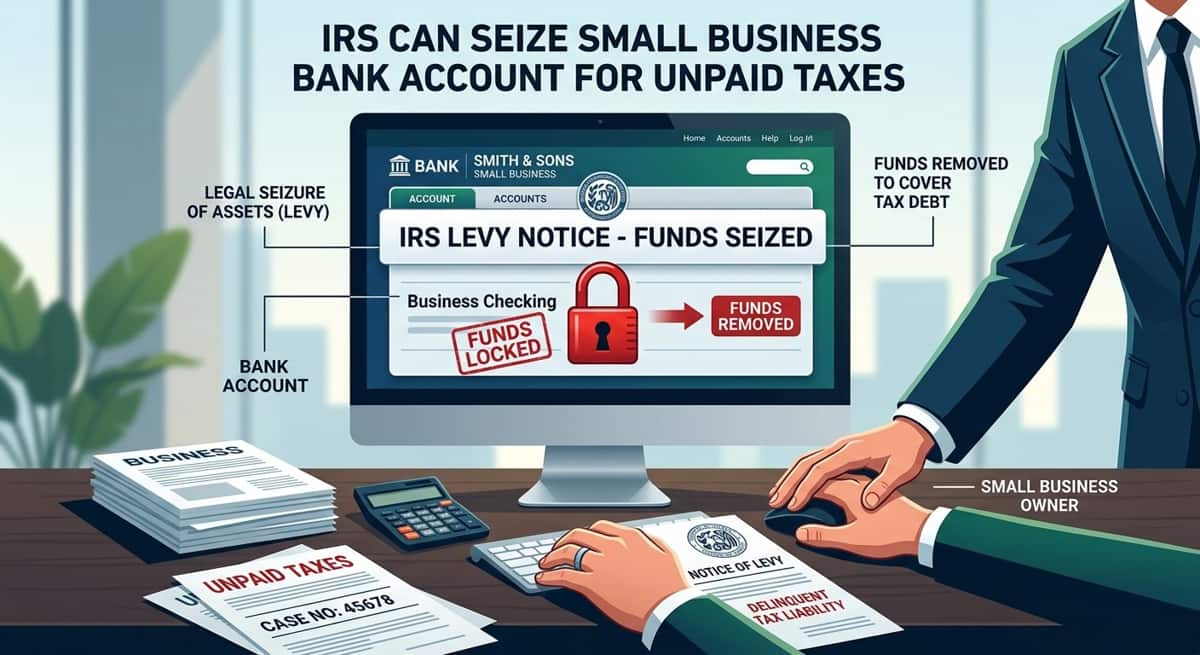
For certain circumstances, it can be so complex in its nature that the best choice isn't isolating yourself in trying to solve it on your own. If you are dealing with a federal tax lien, bank levy, wage garnishment or business audit hiring an expert to help navigate your specific issue may provide you significant relief.
Once you’re aware of these differences, the professionals who can legally represent you will be more apparent. An accountant, CPA (Certified Public Accountant) is perfect for accounting, helping in filing and general financial advice. An Enrolled Agent (EA) is licensed solely by the IRS and has expertise in tax matters as well as IRS representation. When the situation involves legal nuances like a big dispute, maybe fraud allegations, or advanced litigation a tax attorney is the correct route.
Sadly, it's also a hotbed for predatory companies who feed off of fear. Beware of red flags: companies that require large upfront fees before doing any work, assert a specific settlement number without first evaluating your case or pressure you to sign immediately. An actual professional will not forecast on trust; they will analyze your financials first and provide you stats, not promise.
If you want to find help, with specifically greater experience with ITIN filers and immigrant-owned businesses (and face it only in case you are going for the bilingual provider, approach the service in Hindi, Urdu, Bengali, Punjabi, Gujarati Tamil or whichever language ) such that you're maximum relaxed discussing your budgets.
How to Pick the Best Tax Debt Relief path for You
Nothing like a couple of sincere questions will lead you in the right direction. Is your income stable, or will it be subject to seasonal fluctuation? A regular paycheck usually leads to an installment agreement, while sporadic business income may require something more volatile. Is this a temporary setback, an illness or a bad year, or is every month the monthly struggle to put food on the table? Penalty abatement could be appropriate for a temporary setback while Currently Not Collectible status might make sense for a more long-term hardship. Is this personal income, small business debt, or both (because a lot of business debt has more moving pieces)?
There is no one right answer and these are not mutually exclusive options -- many take two or more. Instead of going all-in on a path, consider having a discussion with a licensed tax attorney who can look at your whole financial picture and help you save yourself from mistakes that may cost you thousands.
Common Mistakes to Avoid When Dealing With Tax Debt
A few mistakes tend to make tax debt situations worse rather than better. Ignoring IRS notices is one of the biggest, since problems that get addressed early are almost always easier to resolve than ones left to snowball. Missing appeal windows can close off options that would otherwise have been available to you. Working with unlicensed "ghost preparers," people who prepare your return for cash but never sign it or take responsibility for it, can lead to errors that create the very debt you're trying to avoid. And many people don't realize that free help exists: the Taxpayer Advocate Service and VITA/TCE volunteer programs offer no-cost assistance, and they're especially helpful for ITIN filers and lower-income households.
The First Step to Tax Relief
This first generation heirs often had to make money in interest on payments they owed tax and small business owners do this every day owing IRS and no problem acting like its a normal thing but owning the money to IRS just feel silliness at that moment. Whatever route fits your situation, be it an installment agreement, Offer in Compromise, Currently Not Collectible status, penalty abatement or a professional the biggest step is just getting started.
If you are finding your books to be fickle perhaps consider reaching out to a qualified licence Enrolled Agent, CPA or Tax Attorney for a one-on-one consultation about your specific issue. It is not personalized tax or legal advice but rather designed to be an educational overview so that you are armed with the knowledge, ideally feeling less alone and more empowered to take that first step.
Ready to Get Started?
Get a free consultation with a certified debt consultant to see if debt settlement is right for you.
Get Free ConsultationAbout the Author
Bhupinder Bajwa
.
Related Articles
IRS Tax Fraud: Types, Penalties, Warning Signs, and What to Do
11 min read
What Is the Difference Between Tax Fraud and an Honest Tax Mistake?
11 min read
Can You Be Charged With Tax Fraud for Not Filing Taxes?
10 min read
How Much Should You Pay Per Month on an IRS Installment Agreement?
10 min read
What Is a Reasonable Cause for IRS Penalty Relief
12 min read
Can the IRS Seize a Small Business Bank Account for Unpaid Taxes?
11 min read
Get Your Free Consultation
Speak with a certified debt consultant to explore your options.
Start NowNo obligation • Free consultation