
Tax Evasion Vs Tax Fraud And The Statute Of Limitations
If you run a cash bsiness a motel, a convenience store, a restaurant, a rideshare or trucking operation you already know the IRS pays closer attention to cash income. Add in sending money home to family, filing taxes with an ITIN instead of a Social Security number, and the fact that any tax trouble can ripple into a visa renewal, a green card application, or naturalization down the road, and it's easy to see why "evasion" and "fraud" aren't just legal vocabulary words. They're words that can shape your family's future in this country.
This article walks through what each term actually means, how the IRS tells them apart, how long they can look back at your filings, and most importantly what your options are if you're worried you might have a problem. I've spent years helping immigrant-owned small businesses sort through exactly these situations, and the good news is: most of what feels overwhelming right now has a clear, manageable path forward.
What Is Tax Evasion?
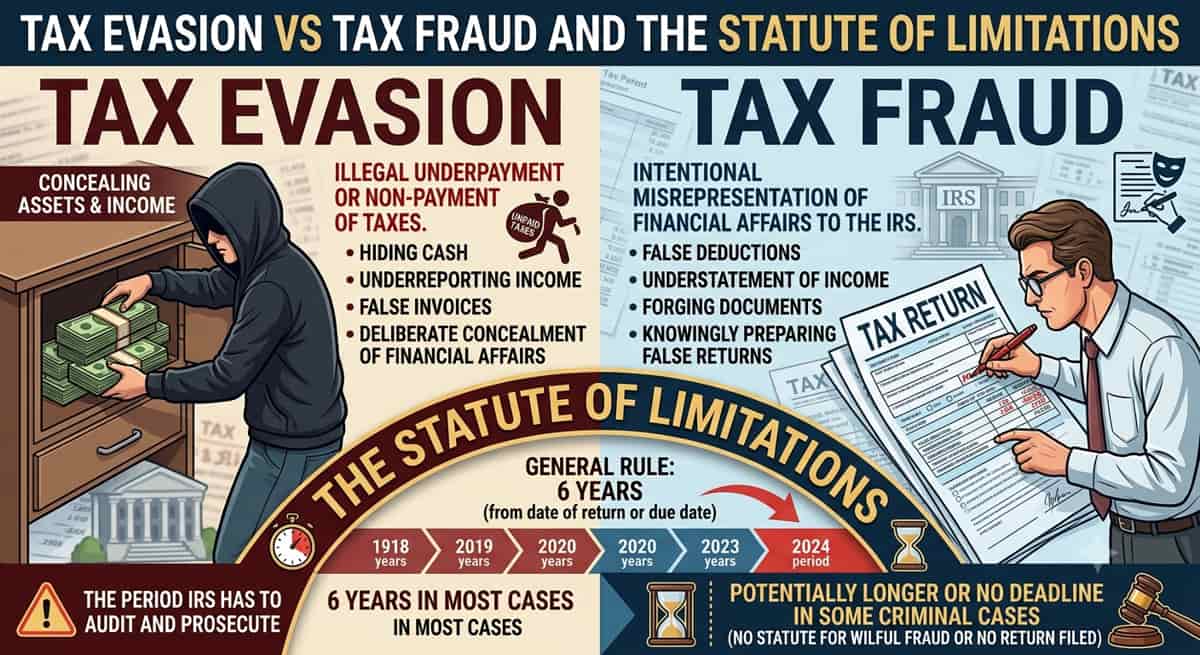
Tax evasion has a specific legal meaning under federal law (26 U.S.C. § 7201): it's a willful attempt to evade or defeat a tax you owe. The key word is willful. This isn't about a math error on your return or forgetting to report a small 1099. It's about knowingly and intentionally trying to avoid paying tax that you understand you owe.
Because intent is required, evasion is always treated as a criminal matter. Prosecutors have to prove you knew what you were doing and did it on purpose not that you made a mistake or misunderstood the rules.
Common examples of tax evasion include underreporting cash receipts so your books show less income than you actually took in, keeping two sets of financial records (one real, one for the IRS), moving money offshore or into a relative's account to hide it, and paying employees off the books in cash to avoid payroll taxes. These are the patterns that tend to show up in cash-heavy, family-run businesses which is exactly why this topic hits close to home for so many South Asian entrepreneurs.
What Is Tax Fraud?
Tax fraud is the bigger umbrella term. It covers any intentional deception on a tax return, and unlike evasion, it doesn't automatically mean criminal charges. Fraud can be handled two ways: civilly, where the IRS assesses a monetary penalty and closes the matter, or criminally, where it's referred for prosecution under IRC § 7206 (fraud and false statements).
Tax fraud situations that come up often in South Asian-owned businesses include not reporting all the cash tips or sales at a motel or restaurant, claiming dependents who don't actually qualify, inflating business deductions, misusing an ITIN, or mixing personal remittances with business income in a way that misrepresents what the business actually earned. Some of these happen out of genuine confusion about U.S. tax rules rather than any intent to deceive and that distinction matters enormously, which we'll get into below.
Tax Evasion vs. Tax Fraud: Key Differences
Factor | Tax Evasion | Tax Fraud |
Nature | Always criminal | Civil or criminal |
Core element | Willful non-payment or underpayment | Willful deception or misrepresentation |
Governing law | IRC § 7201 | IRC § 7206, § 6663 (civil fraud) |
Burden of proof | Criminal: beyond a reasonable doubt | Civil: clear and convincing evidence |
Outcome | Prosecution, prison, fines | Penalties (up to 75% of underpayment) and/or prosecution |
Here's the simplest way to think about it: evasion is technically a type of fraud. All tax evasion is fraud, but not all fraud is evasion. Fraud is the broader category; evasion is the narrower, always-criminal slice of it.
Civil Fraud vs. Criminal Fraud: What's the Real-World Difference?
Most people who hear the word "fraud" immediately picture handcuffs and courtrooms. In reality, the vast majority of fraud cases the IRS handles stay civil. That means the IRS reviews your return, decides the underpayment was the result of intentional deception, and assesses a civil fraud penalty up to 75% of the underpaid tax under IRC § 6663. It's a serious financial hit, but it's not a criminal case.
Criminal fraud is a different track entirely. It happens when the IRS refers a case to its Criminal Investigation division (CI), which can lead to indictment and, in the most serious cases, prison time. Only a small percentage of fraud cases ever cross that line. The IRS generally reserves criminal referrals for patterns of deliberate, repeated deception not isolated errors or one bad filing year.
How the IRS Detects Fraud: The "Badges of Fraud"
The IRS and courts look for certain indicators often referred to as “badges of fraud” in deciding whether an error was the result of a mistake or something more malign. Among them are suppressed revenue not correlating to a bona fide business, insufficient or improper documentation, inconsistent narratives that can be contradictory, inactive or unreported bank accounts, large levels of cash operations and scope for sign in years without filing returns.
This isn't an exercise in learning how to hide anything more effectively; rather, it's about recognizing what raises flags and being able to evaluate your own records honestly so you can find out where your cases may raise questions and address them proactively.
How Long Can the IRS Pursue You? The Statute of Limitations, Explained
The Standard 3-Year Rule
Under IRC § 6501, the IRS generally has three years from the date you file to audit your return and assess additional tax. Once that window closes on an honestly filed return, the IRS typically can't come back for more.
The 6-Year Rule for Substantial Understatement
If you understated your income by more than 25%, the window extends to six years. This often comes into play for cash-based businesses where a significant chunk of revenue wasn't reported, even if it wasn't intentional.
No Statute of Limitations for Fraud or Unfiled Returns
This is the single most important thing to understand from this entire article: under IRC § 6501(c), if a return is found to be fraudulent or if a return was never filed at all there is no time limit. The IRS can go back and assess tax from any year, no matter how long ago. A mistake from a decade ago on an honestly filed return is probably safe. A fraudulent return, or a year you never filed, never becomes "safe" just because time has passed.
What This Means If You're a Green Card Holder or Applying for Citizenship
This is where tax issues stop being just a financial concern and start touching your family's immigration status directly. Form N-400, the naturalization application, specifically asks about tax compliance history. Unresolved tax fraud or evasion can raise questions about "good moral character" a requirement for naturalization and can complicate green card renewals or consular processing for family members abroad.
If you have immigration paperwork pending, or coming up, it's worth resolving any tax issues before you file not after. This usually means working with both a qualified tax professional and an immigration attorney together, since a step that looks reasonable from a tax perspective alone can sometimes create complications on the immigration side, and vice versa.
Penalties You Could Face
Type | Penalty |
Accuracy-related (civil) | 20% of the underpayment |
Civil fraud | Up to 75% of the underpayment |
Failure-to-file | Up to 25% of unpaid tax, plus interest |
Failure-to-pay | 0.5% per month, up to 25% total |
Criminal (evasion) | Fines up to $250,000 for individuals, up to 5 years in prison per count |
The gap between civil and criminal penalties is enormous, which is exactly why figuring out early which category your situation falls into honest mistake, civil fraud risk, or something more serious matters so much.
What to Do If You Think You Have a Tax Problem
If any of this sounds close to home, here's a practical way to move forward instead of just worrying about it:
Stop and gather your records first. Don't file anything else or make any more moves until you understand where things stand.
Talk to a tax professional or attorney not just a preparer. An attorney can offer legal protections a preparer can't, particularly around confidentiality.
Ask about voluntary disclosure options if the errors were unintentional. Coming forward proactively is treated very differently than being caught.
Know you're not alone in this. Unreported cash income and record-keeping gaps are extremely common among first-generation business owners this is a well-worn path, not a rare crisis.
Time any pending immigration applications carefully around resolving the tax issue, ideally with both a tax and immigration professional involved.
How Tax Resolution & Debt Relief Options Can Help
Once you understand which side of the line you're on, there are real paths forward. If the situation was an honest mistake underreported income, a missed filing, a misunderstanding about what counted as taxable there are debt relief and negotiation tools available:
penalty abatement (including first-time relief for those with a clean prior record)
Currently Not Collectible status if you're facing genuine financial hardship.
If, on the other hand, the issue involves deliberate, willful evasion, that's a different situation entirely one that calls for criminal defense representation rather than a debt relief conversation. Being honest with yourself about which category you're in is the first and most important step, because it determines who you need in your corner.
Key Takeaways
Tax evasion is always criminal and requires willful intent; tax fraud is broader and can be civil or criminal.
Evasion is technically a subset of fraud all evasion is fraud, but not all fraud is evasion.
Honest mistakes are protected by a 3-year (or 6-year) statute of limitations. Fraud and unfiled returns have no time limit, ever.
Unresolved tax fraud or evasion can directly affect green card renewals and naturalization applications.
If you're unsure where your situation falls, gather your records and talk to a professional before your next filing or immigration deadline most situations have a manageable path forward.
If any of this feels familiar, it's worth having a confidential conversation with a tax resolution specialist who can look at your specific situation and help you understand your options.
Ready to Get Started?
Get a free consultation with a certified debt consultant to see if debt settlement is right for you.
Get Free ConsultationAbout the Author
Bhupinder Bajwa
.
Related Articles
Tax Return Accepted vs Approved: What the Difference Really Means
9 min read
IRS Tax Fraud: Types, Penalties, Warning Signs, and What to Do
11 min read
What Is the Difference Between Tax Fraud and an Honest Tax Mistake?
11 min read

Can You Be Charged With Tax Fraud for Not Filing Taxes?
10 min read
How Much Should You Pay Per Month on an IRS Installment Agreement?
10 min read
What Is a Reasonable Cause for IRS Penalty Relief
12 min read
Get Your Free Consultation
Speak with a certified debt consultant to explore your options.
Start NowNo obligation • Free consultation