IRS Currently Not Collectible Status: What Are The Pros And Cons?
If you've ever opened a letter from the IRS with your stomach in knots, you're far from alone. For a lot of South Asian families in the US, dealing with the IRS can feel especially overwhelming. Maybe English isn't your parents' first language. Maybe you're running a small motel, gas station, or restaurant and the paperwork piled up during a rough year. Maybe you're on a visa and worried that owing the IRS could somehow affect your immigration status. On top of all that, there's often a quiet sense of shame around admitting money trouble to anyone even family.
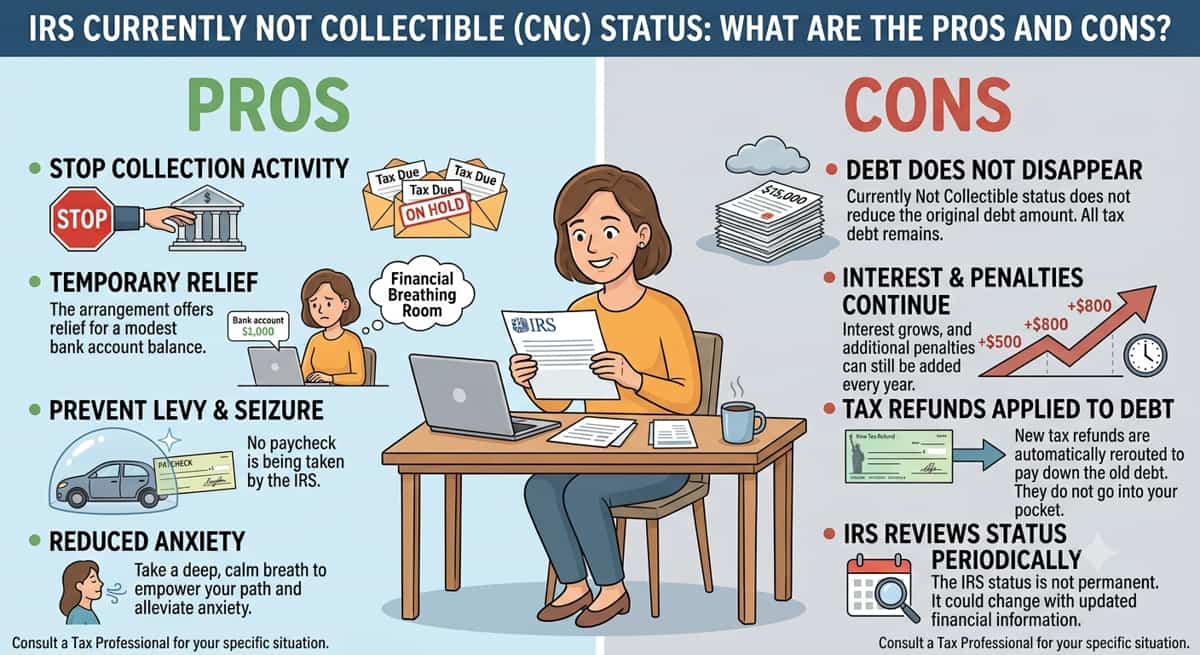
IRS Currently Not Collectible (CNC) status pauses IRS collection actions like wage garnishment and bank levies when you truly can't afford to pay your tax bill and cover basic living costs. It buys you breathing room, but it doesn't erase your debt, and interest keeps adding up while you're in it.
Here's some good news: if you genuinely can't pay right now, the IRS has a program built exactly for that situation. It's called Currently Not Collectible status, or CNC for short.
What Is IRS Currently Not Collectible (CNC) Status?
Think of CNC status as the IRS hitting the pause button. It's an official designation the IRS gives to taxpayers who've shown that paying their tax bill right now would mean not being able to cover essentials rent, groceries, utilities, medical care.
Once you're approved for CNC status, the IRS stops actively trying to collect from you. That means no wage garnishment, no bank account levies, and no more threatening collection letters piling up in your mailbox. Internally, the IRS marks your account with a code often called "Status 53" you might see this mentioned if you ever pull your IRS transcript or talk to a tax professional.
It's important to understand what CNC status is not, though. It's not debt forgiveness. Your balance doesn't disappear it just sits there, on hold, while the IRS backs off. CNC is one part of the IRS's broader Fresh Start Program, which also includes payment plans and settlement options we'll compare later in this guide.
How Does CNC Status Work?
When you apply, the IRS looks at two numbers: how much you earn, and how much you need to spend each month on necessities like housing, food, transportation, health care, and insurance. They use standardized expense guidelines to check this not just whatever you say you spend.
If your income barely covers (or doesn't cover) those necessary expenses, the IRS agrees you can't pay anything right now, and your account gets marked CNC.
A few things to keep in mind about how this plays out over time:
Your debt keeps growing. Interest and penalties don't stop just because collections do.
It's not permanent. The IRS typically reviews your financial situation periodically often once a year to see if anything has changed.
There's a clock running in the background. The IRS generally has 10 years from when a tax debt is assessed to collect it. Time spent in CNC status counts toward that period, which means for some people, the debt can eventually expire if their finances never improve enough to come out of CNC.
Who Qualifies for CNC Status?
Qualifying for CNC status comes down to a few honest checks the IRS runs on your finances.
Income and Expense Test
The IRS compares your monthly income to what it considers reasonable living expenses, based on national and local cost-of-living standards. If what's left over after covering necessities is very small often close to $25 a month or less you're in a strong position to qualify.
Asset Test
The IRS also looks at what you own. If you have significant savings, a lot of home equity, or retirement funds that could realistically be used to pay off some of the debt, that can work against your CNC request. The idea is that CNC is meant for people with genuinely limited options, not for those sitting on assets they could tap into.
Filing Compliance Requirement
Before the IRS will even consider CNC status, you generally need to have filed every tax return you were required to file no missing years. This applies whether you file with a Social Security number or an ITIN. If you've fallen behind on filing, that's usually the first thing to fix.
Self-Employed and Business-Owner Considerations
This one hits close to home for a lot of South Asian households, since so many run their own businesses motels, gas stations, restaurants, rideshare work, or IT consulting through an LLC. If you're self-employed, the IRS will also want to see that you're current on estimated tax payments before approving CNC status. Uneven or seasonal business income can make the math more complicated, so this is often where working with someone who understands small-business finances really helps.
Pros of IRS Currently Not Collectible Status
Immediate Relief From Wage Garnishment and Bank Levies
This is the big one. When you're in CNC status, the IRS usually halts garnishing your paycheck or freezing your bank account. If you've been tossing and turning at night over a smaller paycheck or feeling sick to your stomach every time you check your bank balance, that alone can feel like a huge weight off of the shoulders.
No Required Monthly Payments
CNC state does not direct you to send the IRS anything every month, unlike payment plan. If your finances are already tight then not having to manage an additional bill could be a huge boost to day-to-day living.
Time to Stabilize Finances Without Losing Assets
This CNC status allows you some breathing room, it can put you back on your feet without having to sell a car, liquidate a retirement account or get into a high risk loan just to appease the IRS. If you are between jobs, recovering from a bad medical situation , or have had a rough year with your business and are starting to rebuild, that time can mean a lot.
Protects Take-Home Pay for Family and Remittance Obligations
For many South Asian households, income isn't just supporting the people in this country it's also helping parents, siblings, or extended family back home, or covering shared expenses in a multi-generational household. Because CNC status stops garnishment, it protects that income so it can keep going where it's needed most, instead of being redirected to the IRS.
Doesn't Require Bankruptcy or Asset Liquidation
CNC status lets you address serious tax debt without the long-term consequences of bankruptcy or the pain of selling off property or savings. For business owners especially, this matters you can keep your equipment, inventory, or home equity intact while you work through a hard financial stretch.
Cons and Risks of CNC Status
Interest and Penalties Continue to Grow
While collections pause, your balance doesn't freeze. Interest and penalties keep accumulating the entire time you're in CNC status, so the amount you eventually owe can grow noticeably larger, especially if you're in this status for several years.
The IRS May Still File a Federal Tax Lien
This is one of the most misunderstood parts of CNC status. A lien and a levy are not the same thing. A levy is the IRS actually taking money or property. A lien is more like the IRS putting a public claim on your assets to protect its interest it doesn't take anything directly, but it can show up on property records and make it harder to sell a home, refinance, or get certain types of credit. CNC status stops levies, but it doesn't automatically stop the IRS from filing a lien.
Tax Refunds Can Still Be Seized
Even while you're in CNC status, if you're owed a federal tax refund in a future year, the IRS can apply it directly to your outstanding balance instead of sending it to you. It's worth planning for this so it doesn't catch you off guard.
Status Can Be Reviewed and Revoked
CNC status isn't a one-time approval that lasts forever. The IRS periodically checks in on your financial situation. If your income improves say, you get a raise, your business picks up, or a family member's income now supports the household the IRS can end your CNC status and restart collection efforts.
Not a Permanent Fix - Debt Eventually Resurfaces
It's easy to feel like the problem is solved once collections stop, but CNC status is really a pause, not a solution. At some point whether your finances improve or the 10-year collection window runs its course you'll need a longer-term plan for the debt itself.
CNC Status vs. Other IRS Relief Options
CNC status isn't the only tool available if you owe the IRS more than you can pay. Depending on your situation, an Installment Agreement or an Offer in Compromise might be a better fit.
Currently Not Collectible | Installment Agreement | Offer in Compromise | |
Effect on debt | Debt remains; keeps growing with interest | Debt remains; paid off gradually | Debt can be settled for less than owed |
Monthly payment required | No | Yes | No (one-time or short-term payments) |
Best for | Little to no disposable income | Steady income that can cover a monthly amount | Debt is unlikely to ever be fully repaid |
Credit/asset impact | Lien possible; assets generally protected | Lien possible if balance is high | Lien released once offer is paid |
If you're not sure which route fits your situation, that's exactly the kind of question a tax professional can help you sort out based on your actual numbers.
How to Apply for CNC Status
Applying for CNC status isn't complicated, but it does take some preparation. Here's what the process generally looks like:
Confirm all your tax returns are filed. The IRS won't consider CNC status if you have missing returns from past years.
Gather your financial documents. This usually means recent pay stubs, bank statements, and proof of your necessary monthly expenses like rent, utilities, and insurance.
Complete Form 433-F (or Form 433-A for more detailed cases). This is the IRS's official form for reporting your income, expenses, and assets.
Contact the IRS directly, or have a representative do it for you. You can call the IRS collections line and explain that you're unable to make any payment, not just the full amount. If a tax professional is helping you, they can handle this conversation on your behalf.
Wait for the IRS to review your case. If approved, you'll get written confirmation that your account has been placed in CNC status.
Special Considerations for South Asian Immigrants and Families
A few things come up often for South Asian taxpayers navigating IRS debt that are worth addressing directly.
ITIN filers can qualify too. CNC status isn't limited to people filing with a Social Security number. If you file taxes using an Individual Taxpayer Identification Number, the same basic process and eligibility rules apply to you.
CNC status is a civil tax matter, not an immigration issue. Owing the IRS money and being placed in CNC status does not, by itself, report anything to immigration authorities or trigger enforcement related to your visa or green card. That said, immigration law is its own complex area, and if you have specific concerns about how any financial or legal matter might intersect with your immigration status, it's worth speaking with an immigration attorney directly rather than guessing.
Family business income can complicate things. If your household runs a motel, restaurant, gas station, or similar business, income can look inconsistent month to month, which makes the expense test trickier to document. Keeping clean, separate records for the business and household expenses makes this process much smoother.
You don't need to carry this alone or in silence. There's often pressure in South Asian communities to keep money problems private, even from close family. But tax debt is common, it's fixable, and talking to a qualified professional is a practical step, not a personal failure.
Language shouldn't be a barrier. If English isn't your first language, or your parents are the ones handling the IRS letters, know that the IRS offers interpreter services over the phone, and many Enrolled Agents and CPAs serving immigrant communities are bilingual. You don't have to navigate this in a language that isn't comfortable for you.
When to Work With a Tax Professional (and How to Avoid Scams)
Some situations call for extra help, including:
The IRS has assigned a revenue officer to your case
Your income comes from a business with complicated or seasonal cash flow
You have several years of unfiled returns
You're unsure whether CNC, an installment plan, or an Offer in Compromise fits your situation better
Unfortunately, immigrant communities are often specifically targeted by predatory "tax relief" companies. Watch out for red flags like:
Demands for large upfront fees before any work is done
Promises that they can guarantee a specific outcome
Unsolicited phone calls or ads claiming they can "settle your IRS debt for pennies on the dollar"
Before hiring anyone, verify their credentials. You can check the IRS's public directory of federal tax return preparers, or confirm that someone is a licensed Enrolled Agent, CPA, or tax attorney. A legitimate professional will be upfront about what you actually qualify for even if that means telling you CNC status isn't the best fit.
The Bottom Line
CNC status can be a genuine lifeline when you truly can't afford to pay the IRS without sacrificing basic necessities. It stops the immediate pressure the garnishments, the levies, the constant worry and gives you space to stabilize. But it's a pause, not a cure. Your debt keeps growing quietly in the background, and at some point, you'll need a plan for what comes next.
If you're dealing with IRS debt and aren't sure where you stand, talking to a qualified tax professional who understands your full financial picture is one of the most useful steps you can take. You don't have to figure this out alone, and you don't have to feel ashamed for needing help this is a common, solvable problem, and there's a path forward.
Ready to Get Started?
Get a free consultation with a certified debt consultant to see if debt settlement is right for you.
Get Free ConsultationAbout the Author
Bhupinder Bajwa
.
Related Articles
IRS Tax Fraud: Types, Penalties, Warning Signs, and What to Do
11 min read
What Is the Difference Between Tax Fraud and an Honest Tax Mistake?
11 min read
How Much Should You Pay Per Month on an IRS Installment Agreement?
10 min read
What Is a Reasonable Cause for IRS Penalty Relief
12 min read
Can the IRS Seize a Small Business Bank Account for Unpaid Taxes?
11 min read
What Is an IRS Wage Garnishment and How Does It Work?
10 min read
Get Your Free Consultation
Speak with a certified debt consultant to explore your options.
Start NowNo obligation • Free consultation