Secured vs Unsecured Debt Consolidation: What's the Difference?
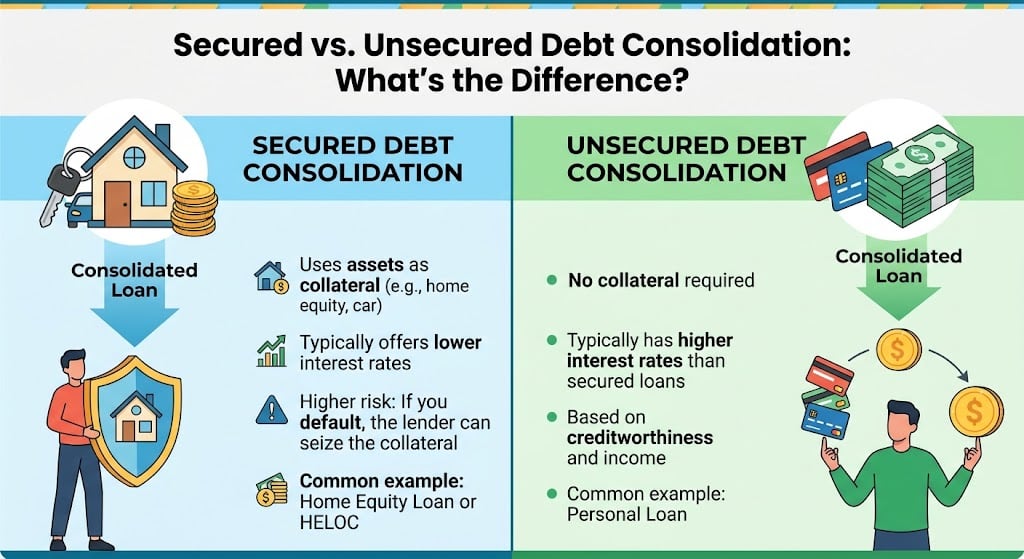
If you're looking into debt consolidation, you've probably come across two very different paths: secured and unsecured. The short version is this secured consolidation means you're putting up something valuable, like your home, a car, or gold, as a guarantee for the loan. Unsecured consolidation doesn't require you to risk any of your assets, but it usually depends more heavily on your credit history and income.
Both can combine multiple debts into one manageable payment, but the risks, costs, and approval requirements can look very different depending on which route you take. Below, we'll walk through exactly what separates the two, so you can figure out which one actually fits your situation.
What Is Debt Consolidation, and Why Does the Secured vs Unsecured Choice Matter?
At its core, debt consolidation means taking several debts, maybe a few credit cards, a personal loan, or medical bills and rolling them into a single loan or payment plan. Instead of juggling different due dates, interest rates, and minimum payments every month, you're left with one payment to keep track of. For a lot of people, that alone brings real relief.
But here's what often gets glossed over: not all consolidation loans work the same way. The moment you start comparing offers or deciding between debt consolidation or debt relief you'll notice some ask for collateral while others don't. That single difference secured versus unsecured ends up shaping almost everything else: how much you can borrow, what interest rate you're offered, how likely you are to get approved, and what you stand to lose if things don't go as planned.
If you're weighing your options and trying to figure out which type of consolidation loan makes sense for your life, your income, your assets, your comfort with risk, this breakdown is for you.
What Is Secured Debt Consolidation?
Secured debt consolidation is a loan that's backed by something you own: your home, your car, a savings account, or even gold and jewelry. That "something" is called collateral, and it acts as a safety net for the lender. If you're unable to keep up with payments, the lender has the legal right to take that asset to recover what's owed.
Because the lender has this backup plan, secured loans are often easier to qualify for and tend to come with lower interest rates compared to unsecured options. That's the trade-off: you're taking on more personal risk in exchange for terms that are typically more favorable. For someone with a lot of high-interest credit card debt, a lower rate can make a real difference in how quickly they can become debt-free. But it's also worth sitting with the fact that if your income takes a hit, a job loss, a medical emergency, a slow season for your business, the asset you put up is the one that's exposed.
Common Types of Secured Consolidation Options
Home equity loan or HELOC (Home Equity Line of Credit): You borrow against the value you've built up in your home. This can offer larger loan amounts and lower rates, but your home is the collateral missed payments can eventually lead to foreclosure.
Secured personal loan: Some banks and credit unions let you borrow against money you already have in a savings account or certificate of deposit (CD). Since the lender can simply hold onto those funds if you default, approval is usually easier.
Gold or jewelry-backed loan: This is a common option in many South Asian households, where gold is often kept as a family asset. You can borrow against its value, but if you can't repay, you risk losing jewelry that may carry both financial and sentimental weight.
Auto equity loan: Similar idea, but using the value of a paid-off (or mostly paid-off) vehicle as collateral. Less common for larger consolidation needs, but it exists as an option.
What Is Unsecured Debt Consolidation?
Unsecured debt consolidation doesn't require you to put up any collateral. Instead, lenders decide whether to approve you and what interest rate to offer based on things like your credit score, your income, and how much debt you're already carrying compared to what you earn ( debt-to-income ratio).
Because there's no asset backing the loan, lenders are taking on more risk if you can't pay it back. To offset that, unsecured loans usually come with higher interest rates than secured options, and approval can be harder to get especially if your credit history is limited or inconsistent. The upside is peace of mind: if something goes wrong financially, you're not risking your home, your car, or a family asset. What's at stake is your credit standing, not a physical possession.
Common Types of Unsecured Consolidation Options
Unsecured personal loan: A lump-sum loan from a bank, credit union, or online lender that you repay in fixed monthly installments. No collateral required, but your credit profile plays a big role in your rate and approval odds.
Balance transfer credit card: You move existing balances onto a new card one of several popular ways to consolidate credit card debt often with a 0% introductory rate for a set period. This can save you money on interest if you pay off the balance before the promotional period ends but watch for transfer fees and what the rate jumps to afterward.
Nonprofit debt management plan: Through a credit counseling agency, you make one monthly payment that the agency distributes to your creditors, sometimes at a reduced interest rate they've negotiated on your behalf. This isn't a loan in the traditional sense, but it serves the same consolidation purpose.
Secured vs Unsecured Debt Consolidation: Side-by-Side Comparison
Once you understand how each option works individually, the differences become easier to see when placed side by side. Here's a quick comparison to help you weigh your choices:
Factor | Secured Consolidation | Unsecured Consolidation |
Collateral required | Yes (home, savings, gold, vehicle) | No |
Typical interest rates | Generally lower | Generally higher |
Approval difficulty | Often easier, especially with limited credit history | Depends heavily on credit score and income |
Risk if you default | Loss of the asset (foreclosure, repossession, loss of collateral) | Damage to credit score; possible collections or legal action, but no asset seized directly |
Loan amounts | Often higher, tied to the value of the collateral | Usually smaller, based on income and creditworthiness |
Best suited for | Those comfortable risking an asset for better terms | Those who want to avoid risking property, even with a higher rate |
There's no universal "better" choice here; it depends on what you're able to risk, what you qualify for, and how confident you feel in your ability to keep up with payments.
What Happens If You Default?
This is the part of the decision that deserves the most attention, because it's easy to focus on interest rates and overlook what happens if life doesn't go according to plan.
With secured debt consolidation, defaulting means the lender can legally claim the asset you put up. If you used your home as collateral through a HELOC or home equity loan, missed payments can eventually lead to foreclosure. If you use a vehicle, it can be repossessed. If you used gold or jewelry, it can be sold to recover what's owed. Because the lender has a legal claim on the asset, they have a fairly direct path to recovering their money, and that path runs through something you own.
With unsecured debt consolidation, there's no asset directly at risk, but that doesn't mean default is consequence-free. Missed payments can lead to the debt being sent to collections, a significant drop in your credit score, and depending on your state's laws potential legal action from the lender, which in some cases can lead to wage garnishment. The Consumer Financial Protection Bureau (CFPB) and Federal Trade Commission (FTC) both offer resources on your rights if a debt goes to collections, and it's worth understanding those protections before you're in that situation, not after.
The bigger point here: the "right" choice isn't just about which loan has the lower rate. It's about how much risk you're realistically able to absorb if your financial situation changes.
Which Option Fits Your Credit Profile?
If you've recently moved to the U.S., or simply haven't built up a long credit history here yet, you may run into what's sometimes called "credit invisibility" meaning there isn't enough information in the system for lenders to confidently assess your risk. This can make it harder to qualify for unsecured consolidation options, or push the interest rate higher than you'd expect for someone with your actual financial habits.
In these situations, secured consolidation can sometimes open a door that would otherwise stay closed. Because the loan is backed by an asset, some lenders are more willing to approve applicants with a limited or "thin" credit file. That said, this convenience comes with the same trade-off mentioned earlier: real risk to whatever you've put up as collateral.
Your debt-to-income ratio how much you owe compared to how much you earn also plays a major role, especially if your income comes from self-employment, a family business, or multiple sources that aren't always easy to document with a standard pay stub. Lenders may ask for more paperwork in these cases, such as tax returns or bank statements, to get a full picture of your ability to repay. Being prepared with this documentation ahead of time can make the process smoother, regardless of which consolidation path you choose.
Ready to Get Started?
Get a free consultation with a certified debt consultant to see if debt settlement is right for you.
Get Free ConsultationAbout the Author
Bhupinder Bajwa
.
Related Articles
What’s The Difference Between Debt Consolidation And Debt Settlement?
12 min read
Debt Consolidation vs. Debt Relief: Which Option Fits Your Situation?
10 min read
Can You Consolidate Debt With a Low Credit Score?
11 min read
When a Debt Consolidation Loan Truly Solves the Problem
11 min read
How Interest Rates Affect Debt
13 min read
How To Pay Off Debt Fast With Low Income
11 min read
Get Your Free Consultation
Speak with a certified debt consultant to explore your options.
Start NowNo obligation • Free consultation