Chapter 7 Or Chapter 13? What Actually Goes Into The Decision
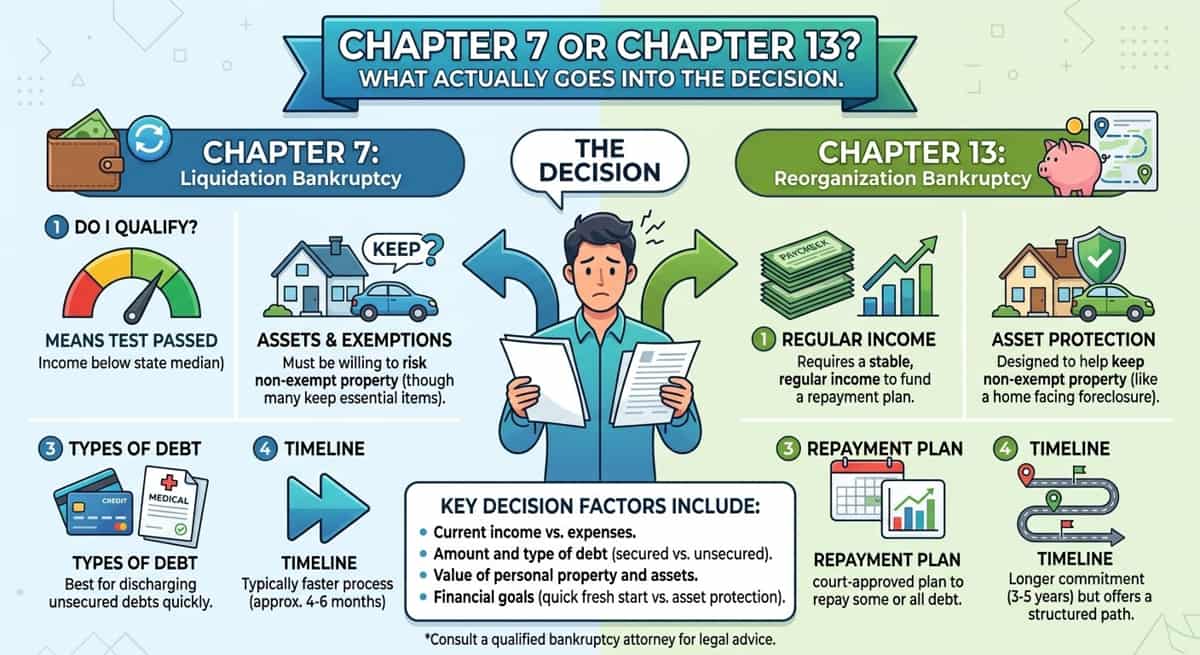
Chapter 7 wipes out eligible unsecured debt, like credit cards and medical bills, in about three to four months if you pass an income test. Chapter 13 is a three-to-five-year repayment plan, usually chosen to protect a home, catch up on missed payments, or when income is too high for Chapter 7.
If you are reading this late at night, worried about credit card bills, a job loss that put your visa in question, or money your family back home still counts on, you are not alone. Many South Asian families carry this stress quietly, and that silence makes it heavier.
Bankruptcy is a legal debt relief process. It comes down to your income, what you own, and what you need to protect. This guide walks you through each factor in plain English, so you can decide with confidence.
What Is the Main Difference Between Chapter 7 and Chapter 13 Bankruptcy?
The main difference is how your debts get handled. Chapter 7, often called liquidation bankruptcy, wipes out eligible unsecured debt, such as credit cards, medical bills, and personal loans, usually within a few months.
Chapter 13, called reorganization bankruptcy, lets you keep your property while you repay part of what you owe through a three-to-five-year plan.
In both, an automatic stay begins the day you file. Collection calls, lawsuits, and wage garnishment must stop while your case is open. That relief alone is often what families need first.
Chapter 7 vs Chapter 13 at a Glance
Chapter 7 | Chapter 13 | |
How it works | A trustee reviews your case. Most people keep their exempt property, and eligible debts are discharged. | You make one monthly payment to a trustee, who distributes it to creditors. |
Typical timeline | About 3 to 4 months | 3 to 5 years |
Who it suits | Lower income, mostly unsecured debt, few assets at risk | Steady income, behind on a mortgage or car loan, or income too high for Chapter 7 |
What happens to assets | Non-exempt property may be sold. Exemptions vary by state. | You generally keep your assets, but your plan must pay creditors at least what they would have received in Chapter 7. |
Credit report | Generally up to 10 years from filing | Generally up to 7 years from filing |
Not for | People above the income limit, or with valuable non-exempt property | People without steady income to sustain a multi-year plan |
Many people start by asking which one is cheaper. A more useful question is: what do I need to protect, and what can I realistically pay every month? If your priority is keeping a home with missed mortgage payments, or protecting a relative who co-signed a loan, Chapter 13 may fit better. If your debts are mostly unsecured and your income is limited, Chapter 7 may bring relief faster.
When Does Chapter 13 Make More Sense Than Chapter 7?
If you have asked yourself, "Is Chapter 13 better than Chapter 7?", the honest answer is that it depends on what you are trying to protect. Chapter 13 often fits when Chapter 7 would force you to give something up.
Chapter 13 may make more sense if:
Your income is above the means test limit.
You are behind on your mortgage or car payments and want to catch up over time instead of facing foreclosure or repossession.
You own valuable non-exempt property you want to keep.
A relative co-signed a loan for you. Chapter 13's co-debtor stay can shield many co-signers on consumer debts while your plan runs.
You received a Chapter 7 discharge recently and are not yet eligible for another.
People searching "chapter 13 vs chapter 7 to keep my house" are usually in the first group, and Chapter 13 is built for that situation.
Here is how a Chapter 13 repayment plan works. You propose a three-to-five-year plan based on your disposable income. The court must approve it, a step called plan confirmation. You then make one monthly payment to a trustee, who pays your creditors. Wage garnishment and collection calls stop while the plan stays on track. The plan must also be realistic for your income, and you generally must pay creditors at least what they would have received in Chapter 7.
A Small-Business Owner with a Motel, Grocery, or Gas Station Loan
Imagine Rakesh, who owns a small gas station and convenience store in Texas. His income is too high for Chapter 7, and he is two months behind on a loan secured by the property. Chapter 13 could let him catch up on the arrears over time while keeping the business running. Business debt, tax debt, and student loans follow special rules, though, so he would need an attorney to review his options and the current Chapter 13 debt limits.
Chapter 13 does have a trade-off. Many cases fail when income is unstable, which matters for H-1B holders and contract workers. A plan only works if you can make every payment for years.
Can Immigrants, Green Card Holders, and Visa Holders File for Bankruptcy in the US?
Yes, in most cases. Bankruptcy courts generally allow anyone with a US residence, domicile, place of business, or property in the US to file, regardless of citizenship. Being a non-citizen does not block you, though you should confirm your specific situation with an attorney.
Here is how it often looks by status:
Green card holders (lawful permanent residents): You can file just like a citizen.
H-1B and L-1 holders: You can file. Chapter 13 needs steady income, so job security and work authorization matter, because a plan can fail if you lose your job.
F-1 students and OPT: You may be eligible to file, but work limits can affect your income and your ability to sustain a repayment plan. Talk to an attorney before filing.
DACA recipients: You can file if you meet the residence or property requirement.
ITIN filers: You can file without a Social Security number, but your paperwork must show your ITIN and be accurate.
Accuracy matters. Your name, ID numbers, addresses, income, and every creditor must match your records exactly. Mistakes or missing information can delay your case or raise questions, so gather your documents carefully.
A bankruptcy filing is a legal event separate from your immigration filings. Even so, the two can affect each other in ways many families worry about, and that is where we go next.
Will Filing Bankruptcy Affect My Visa, Green Card, or US Citizenship Application?
This is the question that keeps many people from getting help, so here is the direct answer first. Bankruptcy by itself is generally not a reason to deport someone or to deny a visa or green card. What matters more is how the debts were incurred and how your case is handled.
Naturalization and "Good Moral Character"
If you are planning to apply for citizenship, USCIS looks at your overall character, including honesty and how you meet your obligations. A bankruptcy filing alone does not disqualify you. The real risks are:
Unpaid taxes
False statements on forms or in the bankruptcy case
Large luxury charges or cash advances made right before filing
Hiding assets or income
Be prepared to explain your finances calmly and truthfully at your naturalization interview. Honest, well-documented bankruptcies are usually far less worrying than people fear.
Public Charge and Sponsored Immigrants
If a family member sponsored you, or you sponsored a spouse or parent, the I-864 Affidavit of Support is a separate legal promise to the government. Bankruptcy generally does not erase it. If you are a sponsor, that obligation may continue even after your other debts are discharged. Ask an immigration attorney to review this before you file.
Visa Renewals and Employer Background Checks
Most routine H-1B renewals focus on your job and status, not your credit history. Some roles are different. Jobs in finance and positions requiring a security clearance may review your financial record, and a bankruptcy can prompt questions, though it is not always disqualifying.
Because immigration and bankruptcy rules interact, speak with both an immigration attorney and a bankruptcy attorney before you file, not after. A short consultation now can protect your status, your family, and your future applications.
What Happens to Money I Send Home and Assets I Own in India, Pakistan, Bangladesh, Nepal, or Sri Lanka?
For many South Asian families, money does not stop at the US border. You may support parents, pay for a sibling's wedding, or own a plot of land back home. If you are asking, "Do I have to disclose foreign property in bankruptcy?", the answer is yes. Foreign bank accounts, property, jewelry, and gifts all go on your schedule of assets. Hiding anything can cost you your discharge and may lead to criminal exposure, so full honesty is your best protection.
Remittances Before and During Bankruptcy
Regular monthly support for family is usually viewed very differently from a large lump-sum transfer. Trustees can review transfers made shortly before you file, generally up to two years back, and may reverse them under fraudulent transfer rules. Sending a large amount to a relative right before filing is the kind of move that raises concern.
Keep a record of every transfer: dates, amounts, receipts, and the purpose. Ask your attorney how to handle ongoing support once your case is open.
Informal Debts and Community Lending
Committees, chit funds, and loans from relatives or friends are common in our community, and they still count as debts. You must list these creditors even if nothing was written down. Be careful about repaying family or friends just before filing. These preferential payments can be challenged and reclaimed, with a longer window for relatives, generally one year. Money sent through informal transfer systems, such as hawala-style arrangements, should be disclosed too.
Parents and In-Laws as Co-Signers or Guarantors
If a parent or in-law co-signed a loan, they remain legally responsible even after you receive a discharge in Chapter 7. In Chapter 13, the co-debtor stay can protect many co-signers on consumer debts while your plan stays on track. Talk with them early, before you file, so nobody is blindsided.
How Long Does Bankruptcy Stay on My Credit Report, and How Fast Can I Rebuild My FICO Score?
After everything covered so far, it is natural to wonder what bankruptcy does to your credit. A Chapter 7 can stay on your credit report for up to 10 years from the filing date, and a Chapter 13 for up to 7 years. Your score takes a hit at first, but the impact lessens over time, and many people see real FICO score recovery within a couple of years if they build good habits.
If you are newer to the US and your credit file is still thin, take heart. Bankruptcy can be recovered from, and you are building history from a clean slate.
A simple rebuilding sequence looks like this:
Check your reports for free at annualcreditreport.com, and dispute errors, such as old debts still showing a balance.
Open a secured credit card. Keep credit utilization low and pay in full each month.
Try a credit-builder loan from a credit union or community bank.
Add on-time rent payments through a reporting service, if your landlord supports it.
Be careful with authorized-user offers. Only join accounts held by someone with a spotless record.
Thinking about buying a home? Mortgage waiting periods after bankruptcy differ by loan type, so ask a lender early.
Is Bankruptcy Better Than Debt Settlement, Debt Consolidation, or Credit Counseling?
Bankruptcy is not always the right answer. If you have been searching "bankruptcy vs debt settlement" or what are the safest debt relief options, it helps to see all your choices side by side , so you can pick the one that fits your situation.
Credit counseling and debt management plans: A counselor negotiates lower APRs with your card issuers, and you make one monthly payment, usually over three to five years. This works best when your debt is manageable and your income is steady.
Debt consolidation loans: You take one new loan to pay off several cards. It only helps if you can qualify for a lower rate and keep up with the payments. With a thin US credit file, approval may be harder.
Debt settlement program: A company negotiates to pay less than you owe. Be careful here. Your credit can suffer while you stop paying, fees can be high, and any forgiven debt may be reported on a 1099-C and counted as taxable income.
Chapter 7 or Chapter 13: These are legal protections with court oversight, covered in the sections above.
Try This First If
Your debt is manageable: If you can repay within about five years with some help, start with nonprofit credit counseling or ask your lenders about a hardship program.
Your debt is more than you can realistically repay: If minimum payments eat your paycheck or you are borrowing to pay other debts, bankruptcy may bring relief faster and more safely.
Whichever way you lean, avoid any company that demands large upfront fees or guarantees results. A free consultation with a nonprofit counselor or an attorney costs you nothing and can show you where you stand.
How Do I Decide Between Chapter 7 and Chapter 13? A Step-by-Step Framework
By now you have seen a lot of information, so let's bring it together. Work through these seven steps at your own pace, ideally with a notebook or spreadsheet. There is no right or wrong answer here, only a clearer picture of where you stand.
List all your debts. Mark each as secured (like a mortgage or car loan) or unsecured (like credit cards and medical bills).
Compare your household income to your state median. Include your spouse's income, and look at your debt-to-income ratio too.
Inventory what you own. Include jewelry, gold, and any property back home. This is the start of your exemption planning.
Check for missed payments on your mortgage or car loan that you need to catch up on.
Identify co-signers and family obligations, including parents or in-laws who share your loans and relatives you support.
Review your immigration status and any upcoming applications, such as a green card renewal or citizenship.
Book a bankruptcy attorney consultation, and an immigration attorney consultation if your status is a concern.
Quick Scorecard
If this sounds like you… | It may lean toward… |
Income below your state median, mostly unsecured debt, few assets at risk | Chapter 7 |
Behind on mortgage or car payments, steady income, valuable property, or a co-signer to protect | Chapter 13 |
Debt you can realistically repay within about five years | Consider alternatives (credit counseling, a hardship program) |
This table is a starting point, not a verdict. Your repayment ability and your attorney's review will make the final call.
Dealing with Shame, Family Pressure, and Debt Relief Scams
In many South Asian families, money troubles are carried in silence. The fear of "what will people say" can feel heavier than the debt itself. Please know this: bankruptcy is a legal protection built into US law, not a moral failure. Medical bills, job loss, and supporting family on two continents can overwhelm anyone.
Sadly, people in this situation are also targeted by scams. Be wary of notarios and unlicensed "visa and debt consultants," companies that demand large upfront fees, and anyone who guarantees results. You can verify an attorney through your State Bar and report scams to the FTC.
When choosing an attorney, look for:
A license to practice in your state
Transparent fees explained in writing
Multilingual support, if you need it
No promises about outcomes
A free consultation or nonprofit financial counseling session can help you compare your options safely.
Conclusion and Next Steps
Choosing between Chapter 7 and Chapter 13 comes down to your income, what you own, what you need to protect, and what you can realistically repay. Your immigration status and family obligations matter too, and none of this makes you a failure. It makes you someone taking responsibility.
Your next steps:
Gather your income records and a full list of your debts.
Complete the required credit counseling course with an approved provider.
Book consultations with a bankruptcy attorney and, if needed, an immigration attorney.
If you would like to talk it through, we offer a confidential, multilingual consultation, and you do not have to decide alone.
Ready to Get Started?
Get a free consultation with a certified debt consultant to see if debt settlement is right for you.
Get Free ConsultationAbout the Author
Bhupinder Bajwa
.
Related Articles
Low Income Debt Relief Programs And Options
14 min read
Before Filing for Bankruptcy: What You Need to Know
11 min read
4 Reasons Why Filing for Bankruptcy Should Be Your Last Option
10 min read
What Debts Can Be Included in Debt Relief?
13 min read
How Much Tax You Pay On Lawsuit Settlements
9 min read

Filing For Business Bankruptcy? You Need To Know This First
10 min read
Get Your Free Consultation
Speak with a certified debt consultant to explore your options.
Start NowNo obligation • Free consultation