
What Is An IRS Partial Payment Plan?
Getting an IRS notice in the mail is stressful enough. But when the balance keeps growing and there's no clear way to pay it all off that stress can take over your entire life. If you've been losing sleep over tax debt, worried about your paycheck being garnished or your bank account being frozen, you're not alone.
The good news is that the IRS isn't always looking to collect everything at once. There's a little-known option called a Partial Payment Installment Agreement (PPIA) , a monthly payment plan where you pay only what you can actually afford, based on your real income and expenses. If any balance remains when the IRS's legal collection window closes (called the Collection Statute Expiration Date, or CSED), the IRS simply stops collecting it.
In plain terms: you pay what you can, for as long as the IRS has time to collect and whatever's left after that goes away.
How Does an IRS Partial Payment Plan Work?
Most people don't realize that the IRS has a deadline for collecting tax debt. By law, the IRS has 10 years from the date your tax was assessed to collect what you owe. That deadline is called the Collection Statute Expiration Date (CSED). Once it passes, the IRS can no longer come after you for that balance.
A Partial Payment Installment Agreement works around this window. Instead of demanding full payment upfront, the IRS agrees to accept a smaller monthly amount, one that's calculated based on what you can realistically afford after covering your basic living expenses like rent, food, utilities, and transportation.
Here's how the math works in practice: the IRS looks at your monthly income, subtracts your allowed living expenses, and whatever is left becomes your monthly payment. If there's still a balance when your CSED expires, the IRS stops collecting no further action, no follow-up.
One important thing to know: the IRS will review your financial situation every two years. If your income goes up or your expenses go down, your monthly payment could increase.
You pay what you can. The IRS collects what it can. When time runs out, the rest disappears.
IRS Partial Payment Plan vs. Regular Installment Agreement
If you've already looked into IRS payment options, you've probably come across a few different names: installment agreements, partial payment plans, Offer in Compromise. It can feel overwhelming. Here's a simple breakdown of what each one actually means.
Standard Installment Agreement
This is the most common IRS payment plan. You pay off your full tax debt including penalties and interest in monthly installments over time. It works well if you have a steady income and can realistically pay everything off, just not all at once.
Partial Payment Installment Agreement (PPIA)
This is for people who genuinely cannot pay the full amount, even if they had 10 years to do it. Payments are based on what you can afford after essential living costs. Whatever remains when the IRS collection window closes is no longer collectible.
Offer in Compromise (OIC)
An OIC lets you settle your tax debt for less than you owe but it comes with a strict approval process, a 20% upfront deposit requirement, and significant paperwork. A PPIA sits in the middle: you're not settling for a lump sum, but you're also not expected to repay everything.
Feature | Standard Installment Agreement | Partial Payment Plan (PPIA) |
Repayment Goal | Pay full balance | Pay what you can afford |
Financial Disclosure Required | Sometimes | Always |
IRS Review Frequency | Rarely | Every 2 years |
Remaining Balance at CSED | Must be paid in full | Discharged — no longer collectible |
Best For | Stable income earners | Financial hardship situations |
If you're on an H-1B visa, running a small business, or managing income from multiple sources, situations common among South Asian immigrants in the U.S. your financial picture can be more complicated than most. Self-employment income, overseas assets, or a spouse working abroad can all factor into the IRS's review. In cases like these, a PPIA may offer more realistic relief than a standard plan that doesn't account for the full complexity of your finances.
Who Qualifies for an IRS Partial Payment Plan?
Not everyone will qualify for a PPIA, but if you're genuinely struggling to keep up with a tax balance that feels impossible to clear, it's worth understanding exactly where you stand.
To be considered, you generally need to meet the following conditions:
You owe tax debt that cannot realistically be paid in full before the IRS collection window closes
You have filed all required tax returns — even if you couldn't pay what was owed at the time
You are current on any estimated tax payments if you're self-employed or running a business
You are willing to submit a complete financial disclosure through IRS Form 433-A (for individuals) or Form 433-B (for businesses), along with Form 9465 to formally request the installment agreement
What Can Disqualify You?
Even if you're struggling financially, certain factors can work against your application:
Significant assets with equity — if you own a home, rental property, or have retirement savings, the IRS may expect you to borrow against them or liquidate them before approving a PPIA
Unfiled tax returns from previous years — this is one of the most common reasons applications get denied, and it's entirely preventable
A previous installment agreement that you defaulted on without resolving — the IRS takes compliance history seriously
Special Considerations for South Asian Immigrants
If you came to the U.S. on an H-1B visa, hold a green card, or are in the naturalization process, there are a few things worth knowing before you apply.
Unresolved tax debt can affect your naturalization application. The USCIS considers financial responsibility as part of the "good moral character" requirement, and significant IRS debt especially if unaddressed can raise flags during the process.
Foreign bank accounts and overseas assets count. If you have savings back home in India, Pakistan, Bangladesh, or elsewhere, those assets may factor into the IRS's financial analysis. If your foreign accounts exceed certain thresholds, you may also have FBAR filing obligations, a separate requirement that's easy to overlook but carries serious penalties.
Self-employed individuals need to be especially careful. Whether you run a restaurant, work as an IT contractor, or practice medicine privately, your quarterly estimated tax payments must be current before the IRS will consider your PPIA application.
Every financial situation is different, and the details matter a great deal with the IRS. Before submitting any forms, it's strongly recommended that you speak with a licensed Enrolled Agent, CPA, or Tax Attorney who has experience with IRS collections ideally one familiar with the specific financial circumstances that many immigrant families navigate. The IRS Taxpayer Advocate Service is also a free, independent resource that can help if you're unsure where to start.
How to Apply for an IRS Partial Payment Plan — Step by Step
If you've decided that a PPIA might be the right option for you, here's exactly what the process looks like. It takes some preparation, but it's more straightforward than most people expect especially when you go in knowing what to bring.
Step 1 — Get Current on All Tax Filings
Before anything else, make sure you've filed all your required tax returns even for years when you couldn't pay what was owed. The IRS will not approve a PPIA if you have unfiled returns sitting in the background. If you're missing any, file them first. You don't need to pay the full balance to file, just getting the returns in is what matters at this stage.
Step 2 — Calculate What You Can Realistically Pay Each Month
The IRS uses a straightforward formula: your monthly gross income minus your allowable living expenses equals your ability to pay. Allowable expenses include things like rent or mortgage payments, groceries, utilities, transportation, and healthcare costs. The number left over after those deductions becomes your proposed monthly payment.
This is called an ability-to-pay analysis, and it's based on the IRS's own Collection Financial Standards guidelines that set reasonable limits for common household expenses. If your expenses are higher than those limits, the IRS may not count the full amount, which is another reason having a tax professional on your side can make a real difference.
Step 3 — Complete the Required IRS Forms
Gather your documents and complete the following:
Form 433-A — Collection Information Statement for Individuals (this is your full financial disclosure — income, expenses, assets, liabilities)
Form 9465 — Installment Agreement Request (this is the formal ask for the payment plan)
Supporting documents you'll need to attach:
Recent pay stubs or proof of income
Last 3–6 months of bank statements
Lease agreement or mortgage statement
Utility bills
Medical expense records, if applicable
Being thorough here matters. Missing documents slow the process down and can give the IRS reason to question your numbers.
Step 4 — Submit Your Application and Wait
Once your forms are complete, submit them to the IRS either by mail or through a revenue officer if one has already been assigned to your case. After submission, an IRS manager reviews your application and verifies your financial information.
Expect a response within about 30 days. The IRS may come back with a counteroffer for a higher monthly payment than you proposed. This is common, and it's negotiable with the right representation. Don't assume their first number is the final one.
Step 5 — Stay Compliant Once You're Approved
Getting approved is just the beginning. To keep your PPIA in good standing, you must:
Make every monthly payment on time
File all future tax returns by their due dates
Report any major changes to your income or assets the IRS reviews your financial situation every two years
Avoid taking on new tax debt
If you miss a payment or fall behind on filings, the IRS can default your agreement and resume collection action immediately including wage garnishment or bank levies. Staying compliant protects everything you've worked to set up.
Dealing with the IRS can feel intimidating particularly if English isn't your first language, or if you're navigating a financial system that works very differently from what you grew up with. That's completely understandable. The good news is that you don't have to do this alone. A licensed Enrolled Agent or Tax Attorney can handle the paperwork, negotiate on your behalf, and make sure your application reflects your true financial picture, not just a number the IRS finds convenient.
What Happens to Penalties and Interest Under a PPIA?
This is one of the most common questions people have and it's an important one to understand before you commit to a plan.
The honest answer: penalties and interest do not stop accruing just because you're on a PPIA. While you're making monthly payments, the IRS continues to add interest to your unpaid balance, along with a failure-to-pay penalty of 0.25% per month. This is one of the key differences between a PPIA and an Offer in Compromise with an OIC, once you settle, it's done. With a PPIA, the clock keeps running on what you owe.
That said, here's the part that often surprises people: whatever that balance grows to penalties included is still discharged when your CSED expires. You don't have to worry about chasing down a larger number at the end. The total outstanding amount, however it's grown, simply becomes uncollectible once the IRS's collection window closes.
There is also a separate option worth knowing about called IRS Penalty Abatement specifically, First-Time Abatement or Reasonable Cause relief. If you qualify, this can reduce or remove certain penalties that have built up on your account, independent of your PPIA. It won't stop interest, but it can meaningfully lower the overall burden.
Because penalties and interest can add up in ways that are hard to track on your own, it's worth having a licensed Enrolled Agent or CPA calculate what your total balance might look like over the life of your payment plan. That way, you're making a fully informed decision not just a hopeful one.
PPIA Pros and Cons — Is It Right for You?
A PPIA can be a genuine lifeline for the right person but it's not a perfect solution for everyone. Here's an honest look at both sides so you can decide if it fits your situation.
What Works in Your Favor
Advantage | What It Means for You |
Stops aggressive IRS collection | Once approved, wage garnishments, bank levies, and asset seizures are put on hold |
Payments reflect what you can actually afford | No arbitrary fixed amount — your income and real expenses determine the number |
Remaining balance discharged at CSED | Whatever you haven't paid when the IRS collection window closes is no longer collectible |
No large upfront deposit | Unlike an Offer in Compromise, there's no 20% lump sum required to get started |
IRS-approved and structured | You're not hiding from the IRS — you're in a formal, recognized agreement with them |
What to Watch Out For
Disadvantage | What It Means for You |
Penalties and interest keep accruing | Your total balance continues to grow while you're on the plan |
IRS reviews your finances every two years | If your income increases, your monthly payment can go up |
Missing a payment can unravel everything | Defaulting on the agreement puts you back at square one — and collection action resumes |
Federal tax lien may remain | A PPIA doesn't automatically remove a tax lien, which can affect your credit and financial standing |
Significant assets can complicate approval | Home equity, retirement savings, or jointly owned property may count against you |
That last point is worth pausing on especially if you come from a family where assets are shared. In many South Asian households, property is co-owned between spouses, parents, or siblings sometimes across borders. Even if you don't think of yourself as someone with significant assets, the IRS may see it differently if you have equity in a jointly owned home or savings accumulated over the years. This is exactly the kind of nuance that a tax professional can help you navigate before you apply, so there are no surprises during the IRS's review.
When to Seek Professional Help for IRS Tax Debt Relief
There's no rule that says you have to handle this alone and for many people, trying to do so actually makes things harder. While some straightforward tax situations can be managed independently, there are moments when having a professional in your corner isn't just helpful, it's essential.
Consider reaching out to a licensed Enrolled Agent (EA), Certified Public Accountant (CPA), or Tax Attorney if any of the following apply to you:
You're self-employed whether you run a small business, work as a 1099 contractor, or practice independently as a physician, dentist, or consultant
You have foreign income, overseas bank accounts, or assets abroad particularly if you send money home regularly or hold property in India, Pakistan, Bangladesh, or elsewhere
You're in the process of applying for a green card or U.S. citizenship and have unresolved IRS debt
The IRS has already started garnishing your wages or freezing your bank account in these situations, time matters and a professional can move faster than going it alone
You're unsure about FBAR filing requirements or whether your overseas financial activity has been properly reported
A Word of Caution About "Tax Relief" Companies
If you've been searching for help online, you've likely come across companies promising to settle your IRS debt for "pennies on the dollar." Some of these companies are legitimate but many target immigrants and first-generation Americans who may feel uncertain about their rights or unfamiliar with how the U.S. tax system works.
Before paying anyone to represent you, verify their credentials. The IRS maintains a free, searchable directory of licensed tax professionals. A genuine professional will be listed there. If someone is making big promises but can't be verified, that's a warning sign worth taking seriously.
The goal isn't to scare you it's to make sure that when you do ask for help, you're getting real help from someone who is actually qualified to give it.
Moving Forward: Taking Control of Your Tax Debt
Facing down IRS debt is undeniably overwhelming, but as you now know, a high tax balance doesn't have to mean financial ruin. The Partial Payment Installment Agreement (PPIA) stands as a powerful, legally backed tool designed for one exact purpose: to protect your everyday life while you pay only what you can genuinely afford.
For immigrant families, small business owners, and independent contractors navigating complex financial waters, this path offers more than just a lower monthly payment—it offers a definitive end date and a clear road back to peace of mind.
Ready to Get Started?
Get a free consultation with a certified debt consultant to see if debt settlement is right for you.
Get Free ConsultationAbout the Author
Ooraa Team
Our team of certified debt consultants has over 10 years of experience helping families become debt-free. We specialize in debt settlement strategies and financial education.
Related Articles
IRS Tax Fraud: Types, Penalties, Warning Signs, and What to Do
11 min read
What Is the Difference Between Tax Fraud and an Honest Tax Mistake?
11 min read
How Much Should You Pay Per Month on an IRS Installment Agreement?
10 min read
What Is a Reasonable Cause for IRS Penalty Relief
12 min read
Can the IRS Seize a Small Business Bank Account for Unpaid Taxes?
11 min read
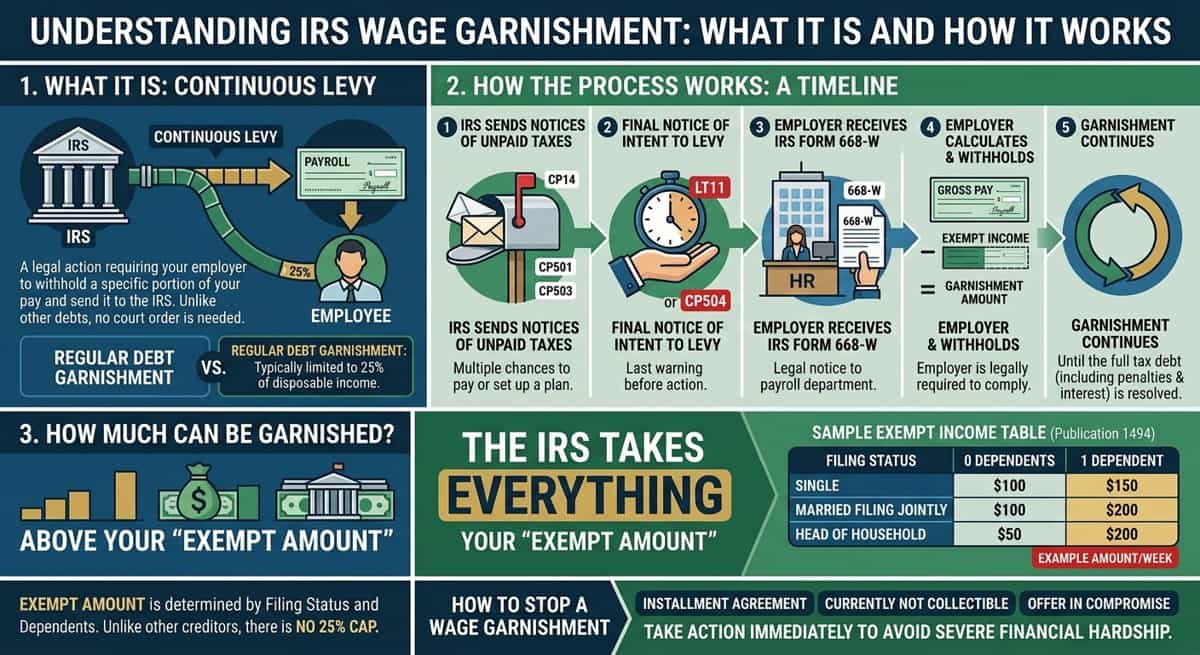
What Is an IRS Wage Garnishment and How Does It Work?
10 min read
Get Your Free Consultation
Speak with a certified debt consultant to explore your options.
Start NowNo obligation • Free consultation