Is 639 A Good Credit Score? How It Affects Loans, Credit Cards And Ways To Improve It
You checked your credit score, and there it is: 639. Maybe it showed up on your banking app, or a loan officer mentioned it, and now you're wondering is that good? Bad? Should you be worried?
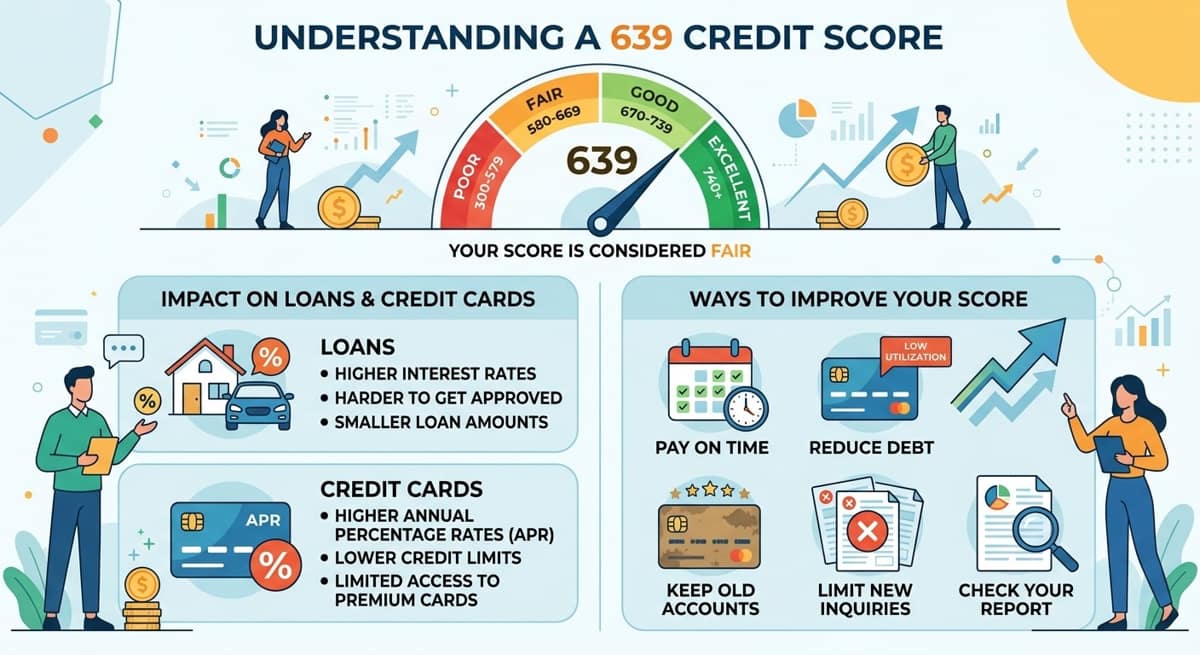
A 639 credit score falls into the "Fair" range. It's not a bad score, and it's definitely not something to panic about. But it's also not quite where you want to be if you're hoping for the best interest rates on a loan or the most rewarding credit cards. The good news is that a score like this is very common, especially if you're newer to the U.S. financial system, and it's also one of the easier things to improve once you understand what's actually driving it.
Is 639 a Good Credit Score?
A 639 score sits in the "Fair" range on the FICO scale, which runs from 580 to 669. It's below average, but it's not considered high-risk either.
A 639 score usually means you can still get approved for a credit card, car loan, or even a mortgage. You're not being locked out of the system. What changes is the price lenders will likely charge you a higher interest rate than they'd offer someone with a 700 or 750 score, because from their point of view, you're a slightly bigger risk.
Think of it less like a report card grade and more like a starting negotiating position. It's workable, but there's real money on the table if you improve it.
Understanding Credit Score Ranges (FICO vs. VantageScore)
There are two main scoring models you'll run into in the U.S.: FICO and VantageScore. Most lenders, especially for mortgages and auto loans rely on FICO, but you might see VantageScore on free apps like Credit Karma or Chase Credit Journey. The ranges are close but not identical, which is why your score might look slightly different depending on where you check it.
Rating | FICO Score Range | VantageScore Range |
Poor | 300–579 | 300–499 |
Fair | 580–669 | 500–600 |
Good | 670–739 | 601–660 |
Very Good | 740–799 | 661–780 |
Exceptional | 800–850 | 781–850 |
A 639 lands solidly in "Fair" on the FICO scale, and would typically fall in the "Good" range on VantageScore which is part of why the same person can see two different labels depending on which app they're using. Neither number is "wrong." They're just measuring slightly different things, using data from different credit bureaus (Experian, Equifax, and TransUnion), so small differences are completely normal.
Why a 639 Score Is Considered "Fair" Credit
Your score isn't random. It comes from five main ingredients, and understanding them helps you see exactly why you're at 639 instead of 739:
Payment history (35%) — Do you pay your bills on time?
Amounts owed / utilization (30%) — How much of your available credit are you using?
Length of credit history (15%) — How long have your accounts been open?
Credit mix (10%) — Do you have a mix of credit types, like a card and a loan?
New credit (10%) — Have you opened several new accounts recently?
A 639 score usually means one or two of these areas need work, not all of them. Maybe you've paid on time consistently but you're carrying a high balance on one card. Maybe your accounts are still young. Whatever the cause, it's fixable and "Fair" credit is a stage people move through, not a permanent label.
Common Reasons South Asian Immigrants and Newcomers Land at 639
If you moved to the U.S. from India, Pakistan, Bangladesh, Sri Lanka, or Nepal, there's a good chance your credit journey started later and looks different than someone who grew up here. A few patterns show up again and again:
You had a credit history back home that just doesn't count here. A strong CIBIL score in India or a clean repayment record elsewhere doesn't transfer to the U.S. When you land, you're often starting from zero, regardless of how financially responsible you've been.
You started building credit later in life. If you arrived on an H-1B visa, transitioned off OPT, or moved here after getting married, you may have opened your first U.S. credit card in your late 20s or 30s years after your American-born peers, who often start as college students. Since "length of credit history" is one of the five scoring factors, this alone can hold your score back for a while.
You're supporting your family back home. Sending money to parents or relatives is completely normal in South Asian households, but if that means routinely running one card close to its limit, your credit utilization goes up and so does your score's biggest single factor working against you.
You cosigned or were added to a family member's account. Helping a sibling get their first car loan or being added as an authorized user on a parent's card ties your score to their repayment behavior. If they miss a payment, it can quietly pull your score down too.
You simply prefer cash or debit. Many South Asian households are taught to avoid debt and pay for things upfront. It's a healthy instinct financially, but ironically, it means fewer credit accounts and a thinner credit file which can keep your score in the "Fair" zone longer than it needs to.
None of these are mistakes. They're just realities of building a financial life in a new country, and once you see the pattern, it's much easier to fix.
How a 639 Credit Score Affects Loans
Lenders use your score to price risk, not to shut the door. A 639 generally means approval is still realistic but the terms will cost you more than they would with a higher score.
Mortgage Loans
With a 639, an FHA loan is often your most realistic path, since FHA guidelines typically accept scores as low as 580 with a 3.5% down payment. A conventional mortgage is possible too, but usually requires a higher score or a bigger down payment to offset the risk. Either way, expect a higher interest rate than a borrower with a 700+ score, and you may also be required to carry private mortgage insurance (PMI) until you build enough equity.
Auto Loans
A 639 score usually places you in "non-prime" territory with most auto lenders. You'll likely still get approved, but the APR (annual percentage rate) will be noticeably higher than what a prime borrower pays. Putting down a larger down payment or choosing a shorter loan term can help soften that extra cost.
Personal Loans
Many online lenders and credit unions will approve applicants with fair credit, though usually at a higher APR. If you're hoping to use a personal loan for debt consolidation, high interest rates can be a hurdle exploring debt consolidation can help reduce your monthly burden without taking on expensive new loans.
How a 639 Credit Score Affects Credit Cards
A 639 score qualifies you for a decent range of credit cards. Many mid-tier cards and store cards will approve you without much friction. What's less likely is getting approved for premium rewards cards with big sign-up bonuses and travel perks that are typically reserved for applicants with "Good" or "Very Good" credit.
What you can expect with a 639: a higher APR than advertised "best-case" rates, a smaller starting credit limit, and possibly an annual fee on some cards designed for your credit tier.
If you're newer to credit in the U.S., a few realistic starting points are worth considering: secured credit cards (where you put down a refundable deposit that becomes your credit limit), credit-builder cards designed specifically to help you establish history, and student or starter cards if you're still in school. None of these are permanent; they're stepping stones to better cards down the line.
The Real Cost of a 639 Score
Numbers make this easier to picture. Say you're financing a $20,000 car loan over 5 years:
With a "Fair" credit score around 639, you might see an APR near 13–14%, putting your monthly payment around $460, and total interest paid over the life of the loan around $7,700.
With a "Good" credit score around 700+, the same loan at roughly 7–8% APR might cost closer to $400 a month, with total interest around $4,000.
That's a difference of nearly $3,500 in interest for the exact same car. This isn't meant to scare you; it's meant to show you why spending a few months improving your score before a big purchase is almost always worth it.
Step-by-Step Ways to Improve a 639 Credit Score
Most people can move from "Fair" to "Good" credit within 6 to 12 months of steady habits. Here's where to focus your energy:
1. Pay Every Bill on Time
Payment history is the single biggest factor in your score. Set up autopay for at least the minimum due on every card and loan, so a late payment never happens by accident.
2. Lower Your Credit Utilization Below 30% (Ideally Under 10%)
If your credit limit is $5,000, try to keep your balance under $1,500 and under $500 if you can. Paying down balances is often the fastest way to see your score move, and enrolling in a debt relief plan can help accelerate your progress if high interest charges are holding you back.
3. Avoid Opening Several New Accounts at Once
Each new application creates a small, temporary dip in your score. Space out applications and only apply for credit you actually need.
4. Keep Older Accounts Open to Preserve Credit History Length
Even if you rarely use your oldest card, keeping it open (and maybe running one small bill through it) helps your average account age, which supports your score over time.
5. Dispute Errors on Your Credit Report
Mistakes happen more often than you'd think a payment marked late by accident, or an account that isn't even yours. Pull your free reports at Annual Credit Report and dispute anything incorrect directly with the credit bureau.
6. Diversify Your Credit Mix Carefully
Having both a credit card (revolving credit) and a loan (installment credit) in good standing shows lenders you can manage different types of debt responsibly. Don't take on debt just for this reason, but if you already have both, make sure both are being paid consistently.
Credit-Building Tips for South Asian Families in the U.S.
Building credit as a newcomer doesn't have to mean starting completely from scratch; working with specialized teams that offer multilingual debt and financial guidance makes navigating the U.S. system far more accessible. . A few strategies work especially well within South Asian family and community structures:
Become an authorized user on a trusted family member's card. If a parent, spouse, or sibling has a long-standing card with a strong payment history and low balance, being added as an authorized user can let some of that positive history reflect on your own report, often with very little risk to either of you, as long as the primary cardholder keeps paying on time.
Look into credit-builder loans. Many community banks and credit unions including some that specifically serve South Asian communities offer small credit-builder loans designed to help people establish a payment history from zero.
Consider rent-reporting services. If you rent from a private landlord or a family-owned property, standard rent payments usually don't show up on your credit report at all. Rent-reporting services can add that history, turning a bill you're already paying into something that helps your score.
Be cautious with informal lending circles. Committees, chit funds, or kameti-style savings groups are a trusted tradition in many South Asian communities, and they're genuinely useful for building savings discipline. But it's worth knowing they don't report to U.S. credit bureaus, so they won't move your credit score. They work alongside your credit-building efforts, not instead of them.
Balance remittances with local obligations. If you're regularly sending money home, try to time those transfers so they don't push your credit card balances up right before your statement closes. Even shifting the timing by a week or two can lower your reported utilization.
When to Consider Professional Debt Relief or Credit Counseling
Sometimes a 639 score is part of a bigger picture: missed payments piling up, balances that don't seem to shrink no matter how much you pay, or debt across several cards that's become hard to track. If that sounds familiar, it may be worth talking to a professional.
Look for nonprofit credit counseling agencies affiliated with the NFCC (National Foundation for Credit Counseling). They can walk you through your full financial picture and, if it makes sense, set up a structured debt management plan to pay down what you owe at a more manageable pace. Be cautious of for-profit "debt settlement" companies that promise guaranteed results or ask for large upfront fees legitimate help doesn't come with pressure tactics.
This guide is meant to give you a clear starting point, not to replace personalized advice. If your situation feels complicated, a certified, accredited counselor can look at your specific numbers and help you build a realistic plan.
Key Takeaways
A 639 credit score is fair credit, not bad credit; it's a workable starting point, not a wall. You can still get approved for loans and credit cards, but you'll likely pay more in interest until you build it up. The path forward is straightforward: pay on time, lower your balances, be patient with your credit history length, and if you're newer to the U.S. financial system, lean on tools like authorized-user status, credit-builder loans, and rent reporting to speed things along.
Fair credit is a stage, not a sentence. With consistent habits and support from Ooraa's debt management services, moving from 639 to "Good" credit is one of the most achievable financial wins you can set for yourself this year. . Start today by reviewing your credit report and taking action on the factors holding your score back. If you need personalized guidance, contact a credit professional to discuss the best steps for improving your credit based on your financial situation.
Ready to Get Started?
Get a free consultation with a certified debt consultant to see if debt settlement is right for you.
Get Free ConsultationAbout the Author
Bhupinder Bajwa
.
Related Articles
Does Paying Off Debt Improve Your Credit Score?
8 min read
How to Settle SBA Loan Debt: Complete Guide to Debt Relief Options
11 min read
What to Know Before Getting a Debt Consolidation Loan
10 min read
Low Income Debt Relief Programs And Options
14 min read
The Ultimate Guide To Side Hustles To Pay Off Debt
12 min read
10 Reasons Why You Should Pay Off Debt
9 min read
Get Your Free Consultation
Speak with a certified debt consultant to explore your options.
Start NowNo obligation • Free consultation