How to Use the Debt Snowball Method to Pay Off Debt
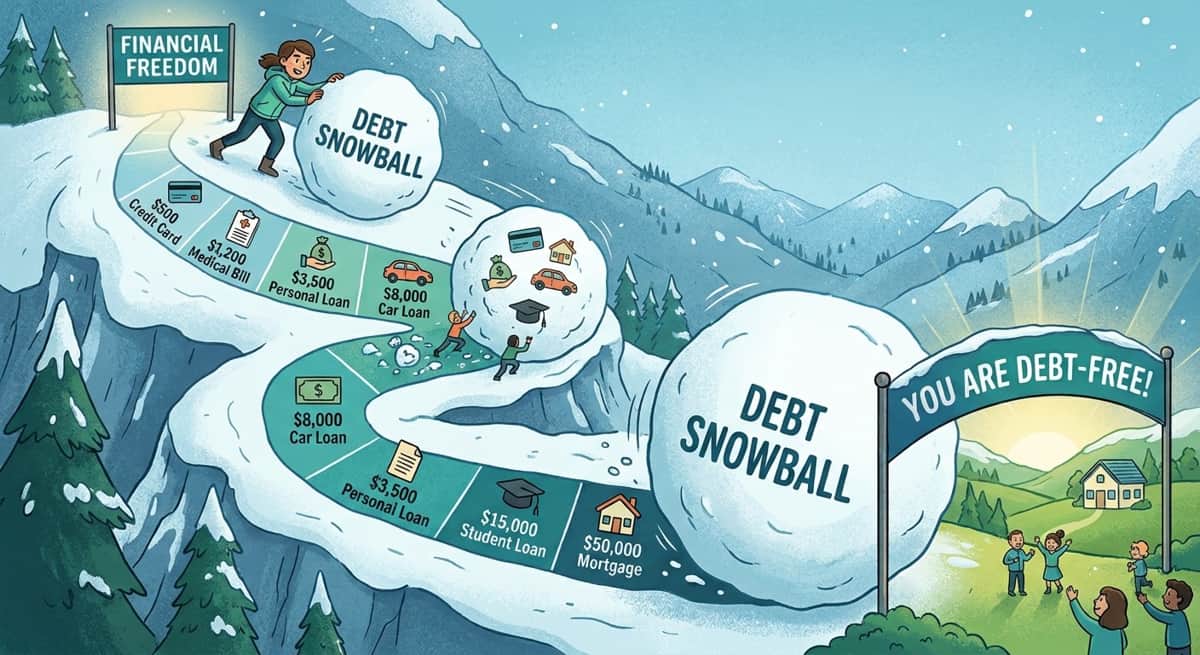
The debt snowball method is a way to pay off debt by making the minimum payment on every account, putting all your extra money toward the smallest balance first, and then rolling that payment into the next-smallest debt until you're debt-free.
If you're juggling several credit cards, a loan or two, and a pile of due dates, it's normal to feel stuck. The snowball method gives you a clear order to follow and early wins that help you keep going.
In this guide, you'll learn how the method works, see a step-by-step example with real numbers, and compare it to the debt avalanche method. You'll also find out when it's a good fit and when another option may serve you better. The snowball works best if you have steady income and can afford your minimum payments. If you're behind on payments or can't cover the minimums, skip ahead to the section on other options.
What Is the Debt Snowball Method?
The debt snowball method is a payoff plan where you pay off your debts one at a time, starting with the smallest balance and working up to the largest.
Definition and origin
You list your debts from smallest balance to largest and pay them off in that order. The idea became widely known through personal finance author Dave Ramsey, though people have used it for much longer. It works because small, quick wins feel good. Each paid-off account shows you the plan is working, and that confidence makes it easier to stick with it month after month.
Why it's called a snowball
Picture a snowball rolling downhill. It starts small and picks up more snow as it goes. Your payment works the same way. Every time you clear a debt, the money you were paying on it moves to the next debt, so your payment gets bigger with each win.
What debts it applies to
You can use it for unsecured debts like credit cards, personal loans, and medical bills, as well as store cards, auto loans, and student loans. Most people leave their mortgage out and keep paying it on its normal schedule, since it usually has a lower interest rate and a much longer payoff timeline.
How the Debt Snowball Method Works: Step-by-Step
There are six steps. You can finish the first two in an afternoon.
Step 1: List every debt from smallest to largest balance
To start your step-by-step plan to become debt-free, write down every debt you owe, except your mortgage, along with the balance, the interest rate (APR), and the minimum monthly payment. Then put them in order from the smallest balance to the largest. Don't worry about interest rates when you set the order. That's the main difference from other payoff methods. A simple spreadsheet or a sheet of paper is all you need.
Step 2: Pay the minimum on every debt
Keep making at least the minimum payment on every debt, including the ones at the bottom of your list. Missing a payment can lead to late fees, a higher interest rate and a lower credit score. Setting up autopay for the minimums is the easiest way to avoid that.
Step 3: Find extra money for your smallest debt
Next, find extra money to put toward your smallest debt. Even $50 or $100 a month makes a difference. Start with your budget. The 50/30/20 rule is a simple guide: about 50% of your take-home pay goes to needs, 30% to wants, and 20% to savings and debt payoff. You may not hit those numbers right now, and that's okay. Look for small cuts, like unused subscriptions, takeout or a pricey phone plan. You can also sell things you no longer use or pick up a short-term side job, then send that money straight to your smallest debt.
Step 4: Pay off the smallest debt, then roll the payment forward
Put all your extra money toward the smallest debt while paying the minimums on the rest. When that debt is gone, take the full amount you were paying on it, the minimum plus your extra, and add it to the minimum on the next-smallest debt. That's the snowball. If you were paying $225 a month on your first debt and the second debt's minimum is $50, you now pay $275 on the second one. Each new target gets a bigger payment than the last, so each one disappears faster.
Step 5: Repeat until you're debt-free
Keep repeating the process. Pay off a debt, roll its payment into the next one, and keep going until every balance is zero. Mark each win on a chart or calendar so you can see how far you've come.
Step 6: Protect your progress
Build a small starter emergency fund, even $500 to $1,000, so a surprise expense doesn't land back on a credit card. And stop adding new balances while you pay down the old ones.
Debt Snowball Example With Real Numbers
Here is how the snowball plays out on $14,100 of debt, with every payment made on time and no new charges.
The sample debts
Say Sam has four debts and can put $580 a month toward them in total. The minimums add up to $380, so $200 is extra. Sam lists them from smallest balance to largest:
Order | Debt | Balance | APR | Minimum payment |
1 | Store card | $600 | 18% | $25 |
2 | Credit card A | $1,800 | 22% | $50 |
3 | Credit card B | $4,200 | 27% | $105 |
4 | Personal loan | $7,500 | 12% | $200 |
Month-by-month payoff plan
Sam sends the $200 extra to the store card first. As each debt is paid off, its full payment moves to the next one:
Debt | Paid off in | Monthly payment while it's the target |
Store card | Month 3 | 225(25 minimum + $200 extra) |
Credit card A | Month 10 | 275(50 minimum + $225 rolled over) |
Credit card B | Month 23 | 380(105 minimum + $275 rolled over) |
Personal loan | Month 31 | $580 (everything Sam has set aside) |
What the result shows
Sam gets the first win in month 3 and is debt-free in about 31 months, or just under two and a half years. Total interest comes to about $3,400, so Sam pays roughly $17,500 in all on $14,100 of debt. These numbers are only an example. Your balances, rates and payments will be different, so try your own debts in a free debt payoff calculator to see your timeline.
Debt Snowball vs. Debt Avalanche: Which Is Better?
The snowball pays the smallest balance first. The avalanche pays the highest interest rate first. Neither is wrong, and the better one is the one you'll stick with.
Quick comparison
Debt snowball | Debt avalanche | |
Payoff order | Smallest balance first | Highest interest rate first |
Interest cost | Usually a bit more | Usually less |
First win | Usually sooner | Can take longer |
Best for | People who want quick wins | People focused on the lowest cost |
Which saves more money?
The avalanche usually costs less in interest because it goes after your most expensive debt first. In Sam's example, both methods finish in 31 months, but the avalanche saves about $210 in interest, roughly $3,190 compared with $3,400. Sam's first payoff would also come in month 17 instead of month 3. Some studies of people paying down debt suggest that clearing whole accounts helps them stay motivated, which is why many people prefer the snowball.
How to choose
Choose the snowball if you've had trouble sticking with a plan or you want an early win. Choose the avalanche if a few debts have much higher rates than the rest and you're confident you'll stay on track. You can also mix the two: start with one or two small balances for momentum, then switch to highest interest first.
Pros and Cons of the Debt Snowball Method
The snowball trades a little extra interest for momentum and simplicity. Here is what you gain and what you give up.
Advantages
You get quick wins. Paying off a small debt in a few months gives you proof that the plan works.
It's simple. You only need to know your balances to set the order.
You have fewer bills sooner. Each paid-off account means one less due date to track.
It builds a habit. Putting a set amount toward debt every month gets easier the longer you do it.
Disadvantages
You may pay more interest. If a large debt has a much higher rate than your small ones, it keeps growing while you work on the small ones first.
Progress can feel slow if your smallest debts have low rates and little to pay off.
It doesn't work without extra money. If you can only cover the minimums, there's nothing to roll forward, and you'll need to look at other options first.
Is the Debt Snowball Method Right for You?
The snowball fits people who can pay their bills on time and have a little room in the budget. If that's not you right now, there are other paths.
It may work well if
You have several debts, such as credit cards, store cards or personal loans.
Your income is steady.
You can cover all your minimum payments each month.
You need quick wins to stay motivated.
Consider other options if
You may need more help if you can't afford your minimums, your debts are in collections, your income changes a lot, or the balances feel out of reach. Your choices include:
A nonprofit credit counselor, such as one affiliated with the National Foundation for Credit Counseling (NFCC). They can review your budget and explain how a debt management plan works, where you make one monthly payment and the agency pays your creditors.
A debt consolidation loan, which combines several debts into one payment. It helps most if you qualify for a lower rate, though you can also explore how to get a debt consolidation loan with bad credit if your score has taken a hit.
A structured debt settlement program, which negotiates with creditors to resolve balances for less than you owe but carries real credit, fee, and tax considerations to weigh first.
Bankruptcy, which is a last resort. Talk to a licensed attorney first.
The Consumer Financial Protection Bureau (CFPB) offers free guides on all of these.
How to Get Started This Week
You can set up your plan in a few short sessions.
Build a simple debt inventory
Pull your free credit reports at Annual Credit Report so you don't miss any accounts. Then list each debt with the lender's name, balance, APR and minimum payment. Include medical bills and small store cards. Put the list in order from smallest balance to largest.
Find extra dollars for your snowball
Look through your last two months of bank statements and circle every subscription or repeat charge you don't use. Call your phone, internet and insurance companies and ask for a better rate. Think about a short-term side income, like weekend gig work or selling things you no longer need. You can also call your credit card companies and ask about hardship programs or a lower APR. It doesn't always work, but it costs nothing to ask.
Automate and track
Set up autopay for every minimum payment so you never miss one. Put a monthly reminder on your calendar for your extra snowball payment. Track your balances in a spreadsheet or a free app and update it each month. Watching the numbers drop keeps you going.
Common Debt Snowball Mistakes to Avoid
A few small slip-ups can slow you down. Watch for these:
Skipping a starter emergency fund. Without one, a car repair or medical bill can send you back to your credit cards.
Missing minimum payments while you focus on the smallest balance. Late fees and credit damage can cancel out your progress.
Closing paid-off cards without a plan. It can lower your available credit and shorten your account history, which may pull your credit score down.
Ignoring a very high-rate debt. If one card charges far more than the others, consider the mixed approach described above.
Not updating your plan when your income changes. Raise your snowball payment when you get a raise, and rework the numbers if your pay drops.
Debt Snowball Method FAQs
Does the debt snowball method hurt your credit score?
Not directly. Paying on time and lowering your balances usually helps your score over time. It can dip if you close paid-off cards, because that lowers your available credit and shortens your account history. If a card has no annual fee, keeping it open is often the better move.
How long does it take to pay off debt with the snowball method?
It depends on how much you owe and how much extra you can pay each month. In our example, $14,100 of debt took about 31 months at $580 a month. A debt payoff calculator can give you an estimate based on your own numbers.
Should I save money or pay off debt first?
Do a little of both. Start with a small starter emergency fund, often $500 to $1,000, so surprises don't go on a card. Then put your extra money toward debt. Once you're debt-free, you can build a larger savings cushion.
Can I use the snowball method with student loans or a mortgage?
Student loans can go on your list. But federal loans come with protections, like income-driven repayment, so check your options before you pay extra. Most people leave their mortgage off the list because it usually has a lower rate and a longer timeline.
What if I can't afford more than the minimum payments?
The snowball needs extra money to work. Start by looking for even a small amount to free up, and call your lenders about hardship programs. A nonprofit credit counselor can also review your budget and talk through your options at no cost or low cost.
Conclusion: Your Next Step Toward Becoming Debt-Free
The debt snowball method comes down to three ideas: pay the smallest balance first, roll each freed-up payment into the next debt, and stay consistent. You don't need a perfect budget to start. You need a list of your debts and a little extra each month.
Your next step is to run your own numbers in a free debt payoff calculator. If your debt feels too heavy to manage on your own, a free or low-cost session with a nonprofit credit counselor or a free debt consultation with our specialists can help you find the right plan.
Ready to Get Started?
Get a free consultation with a certified debt consultant to see if debt settlement is right for you.
Get Free ConsultationAbout the Author
Bhupinder Bajwa
.
Related Articles
How to Become Debt-Free in 5 Steps
10 min read

How to Remove Old Debt From Your Credit Report
11 min read
How to Use a Debt Validation Letter to Protect Yourself
10 min read
How to Settle SBA Loan Debt: Complete Guide to Debt Relief Options
11 min read
What to Know Before Getting a Debt Consolidation Loan
10 min read
Low Income Debt Relief Programs And Options
14 min read
Get Your Free Consultation
Speak with a certified debt consultant to explore your options.
Start NowNo obligation • Free consultation