How To Get Out Of A Merchant Cash Advance Loan
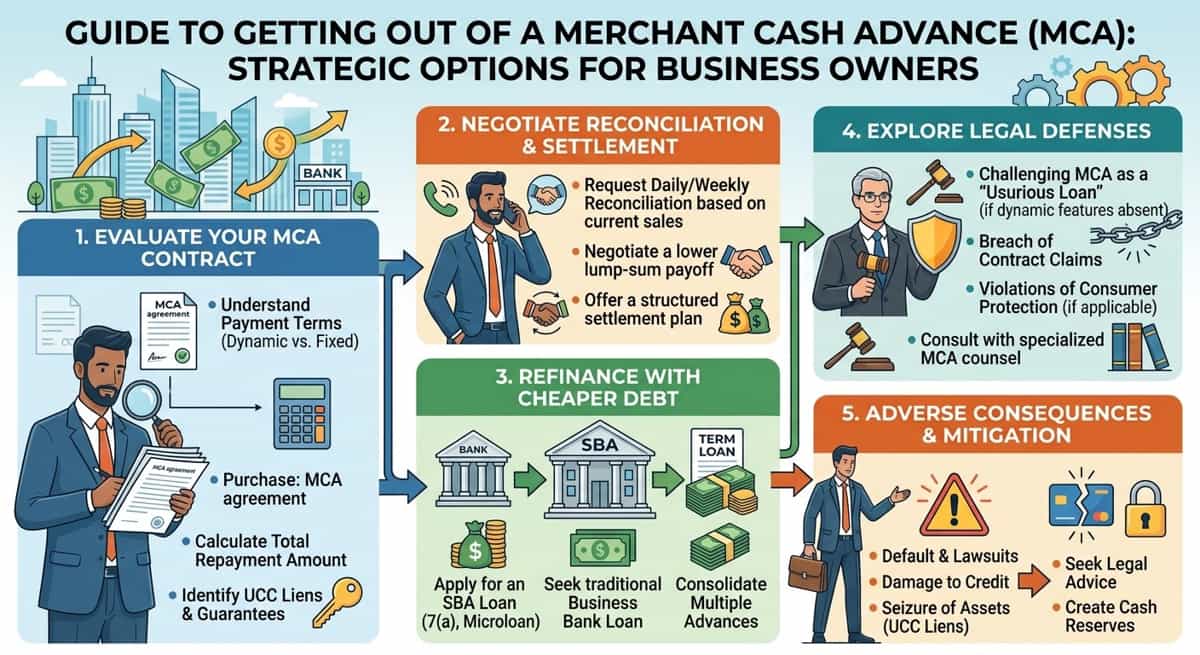
You can get out of a merchant cash advance (MCA) by reviewing your contract, asking for a reconciliation, negotiating lower payments or a settlement, refinancing, using legal defenses, or, as a last resort, filing for bankruptcy. The right path depends on your contract, your cash flow, and whether you signed a personal guarantee.
If money is leaving your business account every single day and there's barely enough left to pay staff, rent, or suppliers, you are not alone. Many hardworking owners get caught in this, and most don't talk about it. This guide walks you through your options in plain language, so you can act with a clear head.
Owners of motels, gas stations, convenience stores, restaurants, grocery stores, trucking companies, salons, and other small businesses who are struggling with MCA payments.
What Is a Merchant Cash Advance, and Why Does It Feel Like a Trap?
An MCA looks simple at first. Someone gives you cash quickly, and you pay it back from your daily sales. No long paperwork, no bank visits, no waiting. But the speed comes at a price, and many owners don't see that price until they're deep in it.
An MCA Isn't Technically a Loan
Legally, an MCA is not a loan. It is the sale of a share of your future sales to the MCA company. That may sound like a small detail, but it matters. Because it isn't called a loan, MCAs often aren't covered by the same interest-rate limits and lending rules that apply to bank loans. That's one reason the costs can climb so high, and why some owners later challenge their contracts in court.
Factor Rates vs APR
MCA companies don't quote interest rates. They use a "factor rate," like 1.3 or 1.4. It sounds small, but look at what it means in real life:
Item | Example |
Cash you receive | $50,000 |
Factor rate | 1.4 |
Total you must pay back | $70,000 |
Cost of the advance | $20,000 |
Repayment period | About 6 months |
Approximate daily payment | About $560 |
You borrowed $50,000 and paid back $70,000 in six months. When you convert that into a yearly rate, it can come out well over 100%. A bank loan would never look like this.
Why Daily or Weekly Debits Create a Cash Flow Spiral
Slow Tuesday? Rainy week? The debit still comes out. When the money runs short, many owners take a second or third MCA to cover the first. This is called stacking, and it makes the spiral faster and deeper.
Why Many South Asian Owners Are Targeted
Many of us start businesses with little help from traditional banks, whether because of limited credit history, a new immigrant background, or simply not knowing how the system works. Some brokers within our own community know this, speak our language, and use trust to sell expensive products. It doesn't mean the broker was a bad person. But the person who sold you the deal often earns a commission, so their interest and yours may not be the same.
Warning Signs You're Stuck in an MCA Debt Cycle
Check how many of these sound familiar:
You took a second MCA to pay the first one
Your bank account keeps going into overdraft because of the debits
You've skipped payroll or delayed paying suppliers
Daily debits take more than 15–20% of your sales
You're getting threatening calls or letters from collectors
You've received lawsuit papers or a UCC lien notice (a legal claim on your business assets)
You're using personal savings or family money to cover business debits
If you checked three or more, keep reading. You still have options, and the sooner you act, the more of them you'll have.
Before You Do Anything: Review Your MCA Contract
Before you call the lender or hire anyone, read your contract carefully. Everything you can do depends on what it says. Most owners signed quickly, trusting a broker's summary. Now is the time to read every page.
Clauses to Find
Look for these and mark them with a highlighter:
Reconciliation clause: Does it allow your payments to be adjusted when your sales go down?
Fixed or percentage payments: Is your payment a fixed daily amount, or a percentage of your actual sales? This matters a lot.
Personal guarantee: Did you promise to pay with your own assets if the business can't? Check how broad it is.
Confession of judgment (COJ): This lets the lender get a court judgment against you without a full trial. Some states limit or ban it, especially for out-of-state businesses.
Governing law and location for disputes: Where would a lawsuit happen? It could be in a state you've never visited.
Default terms: What counts as breaking the contract? Look for UCC-1 filings (a public notice that the lender has a claim on your assets) and any rule against taking other advances.
Documents to Gather
Collect these in one folder:
The full signed contract
6–12 months of bank statements
A record of every payment you've made
Texts, emails, and call notes with the lender or broker
Sales records showing how your revenue has changed
This folder will save you time and money whoever ends up helping you.
6 Ways to Get Out of a Merchant Cash Advance
These options are ordered from the gentlest to the most serious. You may use more than one. Many owners start with option 1 and move down the list only if they need to.
1. Request a Reconciliation
A reconciliation asks the lender to adjust your payment to match your real sales. Many contracts say your payment should be a percentage of what you actually earn. If your sales dropped, your payment should drop too.
You'll usually need to send a written request with recent bank statements showing the drop. Keep the letter short: who you are, your account number, what changed, and what lower amount you're requesting. Send it in a way you can prove (email plus certified mail). Lenders may take a few days to a few weeks to respond. Some will say no, which is why it's smart to keep a record of everything.
2. Negotiate Lower Payments or a Longer Term
If reconciliation doesn't work, explore a structured business debt restructuring strategy to modify your daily obligations. :
Moving from daily to weekly payments
Reducing the payment amount
Stretching the repayment over more months
Be honest about your numbers. Lenders prefer getting paid slowly over not getting paid at all. And whatever you agree to, get it in writing and signed by both sides. A phone promise means nothing if the lender changes their mind later.
3. Negotiate a Lump-Sum Settlement
In a lump-sum MCA settlement, you offer a reduced one-time payment that is less than the full balance, and the lender agrees to call the debt closed. . Lenders are more open to this when they believe you may not be able to pay the full amount, and when they know you understand your rights.
Think through how you'll fund it. Some owners use savings, a loan from a trusted family member, or a new, lower-cost financing option. Before agreeing, ask whether the forgiven amount might be reported to the IRS (Form 1099-C), since that could count as taxable income. A tax professional can help you plan for it. And again, never settle without a written agreement that clearly says the debt is fully resolved and any personal guarantee is released.
4. Refinance or Consolidate the MCA
Refinancing means using a cheaper product, such as an SBA loan, a bank term loan, or a business line of credit, to pay off the MCA. It can cut your payments sharply.
The honest truth is that it's hard to qualify if your credit is damaged or your sales have dropped. Also, be careful of offers called "reverse consolidation," where a company pays off multiple MCAs and then collects a single, big payment from you. Sometimes that just repackages the same problem. Always ask for the total cost, in dollars, before you sign anything.
5. Explore Legal Defenses
Some contracts are challenged in court. Common arguments include:
Recharacterization: The argument that your MCA acted like a loan, in which case interest-rate (usury) laws might apply.
Fraud or misrepresentation: For example, if you were told something that wasn't true or key terms were hidden.
Unlawful confession of judgment: If the COJ wasn't allowed under your state's rules.
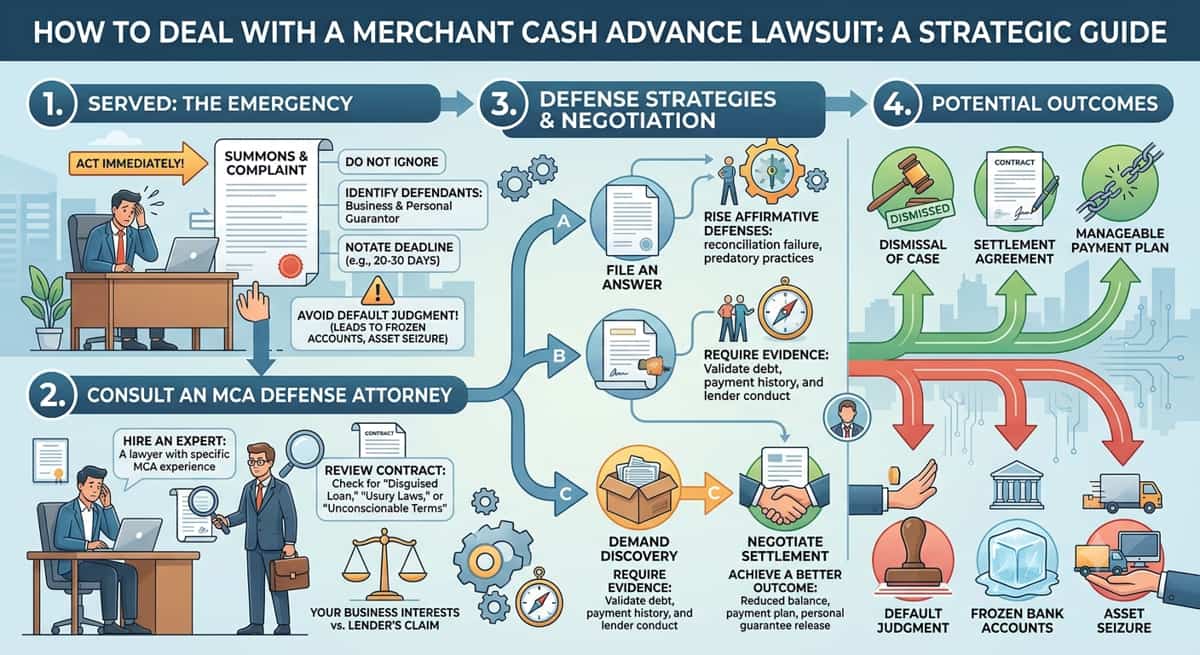
Results differ by state and by judge, and there are no guarantees. This is the point where you should talk to an attorney who handles MCA cases, especially if you've been sued or served legal papers.
6. Bankruptcy as a Last Resort
The bankruptcy process is serious, but it exists for a reason. Depending on your situation, options may include:
Chapter 11, including Subchapter V: Designed for small businesses to reorganize debts and keep operating.
Chapter 7 or Chapter 13: Sometimes used by individuals dealing with a personal guarantee.
One real benefit is the "automatic stay." Once you file, most debits, collection calls, and lawsuits must stop. Bankruptcy has long-term effects on your credit and your finances, so it's a decision to make only after speaking with a bankruptcy attorney.
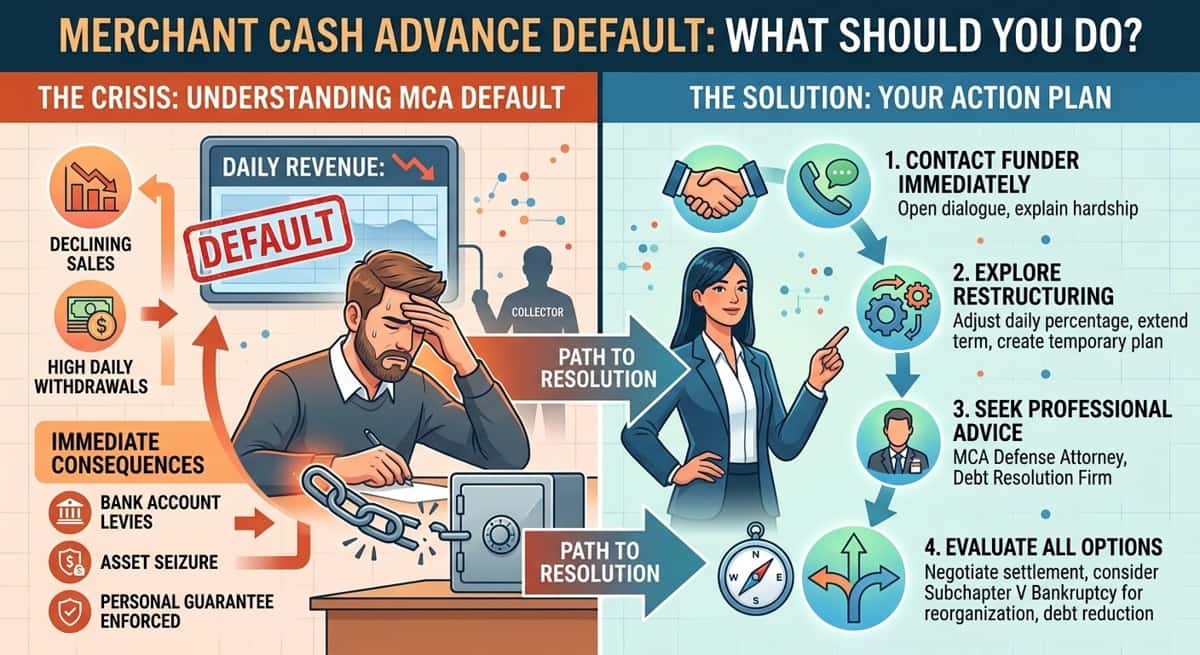
What NOT to Do When You Can't Pay Your MCA
When you're stressed, it's easy to make a move that makes things worse. Please avoid these:
Don't close your bank account without a plan. It can count as breaking your contract and may lead to legal action.
Don't ignore lawsuits or court notices. If you don't respond, the lender can win automatically.
Don't take another MCA to pay the first one. It buys you a few weeks and costs you months.
Don't pay big upfront fees to a "debt relief" company you haven't checked out. Some take your money and do very little.
Don't hide or move assets. It can turn a money problem into a legal problem.
Don't sign anything you haven't reviewed. A new "payment plan" may quietly add new terms against you.
Special Considerations for South Asian Business Owners in the USA
Many owners stay silent because they fear shame, not because they lack options. But waiting makes things harder. The earlier you ask for help, the more choices you have, and the better you protect your family and your business.
Family and Community Guarantees
Many of us run businesses as a family. If you signed a personal guarantee, your home, savings, and other personal assets may be at risk. If a spouse or relative co-signed or owns property jointly with you, they could be affected too. How much is exposed depends on your contract and your state's laws, so have an attorney explain exactly what is and isn't at risk.
Community Brokers and Informal Lending
Trust is a strength in our community, but it shouldn't replace checking the facts. Ask any broker how they get paid, whether they've placed you with other lenders, and what the total payback is in dollars. If they get upset when you ask for time to review, that's a red flag. Alternatives to informal loans include community lenders, credit unions, and CDFIs (community development financial institutions that focus on underserved owners).
Language and Access Resources
You don't have to figure this out alone or in a second language. Look for professionals who offer help in Hindi, Urdu, Bengali, Punjabi, Gujarati, Tamil, or Telugu. Free or low-cost support is also available through:
SCORE: Free business mentors
Small Business Development Centers (SBDCs): Free or low-cost advice
CDFIs: Mission-driven lenders
Legal aid organizations: For those who can't afford a private attorney
If you're worried about how bankruptcy or closing your business might affect your immigration status, please speak with a licensed immigration attorney before making a decision. This is a question that general debt advice can't answer.
Which MCA Exit Strategy Fits Your Situation?
Strategy | Best For | Pros | Cons | Typical Timeline |
Reconciliation | Sales have dropped and your contract allows adjustments | Free, quick, keeps the relationship | Lender may refuse | Days to a few weeks |
Lower payments or longer term | Still earning, but payments are too heavy | Immediate cash flow relief | May increase total cost | 1–4 weeks |
Lump-sum settlement | You can gather a one-time payment | Ends the debt for less | Needs cash up front; possible tax impact | 2–8 weeks |
Refinance or consolidate | Fair credit and steady sales | Lower cost, one payment | Hard to qualify; watch for hidden costs | 2–6 weeks |
Legal defenses | Lawsuit, unfair terms, or unlawful clauses | May reduce or end the debt | Costly, uncertain, varies by state | Months |
Bankruptcy | Debts can't realistically be repaid | Stops collection, fresh start | Long-term credit impact | Months to years |
How to Choose a Reputable Debt Relief Professional
Attorney: Can give legal advice, respond to lawsuits, and represent you in court. Best if you've been sued or have a personal guarantee.
MCA settlement company: Negotiates on your behalf, often for a fee. Quality varies widely, so research carefully.
Financial advisor: Helps with budgeting, planning, and future financing, but usually can't represent you in a legal dispute.
Red Flags of MCA Debt Relief Scams
Walk away if someone:
Guarantees a result ("We'll cut your debt by 70%!")
Demands a large fee before doing any work
Tells you to stop all communication with the lender
Won't put the agreement in writing
Pushes you to sign today
Tells you not to speak to an attorney
Questions to ask before hiring anyone:
How are you paid, and when?
Who will actually handle my case?
Can I see the agreement in writing before I commit?
What happens if you can't get a deal?
Can you give me examples of similar cases (without private details)?
Protect Your Personal Finances and Prevent Future Cash Flow Crises
Once you're out, you want to stay out. A few habits make a big difference:
Keep business and personal money separate. Use different accounts, and don't pay personal bills from the business.
Make a simple cash flow forecast. Know what's coming in and going out each month, and aim for a three-month cash reserve.
Know the real cost before you borrow. Ask for the total payback in dollars and compare yearly rates between options.
Look at better alternatives. SBA microloans, CDFI loans, business lines of credit, and equipment financing often cost far less than an MCA.
Watch your business credit. A stronger profile opens doors to cheaper financing next time.
Conclusion and Next Steps
Being stuck in an MCA can feel like carrying a heavy bag alone. But you have more choices than you think. Here are your next three steps:
Gather your contract and bank statements into one folder.
Request a reconciliation if your sales have dropped and your contract allows it.
Get a professional review from an attorney or trusted advisor before you sign, settle, or stop paying anything.
Ooraa can also help you understand your debt relief options and identify potential next steps based on your situation.
If you'd like help, schedule a free consultation to get started. You don't have to face this on your own.
Ready to Get Started?
Get a free consultation with a certified debt consultant to see if debt settlement is right for you.
Get Free ConsultationAbout the Author
Bhupinder Bajwa
.
Get Your Free Consultation
Speak with a certified debt consultant to explore your options.
Start NowNo obligation • Free consultation