How Do UCC Liens Work? Responding To UCC-1 Lien Notice Filings From MCA Lenders
Getting a letter in the mail that mentions a "UCC-1 lien" can be scary, especially if English isn't your first language and no one in your family has dealt with something like this before. If you run a small business, a grocery store, a gas station, a restaurant, a motel and you took a merchant cash advance (MCA) at some point, this notice is probably connected to that.
The short answer: a UCC-1 lien notice means a lender has filed a public claim on your business assets to secure money you owe them. It does not automatically mean you're losing your business, going to court, or facing bankruptcy. But it does mean you need to understand your debt options and respond the right way.
What Is a UCC-1 Lien, Exactly?
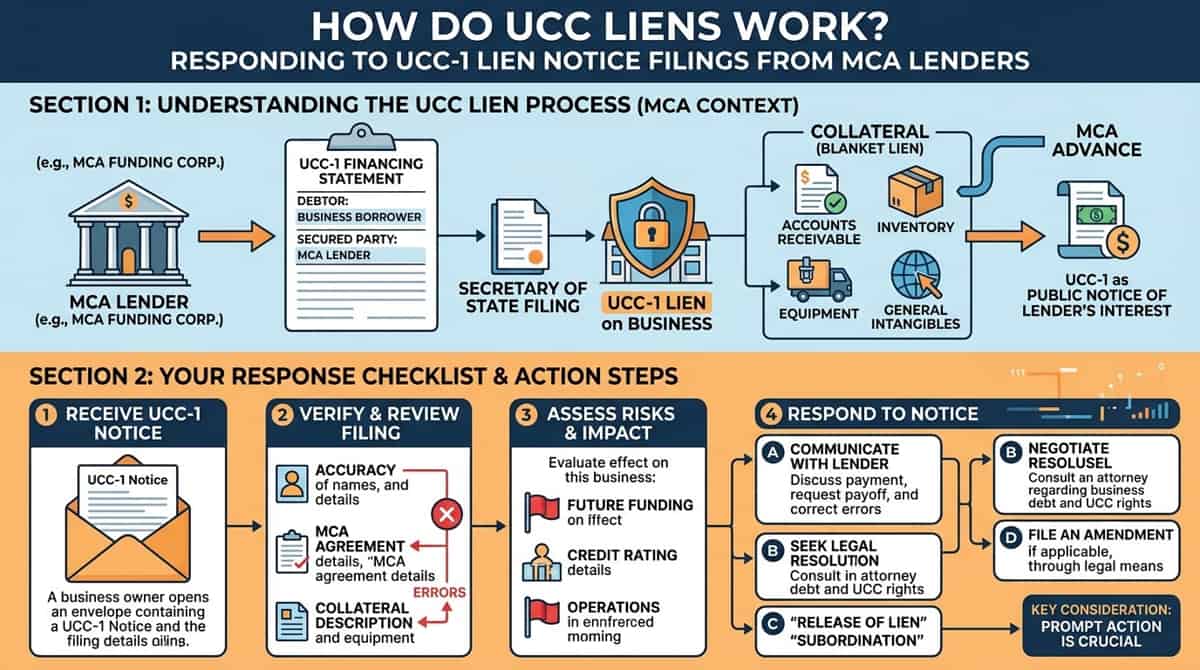
A UCC-1 lien is a public filing a lender makes to legally claim certain business assets as collateral until a debt is paid off. Think of it as the lender putting a flag in the ground that says, "If this business doesn't pay me, I have a legal right to these assets."
UCC stands for Uniform Commercial Code, the set of laws that govern business transactions across all 50 states. When a lender gives you money and wants legal protection in case you don't pay it back, they file a UCC-1 form with your state's Secretary of State office. This is completely normal and happens with banks, equipment financing companies, and MCA lenders every single day.
A few terms you'll see on the notice or in your agreement:
Secured party — the lender who filed the lien
Debtor — that's you, or your business
Collateral — the assets the lien covers (this could be everything you own, or just specific equipment)
Perfection — the legal process of properly filing the lien so it holds up
Priority — which lender gets paid first if there's ever a dispute
Here's the important part: a UCC-1 filing by itself is not a lawsuit, a judgment, or proof that you've defaulted. It's simply the lender protecting their interest. Many business owners panic when they see this notice, thinking the worst has already happened it hasn't.
How UCC-1 Liens Work With Merchant Cash Advances (MCAs)
Merchant cash advance companies almost always file a UCC-1 when they give you an advance. Most of the time, they file what's called a "blanket lien" a claim on essentially everything your business owns, not just one piece of equipment. This can include your inventory, your bank accounts, your equipment, and future receivables.
Here's something many business owners don't realize: an MCA is technically structured as a "purchase of future receivables," not a traditional loan. That's part of why MCA companies can charge such high effective rates and move so fast they're buying a percentage of your future sales, not lending money in the traditional sense. But even though it's structured differently, they still use the UCC-1 filing system to protect that claim, just like a bank would.
This matters a lot if you've taken more than one MCA practice known as "stacking." Before attempting to combine multiple advances, it's essential to understand the risks and advantages of business debt consolidation options. UCC liens follow a "first in time, first in right" rule. The lender who filed first generally has priority over lenders who filed later. If you have three MCAs and three liens, the order they were filed in determines who gets paid first if things go wrong.
A UCC-1 lien on your business can also make it harder to:
Get approved for a bank loan or SBA loan, since banks check for existing liens
Sell your business, since the lien has to be resolved as part of the sale
Take on new financing, since new lenders see you as already encumbered
Lease new equipment or open new merchant accounts, since some vendors also check UCC filings before approving you
This is exactly why understanding and addressing a UCC-1 notice early instead of ignoring it protects your future options. Many business owners don't think about their UCC filing history until they're sitting across from a bank loan officer who just pulled it up and asked questions they weren't prepared for. Getting ahead of it means you walk into that conversation with answers instead of surprises.
Why South Asian Small Business Owners Are Often Targeted by Aggressive MCA Lending
If you feel like your community gets hit harder by MCA debt than others, you're not imagining it. There are real reasons this happens, and understanding them isn't about blame it's about protecting yourself going forward.
Many South Asian-owned businesses in the U.S. convenience stores, gas stations, restaurants, motels, trucking companies run on cash flow that fluctuates daily and doesn't always show up cleanly on paper. That makes it harder to qualify for traditional bank financing, even when the business is genuinely healthy. MCA companies know this, and they market aggressively to exactly this kind of business because approval is fast and credit requirements are low.
There's also a community trust factor. A lot of MCA deals get referred through brokers who are part of the same community, sometimes a family friend, a fellow business owner, or someone from the same religious or cultural circle. That personal connection can make people skip the step of reading the fine print carefully or getting a second opinion, because the deal feels like it's coming through a trusted source rather than a stranger.
And for business owners who are more comfortable in Hindi, Urdu, Punjabi, Bengali, or Gujarati than in English legal language, contracts full of terms like "confession of judgment" and "blanket UCC lien" can be genuinely hard to fully understand before signing.
None of this means you did anything wrong by taking an MCA. It means the deck was somewhat stacked against you having full clarity going in and now the smart move is getting that clarity going forward.
There's also a generational piece to this. Many first-generation business owners came from countries where formal credit systems, credit scores, and secured lending worked very differently, or where a handshake and a personal relationship carried more weight than a written contract. That background is a strength in a lot of ways: it's built strong, loyal community networks but it can also mean less familiarity with how aggressively U.S. commercial lending law protects the lender over the borrower. Learning how these tools work isn't about distrust of your community; it's about making sure the next deal you sign is one you fully understand before you put your signature on it.
What Does It Mean If You Received a UCC-1 Lien Notice?
Not every UCC-1 notice arrives the same way, and where it came from changes what you should do next.
Directly from the lender: Some MCA companies send a formal notice after filing, simply informing you it's been done. This is routine and doesn't necessarily signal a problem with your account.
From a UCC monitoring or credit service: Many business owners actually find out about a lien because they subscribe to (or are contacted by) a service that monitors public UCC filings. This is common and doesn't mean anything urgent is happening, it's just informational.
While applying for new financing: Sometimes business owners only discover an old lien when a bank or new lender runs a search and flags it. This can be the most stressful way to find out, because it can hold up financing you were counting on.
Whichever way you found out, the notice itself does not mean your assets are being seized, that you're in default, or that you're headed toward bankruptcy. A lien is a claim, not a court order. Seizure of assets generally requires a separate legal process, like a judgment.
What you should check on the notice or filing:
The secured party name — is it the lender you actually worked with?
The collateral description — does it match what you agreed to in your contract?
The debtor name — is your business name and entity type listed correctly?
If anything looks off, that's your first clue something needs to be addressed.
Step-by-Step: How to Respond to a UCC-1 Lien Notice
Here's exactly what to do, in order.
1. Verify the filing is legitimate. Every state's Secretary of State website has a free UCC search tool. Search your business name to confirm the lien is real, see who filed it, and see the filing date.
2. Confirm the debt and collateral description match your agreement. Pull out your original MCA contract and compare the collateral language to what's listed in the UCC-1. Errors do happen.
3. Review your MCA contract for the lien and security language. Look specifically for sections labeled "security agreement," "collateral," or "UCC filing authorization." This tells you what you actually agreed to.
4. Determine if the lien is accurate, expired, or improperly filed. UCC-1 filings are only valid for five years unless renewed with a continuation filing. If yours is older than that and wasn't renewed, it may no longer be enforceable.
5. Contact the lender in writing before assuming you need a lawyer. A simple written request asking them to confirm your balance, confirm the lien details, or explain the filing is a reasonable first move and it creates a paper trail.
6. Understand your options. Depending on your situation, you may be able to negotiate a payoff or settlement, dispute inaccurate information, or request a UCC-3 termination once the debt is resolved.
7. Know when to bring in a professional. If you're dealing with multiple liens, aggressive collection calls, or language in your contract you don't fully understand, this is the point to involve an attorney or debt relief specialist rather than handling it alone.
Documents to gather before you respond:
Your original MCA agreement(s)
Any UCC-1 or UCC-3 filings related to your business
Records of payments made so far
Any written communication from the lender
Your business formation documents (LLC, corporation, etc.)
Having these ready before you make a call or send an email will save you time and help you sound confident and prepared.
UCC-1 vs. UCC-3: Amendments, Continuations & Termination Statements
Once a UCC-1 is filed, it isn't necessarily permanent or unchangeable. A UCC-3 form is used to update or close out that original filing, and it comes in a few forms:
Amendment — updates details, like a change in business name or address
Continuation — extends the lien beyond its standard five-year term
Termination (or release) — cancels the lien entirely, typically once the debt is paid in full
Here's what matters most to you: once you've fully paid off an MCA, the lender is generally required to file a UCC-3 termination statement to release the lien. This doesn't always happen automatically or quickly.
If you've paid off your MCA and the lien is still showing as active, follow up with the lender in writing and request the termination filing. If they're unresponsive, this is a situation where a debt relief professional or attorney can help push the process along, since an unreleased lien can quietly block your ability to get new financing for years.
Common Mistakes and Predatory Tactics to Watch For
Ignoring the notice entirely. This is the single biggest mistake. Unresolved liens don't disappear; they sit there, quietly limiting your financing options and growing more complicated over time.
Assuming a lien means immediate asset seizure. A UCC-1 filing alone doesn't give a lender the right to walk in and take your equipment or freeze your bank account. That level of action generally requires a separate legal judgment.
Taking out a new MCA to "cover" an existing one. This is one of the most damaging patterns among small business owners, and it's especially common in underserved immigrant business communities. Stacking a second or third advance on top of the first only deepens the debt and adds more liens competing for priority.
Falling for "lien removal" scams. Distressed business owners are unfortunately a target for companies promising to make a lien "disappear" for an upfront fee. Legitimate lien resolution happens through payoff, negotiation, or dispute not through a mysterious service that promises instant removal.
When to Consult a Debt Relief Professional or Attorney
Some situations you can likely handle with a phone call and a written request. Others genuinely need professional support. Reach out for help if:
You have multiple UCC liens or stacked MCAs on your business
The lender is threatening a confession of judgment or legal action
The collateral description or debt amount on the filing doesn't match your records
You're considering restructuring, refinancing, or selling the business
A licensed attorney or certified debt relief specialist can review your specific contracts and filings, something general information like this simply can't replace. Getting a professional opinion early is almost always cheaper financially and emotionally than waiting until things escalate.
Moving Forward With Confidence
A UCC-1 lien notice can feel overwhelming, especially if it's the first time you've dealt with anything like it. But it's a manageable, common part of business financing not a sign that everything is falling apart. Verify the details, understand your contract, respond in writing, and don't be afraid to bring in a professional once things get complicated.
If you're dealing with a UCC lien from an MCA and aren't sure what your options are, talking to a debt relief professional who understands MCA agreements can help you find a path forward that protects your business.
Ready to Get Started?
Get a free consultation with a certified debt consultant to see if debt settlement is right for you.
Get Free ConsultationAbout the Author
Bhupinder Bajwa
.
Get Your Free Consultation
Speak with a certified debt consultant to explore your options.
Start NowNo obligation • Free consultation