Offer in Compromise vs. IRS Installment Agreement: Which Is Better?
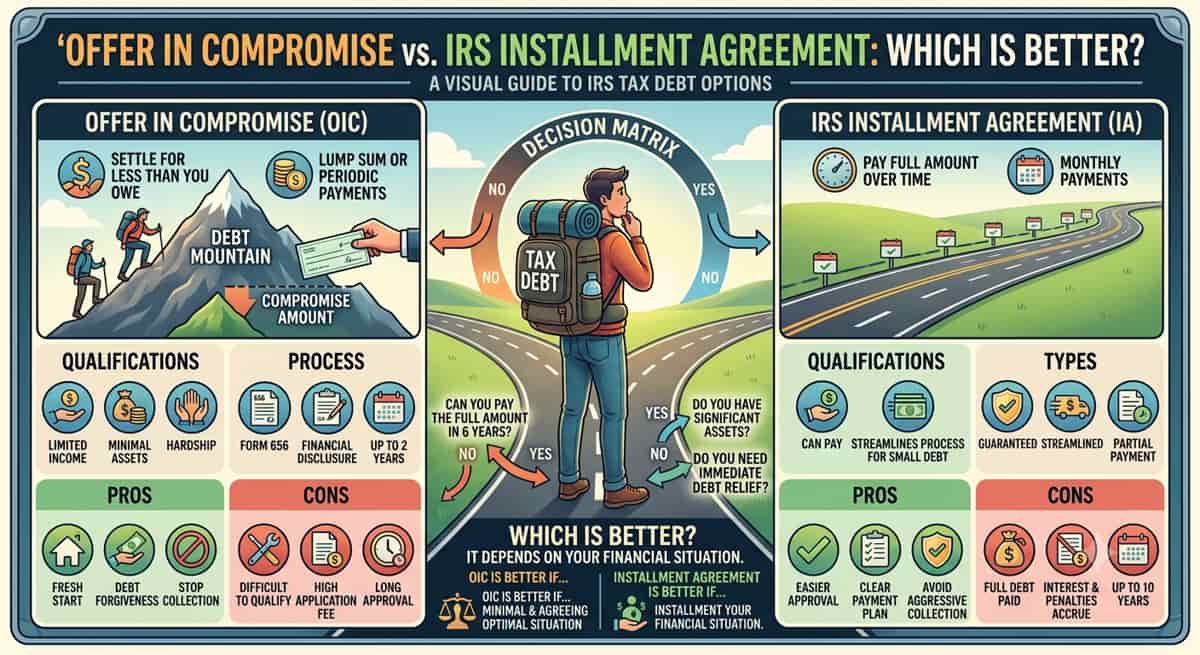
Facing a tax bill that you cannot pay is soul crushing. But just because you owe money to the IRS does not mean that all hope is lost. The good news is that pathways exist in the tax code strictly tailored to get you back on your feet financially, two titans of relief being an Offer in Compromise (OIC) and an IRS Installment Agreement.
While both can save you from aggressive collection efforts, they resolve your tax issue in very different ways. Qualifying taxpayers can use an Offer in Compromise to pay their debt for less than the total amount owed erasing some of the balance. On the other hand, an Installment Agreement takes your repayment and breaks it down into a series of monthly installments over time allowing you to pay full balance without going bankrupt.
Which path is right for you? Basically, it all comes down to your income, assets and economic reality over the long haul. We will see how they compare with step by step so that you can decide which strategy is right for you.
What Is an IRS Offer in Compromise (OIC)?
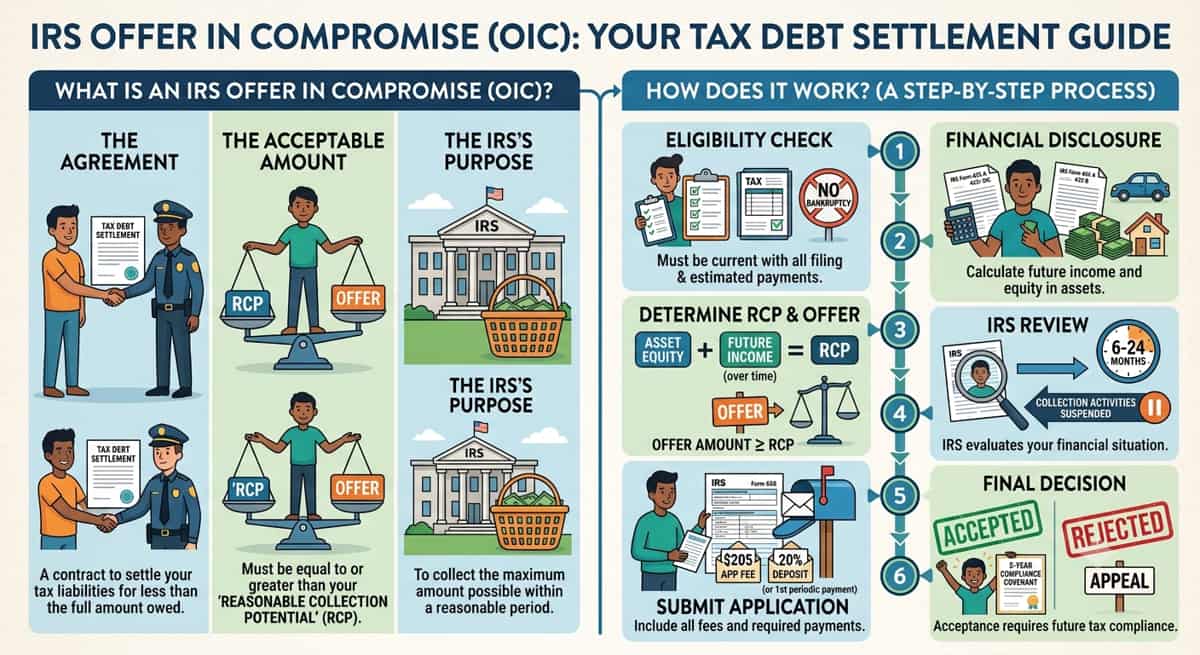
An Offer in Compromise is a deal with the IRS to settle your tax debt for less than what you owe, based upon your ability to pay. For instance, rather than the IRS demanding you pay $40,000 in back taxes, they may be willing to take only $12,000 in full payment if your income, expenses and assets demonstrate that's really all you can afford.
The IRS does not pass these easily. They scrutinize your so-called "reasonable collection potential" what they believe they could actually collect now and in the future, based on where you live, how much you have in savings, the value of your vehicles and business equipment if you're a small-business owner as well as your monthly income after subtracting necessary living expenses. An OIC will probably be denied if the number calculated is close to what you already owe.
Who Qualifies for an Offer in Compromise?
Qualifying can be achieved through any of the following three paths. Doubt as to Collectibility is the most common it is used when you really can not pay the full amount now or in the near future. Doubt as to Liability occurs where there is a genuine dispute concerning whether you are liable for the tax at all, perhaps because of a mistake. Exceptional cases where paying is feasible in a technical sense, but (for example) your circumstances would make actually wiring the funds an egregious hardship or even unfair – those are Effective Tax Administration.
Instead, you would file Form 656, plus a complete financial application (either a Form 433-A for individuals or the much short and easier-to-complete Form 433-B for businesses), along with an app fee. The IRS offers a free online Offer in Compromise Pre-Qualifier tool that can give you a rough idea whether or not you're even close before spending time and money trying to fill out the application.
What Is an IRS Installment Agreement?
An Installment Agreement is a payment plan that lets you pay your full tax debt over time through manageable monthly payments, instead of paying it all at once. It doesn't reduce how much you owe you're still responsible for the total balance, plus any interest and penalties that continue to accrue but it does stop the IRS from taking more aggressive collection action as long as you stay current.
For many people, this is the more realistic, more accessible option, especially if your income is steady and you simply need breathing room rather than a full write-down of debt.
Types of IRS Installment Agreements
There are three types of IRS Installment Agreements, each intended for different amounts of tax debt and financial situations.
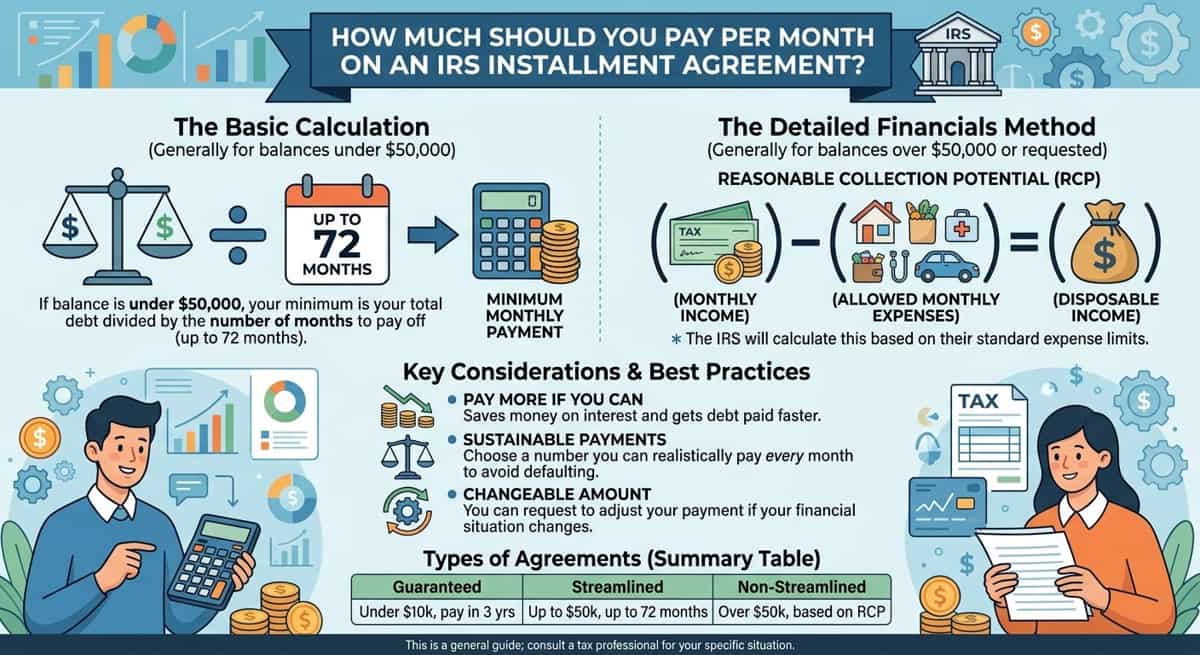
If you owe under $10,000 and meet basic filing requirements, the Guaranteed Installment Agreement is available (i.e. if you qualify the IRS must allow it).
The Streamlined Installment Agreement covers balances up to $50,000 and generally can be set up faster and easier because a full financial disclosure doesn't have to be made.
A larger balance or more complex financial situation is appropriate for the Non-Streamlined (or Partial Payment) Installment Agreement. It has input requirements for specific financial information and the monthly payments in some cases are less than the tax debt amount and may not pay off before IRS can collect. You may apply via Form 9465, or for most taxpayers by using the IRS's Online Payment Agreement tool (faster than mail).
Offer in Compromise vs. Installment Agreement: Key Differences
Factor | Offer in Compromise | Installment Agreement |
What it does | Settles debt for less than owed | Pays full debt over time |
Approval odds | Low - strict financial qualification | High - much easier to get approved |
Cost to apply | Application fee + initial payment | Setup fee (may be waived for low income) |
Processing time | 6–24 months | Days to a few weeks |
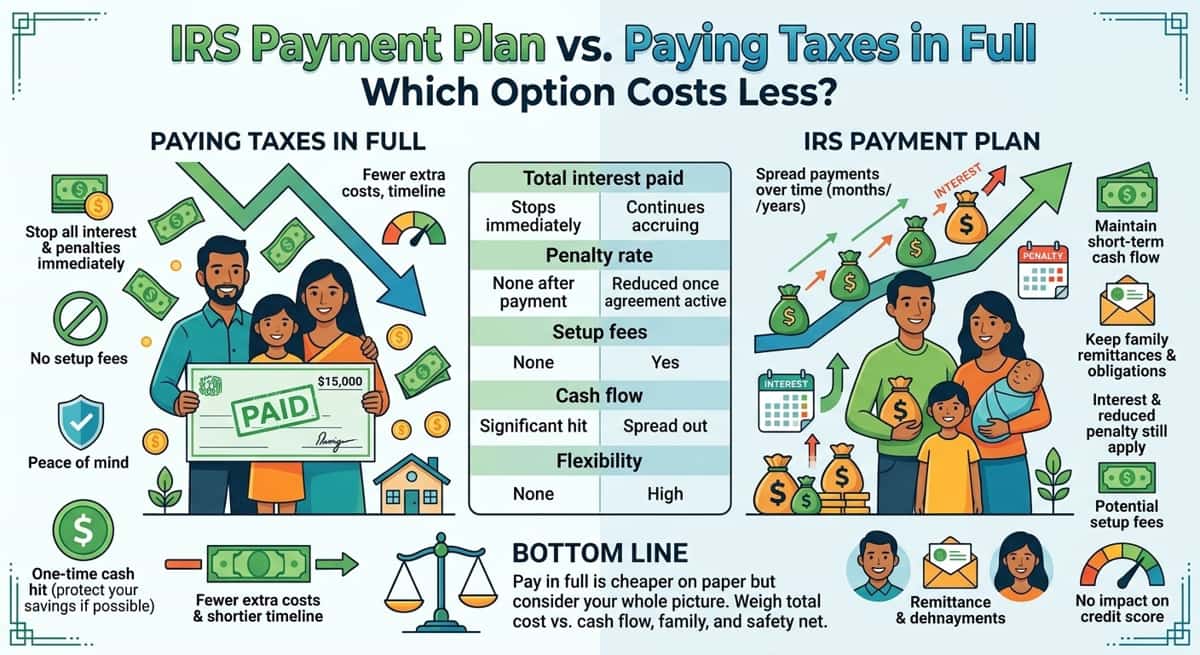
Ongoing interest/penalties | Stops once accepted | Continues to accrue until paid off |
Asset impact | May require using savings/equity | Assets generally untouched |
Compliance requirement | Must stay compliant for 5 years after | Must stay current on future filings/payments |
Best for | Genuine long-term financial hardship | Steady income, need for structured payments |
Pros and Cons of an Offer in Compromise
Pros: You could end up paying significantly less than you originally owed. Once accepted and paid, the debt is considered settled no more interest piling up, no more IRS letters about that balance. It can offer genuine, permanent relief if you truly qualify.
Cons: The acceptance rate is low, and the IRS rejects a large share of applications, often because offered amounts are too low relative to what they calculate you can pay. The process is slow, sometimes taking a year or more, during which you're still expected to stay compliant with all filing and payment obligations. It also requires full, detailed disclosure of your income, assets, and expenses nothing stays private from the IRS during this process.
Pros and Cons of an Installment Agreement
Pros: Approval is much easier and faster, especially for balances under $50,000. You keep your assets your home, your business equipment, your savings untouched. It gives you predictable monthly payments you can plan around.
Cons: You'll pay the full amount owed, plus interest and penalties that keep adding up until the balance is cleared, which often means paying significantly more over time than the original debt. If your income changes or you miss payments, the agreement can default, restarting collection pressure.
Which Option Is Better for South Asian Immigrants and Families in the USA?
There isn't a universal answer, but a few patterns come up often in South Asian households that are worth thinking through carefully.
Self-employed and small-business income is common in our community motels, gas stations, restaurants, rideshare driving, medical and dental practices, retail stores. If your business owns property, equipment, or has cash reserves, the IRS will factor that into an OIC calculation, which can make qualifying harder than it looks on paper, even if take-home income feels tight. An Installment Agreement is sometimes the more realistic path when business assets are substantial but cash flow is inconsistent.
ITIN holders and mixed-status households can generally still apply for both programs tax debt relief options aren't limited to U.S. citizens or green card holders. That said, financial situations in mixed-status households can be more complex, especially when income sources or asset ownership cross between family members with different statuses. It's worth getting this reviewed carefully rather than assuming eligibility either way.
Cultural discomfort around debt is real. Many of us grew up with an unspoken rule that financial struggles stay private, even from close family. But an Offer in Compromise specifically requires laying out your full financial picture and trying to hide assets or downplay income to protect family privacy can lead to rejection or worse. Being upfront, even when it's uncomfortable, is part of what makes the process work.
Jointly held family property a house held with parents, or a business owned jointly with siblings can also complicate a "Doubt as to Collectibility" claim, since the IRS may consider your share of shared assets when calculating what you can pay. This is a detail that trips up a lot of families who assume shared ownership keeps assets out of the equation.
Given these layers, working with a CPA or enrolled agent who understands both IRS procedure and the financial patterns common in immigrant and business-owning families can make a meaningful difference not just in which option you choose, but in how the application is prepared and presented.
How to Apply - Step-by-Step
Applying for an Offer in Compromise
Start by gathering documentation: recent tax returns, bank statements, pay stubs, business financials if self-employed, and records of assets and debts. Complete Form 656 along with Form 433-A(OIC) for individuals or Form 433-B(OIC) for businesses. You'll submit an application fee and an initial payment along with your offer amount, calculated based on whether you're proposing a lump-sum or periodic payment offer. Keep copies of everything, and be prepared for the IRS to request follow-up documentation during their review.
Applying for an Installment Agreement
For most people, this starts with Form 9465 or the IRS's Online Payment Agreement tool, which is usually quicker. You'll choose a monthly payment amount and a payment date, and set up direct debit if possible direct debit plans often come with lower setup fees and are considered more stable by the IRS. Balances under certain thresholds may not require a detailed financial statement at all, which simplifies the process considerably.
Common Mistakes to Avoid When Choosing a Tax Debt Relief Option
Some missteps come back again and again. This almost invariably results in denial or protracted time to resolution: overstating financial distress on the OIC application without good documentation. If you haven't filed for tax returns, even one year missing, could disqualify you from either program before you've lined up your first payment. Option three, where you have Currently Not Collectible (CNC) status which is when the IRS officially stops collecting for a time because you're incapable of paying anything at all is often overlooked (and sometimes more right for you than OIC or an installment plan), If a dealer or bank gives you the choice between cars based on your lowest monthly payment option, rather than what it will cost you over time, chances are they can still make money off of that car in the long run by charging you interest. And overlooking state tax debt Focused on the IRS alone, many people neglect to consider whether they may be facing a separate parallel collection process with their state (which in cases is more aggressive).
Final Thoughts: Making the Right Choice for Your Financial Future
Neither is objectively "better" than the other -- it all depends on things like, how stable your income situation, what types of assets you have and can document as well as really discuss the time commitment or time limitation for how long you're willing to wait for a verdict. An Installment Agreement often makes more sense If you have a steady income and just need some breathing room. Since an Offer in Compromise has far longer timelines and tougher standards to be approved than a Non-Collectible status, if your financial situation is severely limited with no real hope of being able to pay off the entire balance, it may still be worth seeking out.
No matter what you choose, this is not a decision to be made from a search result alone. An licensed tax attorney can view your entire situation your personal and business finances, family structure, wealth profile and steer you down the path that actually fits as opposed to the solution that just looks easier.
Ready to Get Started?
Get a free consultation with a certified debt consultant to see if debt settlement is right for you.
Get Free ConsultationAbout the Author
Bhupinder Bajwa
.
Get Your Free Consultation
Speak with a certified debt consultant to explore your options.
Start NowNo obligation • Free consultation