
What Is A Penalty Abatement And How Do I Get One?
If the late filing or payment was out of your control, it’s especially discouraging to get an IRS notice that adds to your tax bill with penalties and interest.Penalty abatement: The good thing is that the IRS might ease or eliminate some fees. Although penalty abatement does not remove the taIf the late filing or payment was out of your control, it’s especially discouraging to get an IRS notice that adds to your tax bill with penalties and interest.xes you owe or any interest that may continue to accrue, it can drastically lower your payment amount and make addressing your tax debt more affordable.
For many taxpayers who find themselves in this situation, they do not realize that they may be entitled to relief from penalties. There are various options provided by the IRS namely First-Time Penalty Abatement for non-compliance-prone taxpayers with a solid record of compliance and Reasonable Cause Penalty Abatement is only accessible for events such as serious illnesses, natural disasters, or exceptional conditions where causing the tax-related obligations unable to be met. The first step to successfully asking for an abatement is knowing what type of relief applies to your situation.
What Is IRS Penalty Abatement?
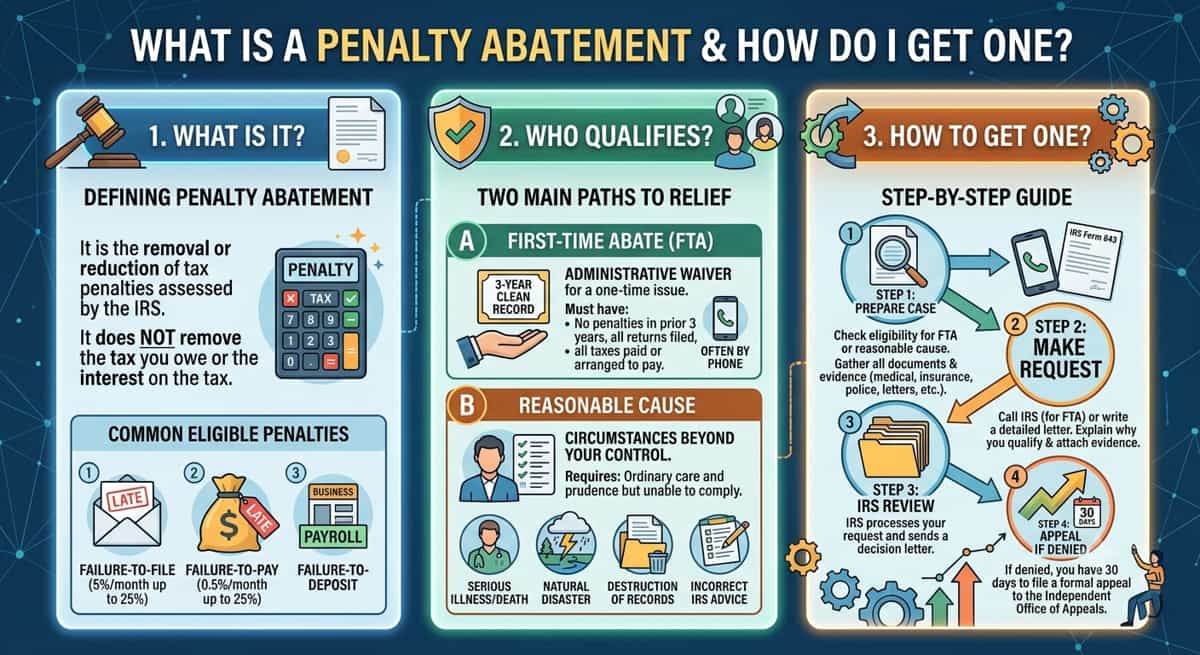
Penalty abatement is simply the IRS agreeing to reduce or completely cancel a penalty they charged you. It doesn't erase the tax you actually owe that part stays the same. What it removes is the extra fee tacked on for filing late, paying late, or making certain mistakes on your return.
Think of it like a late fee on a bill. If you call your landlord and explain that you were hospitalized and that's why rent was late, a reasonable landlord might waive the late fee even though you still owe the rent itself. Penalty abatement works on the same idea, just with more paperwork.
The IRS has built-in rules that allow for this kind of relief. Depending on your situation, you may qualify because it's your first time facing this type of penalty, or because something genuinely out of your control caused the delay. Either way, exploring IRS penalty relief options is a normal, expected part of managing tax debt plenty of people request it every year, and plenty of people get approved.
Common IRS Penalties That Qualify for Abatement
Not every charge on your IRS notice is eligible, but the most common ones usually are. Here's a quick breakdown:
Penalty Type | What Triggers It | Typical Cost |
Failure-to-file | You didn't file your return by the deadline (or extension deadline) | Usually 5% of unpaid tax per month, up to 25% |
Failure-to-pay | You filed on time but didn't pay the full amount owed | Usually 0.5% of unpaid tax per month, up to 25% |
Accuracy-related | Your return had errors that understated what you owed | Typically 20% of the underpaid amount |
If your notice mentions any of these, you're likely in a good position to explore abatement. Other, less common penalties can sometimes qualify too, but these three make up the vast majority of requests.
Types of Penalty Abatement
There are a few different paths to getting a penalty removed, and which one fits you depends on your history with the IRS and the reason behind the penalty.
First-Time Penalty Abatement (FTA)
This is the easiest and fastest path if you qualify. The IRS will generally waive a penalty if you have a clean compliance history meaning you:
Filed all required returns for the past three years (or filed valid extensions)
Paid, or arranged to pay, any taxes you owed during that time
Haven't had a penalty of this type removed in the previous three years
You don't need to prove a specific hardship for FTA. It's essentially a one-time pass for people who otherwise have a good track record. It usually applies to failure-to-file and failure-to-pay penalties.
Reasonable Cause Abatement
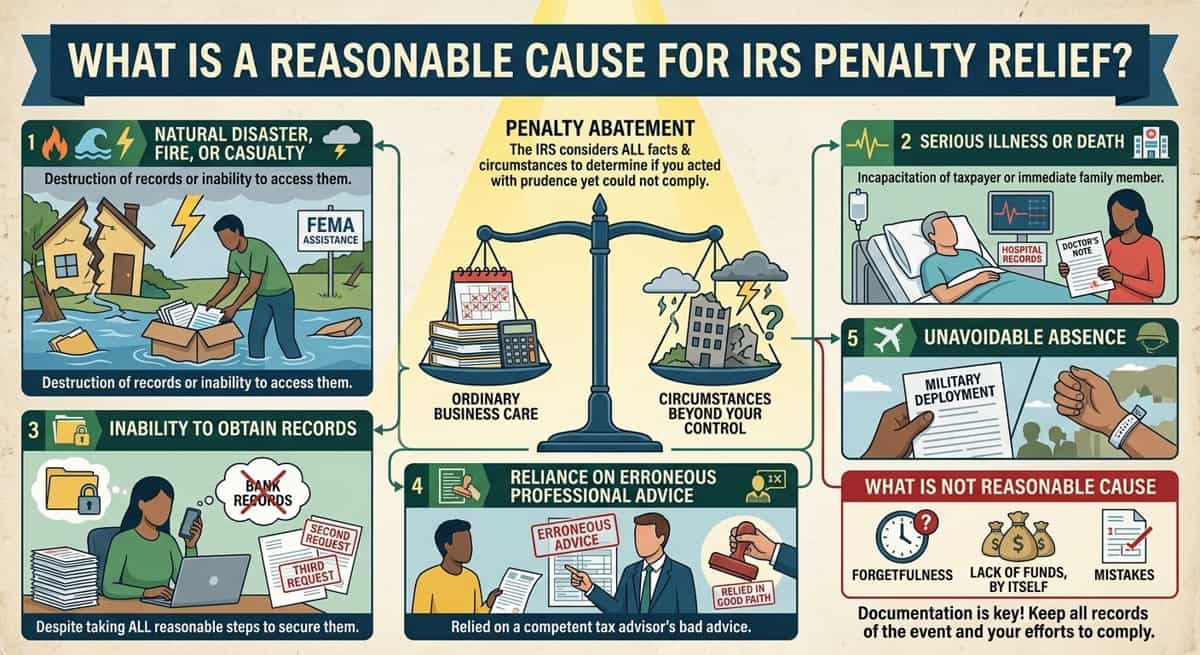
f you don't qualify for FTA maybe this isn't your first penalty, you can still apply for reasonable cause penalty abatement if unexpected events caused the delay. This means something genuinely beyond your control caused the late filing or late payment.
This path requires more documentation than FTA. You'll need to explain what happened and back it up with evidence: medical records, a death certificate, proof of a natural disaster, or something similar. The IRS looks at the full picture what happened, when it happened, and whether you acted responsibly once the situation was under control.
Statutory Exception
This is a narrower option that applies when you received incorrect written advice directly from the IRS and relied on it in good faith. If you followed guidance the IRS itself gave you in writing, and that guidance turned out to be wrong, you may be able to have the resulting penalty removed under this exception. It's less common than the other two, but worth knowing about if it applies to you.
Why Penalty Abatement Matters for Immigrants and First-Generation Filers
If you moved to the US on an H-1B, L-1, or other visa, or you're newer to filing as a green card holder, the US tax system can feel like a completely different world from what you grew up with. Filing deadlines, extension rules, and the sheer number of forms don't always match what you're used to and that gap is exactly where penalties tend to sneak in.
Some situations we see often:
First tax season confusion. You arrived mid-year, weren't sure if you needed to file, or didn't realize the deadline applies even if you're owed a refund.
Language and paperwork barriers. IRS notices are dense and full of jargon, even for native English speakers. It's easy to miss a deadline buried in a letter you didn't fully understand.
Relying on the wrong help. Many families use a friend, relative, or unlicensed preparer instead of a credentialed tax professional, which can lead to honest mistakes.
Foreign income and remittances. Reporting income earned abroad, or money sent back home, sometimes overlaps with other filing requirements people aren't aware of, like FBAR. This can lead to accidental errors that trigger penalties.
None of this means you did anything wrong on purpose. The IRS understands that genuine confusion happens, especially for people navigating the system for the first time. Penalty abatement exists precisely for situations like these it's a legitimate, underused tool, not something to feel embarrassed about using.
Who Qualifies for Penalty Abatement?
Eligibility depends on which path you're applying through:
For First-Time Abatement, you generally qualify if:
You've filed all required returns (or valid extensions) for the past three years
You have no unresolved unpaid balances beyond an approved payment plan
You haven't received this type of penalty relief in the prior three years
For Reasonable Cause, you generally qualify if you can show that:
Something specific and significant caused the delay (illness, disaster, family emergency, etc.)
You couldn't reasonably have avoided the penalty despite acting with normal care
You corrected the issue as soon as you reasonably could
One important thing to understand: owing tax doesn't disqualify you. Penalty abatement is about the penalty, not the underlying debt. Plenty of people who still owe money to the IRS successfully get their penalties reduced or removed the two are handled separately.
How to Get IRS Penalty Abatement: Step-by-Step Process
Here's the process broken down so you know exactly what to do.
Step 1: Confirm Your Compliance History
Before you request anything, check whether you've filed all your returns for the past three years and whether you've had a penalty waived before. You can check your filing and payment history by creating an account on IRS or by calling the IRS directly. This tells you whether you're likely to qualify for the simpler First-Time Abatement route.
Step 2: Gather Supporting Documentation
If you're applying for reasonable cause, start collecting proof of what happened: hospital records, a death certificate, insurance claims from a natural disaster, correspondence with a tax preparer, or anything else that supports your explanation. Even for First-Time Abatement, it helps to have your filing history and payment records on hand in case the IRS asks.
Step 3: Write Your Penalty Abatement Request Letter
Your letter should clearly state which penalty you're disputing, the tax year involved, and why you believe it should be removed. For reasonable cause requests, be specific: explain what happened, when it happened, how it prevented you from filing or paying on time, and what you did once you were able to address it. Vague explanations like "I was busy" or "I forgot" rarely succeed the more concrete and well-documented your explanation, the better.
Step 4: Submit Form 843 or Call the IRS Directly
For many penalties, you'll file Form 843, Claim for Refund and Request for Abatement, along with your letter and supporting documents. For simpler First-Time Abatement requests, you can often call the IRS directly using the number on your notice and request it over the phone this is frequently the fastest option if you qualify. Keep copies of everything you send.
Step 5: Follow Up and Appeal if Denied
Processing can take a while, so don't panic if you don't hear back right away. If your request is denied, you're not out of options you can appeal the decision. The denial letter will explain how to do this and what the deadline is, so read it carefully and don't let that window pass.
Reasonable Cause Examples That Actually Work
The IRS looks favorably on specific, well-documented situations. Some examples that tend to succeed:
Serious illness or hospitalization that prevented you or an immediate family member from managing your taxes during the filing period
A natural disaster flooding, fire, or another event that destroyed records or disrupted your ability to file
Death in the immediate family shortly before or during the filing period
Reliance on a tax professional who made an error, provided incorrect advice, or failed to file on your behalf despite you providing everything needed on time
Genuine first-time confusion navigating the US tax system after immigrating, particularly when combined with evidence that you corrected the issue promptly once you understood it
Notice that each of these is specific and provable. "I didn't know" on its own is a weak argument, but "I didn't know, and here's the evidence showing I acted quickly once I found out" is much stronger.
Common Mistakes to Avoid When Requesting Penalty Abatement
A few missteps can sink an otherwise solid request:
Being vague. A letter that doesn't clearly explain what happened and when gives the IRS little to work with.
Missing documentation. Claims without supporting evidence are much easier to deny.
Choosing the wrong path. Some people request reasonable cause abatement when they actually qualify for the simpler First-Time Abatement always check FTA eligibility first.
Not following up. Requests can sit for a while. If you haven't heard back in a reasonable time, check the status instead of assuming it's been handled.
Giving up after a denial. Many people don't realize they can appeal. A denial isn't always the final word.
Penalty Abatement vs. Other IRS Debt Relief Options
Penalty abatement is one of the programs offered by the IRS that can be a little confusing to someone just starting out with tax debt resolution, so here it goes penalty abatement removes the penalty ONLY, NOT the taxes owed. If you are having trouble paying the tax debt that is underlying, you should consider paying through an installment agreement (a monthly payment plan) or applying for an Offer in Compromise (which settles your tax debt for less than the full amount under certain circumstances).
These aren't either-or choices. The penalty abatement is often combined with the payment plan you have the penalty removed but pay the remaining tax liability over time. Recognizing that these are different tools will allow you to construct a more comprehensive plan for addressing your tax problem.
How a Tax or Debt Relief Professional Can Help
Straightforward, first-time situations are often not a big deal for you to handle on your own if you request penalty abatement. However, professional help is needed when the situation is not so simple such as if you have had penalties in the past, there are several tax years involved in your dispute or language issues make it difficult for you to effectively communicate with the IRS.
Experienced tax relief professionals can assess which type of abatement applies, ensure your documentation is in order, and negotiate directly with the IRS on your behalf. This is helpful if you are also battling against a larger tax debt and need a plan that extends beyond the penalty alone.
Key Takeaways
It's a legitimate, widely-accepted method of reducing or eliminating IRS penalties and it's not a loophole, nor is it just for individuals with complicated tax situations.
1 - First-Time Abatement: designed for those who have a clean record of compliance
2 - Reasonable cause: This is used when something outside your control caused the delay.
In either case, a good documentation makes all the difference. And if it all sounds a bit much, particularly as one of the more recent US tax-filers, that is OK finding help with taxes mean you are not alone.
Ready to Get Started?
Get a free consultation with a certified debt consultant to see if debt settlement is right for you.
Get Free ConsultationAbout the Author
Bhupinder Bajwa
.
Related Articles
Get Your Free Consultation
Speak with a certified debt consultant to explore your options.
Start NowNo obligation • Free consultation