IRS Offer In Compromise Forms And Supporting Documentation
Owning the IRS more than you can pay is stressful. Maybe a job ended, a business slowed down, or a family emergency used up your savings. Now the letters keep coming, and you're wondering if there's any way out. You are not alone.
For some people, there is. It's called an Offer in Compromise (OIC), and it lets you settle your tax debt for less than you owe. But before the IRS even looks at your request, you need to send the right paperwork.
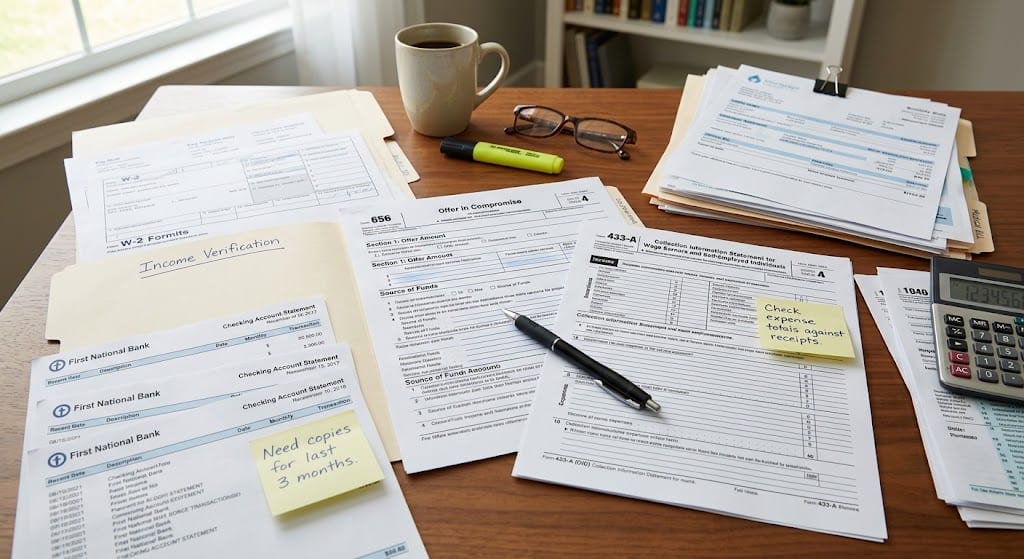
An OIC package has four parts:
Form 656, which is the offer itself.
Form 433-A (OIC) if you're an individual, or Form 433-B (OIC) if you're a business.
Papers that prove what you wrote on those forms.
A $205 application fee and an initial payment, unless you qualify for low-income certification.
Many South Asian families in the U.S. have income, property, or family obligations in more than one country. That makes the paperwork trickier, and a missing document is one of the most common reasons an offer gets sent back.
What Is an Offer in Compromise, and Who Should Consider One?
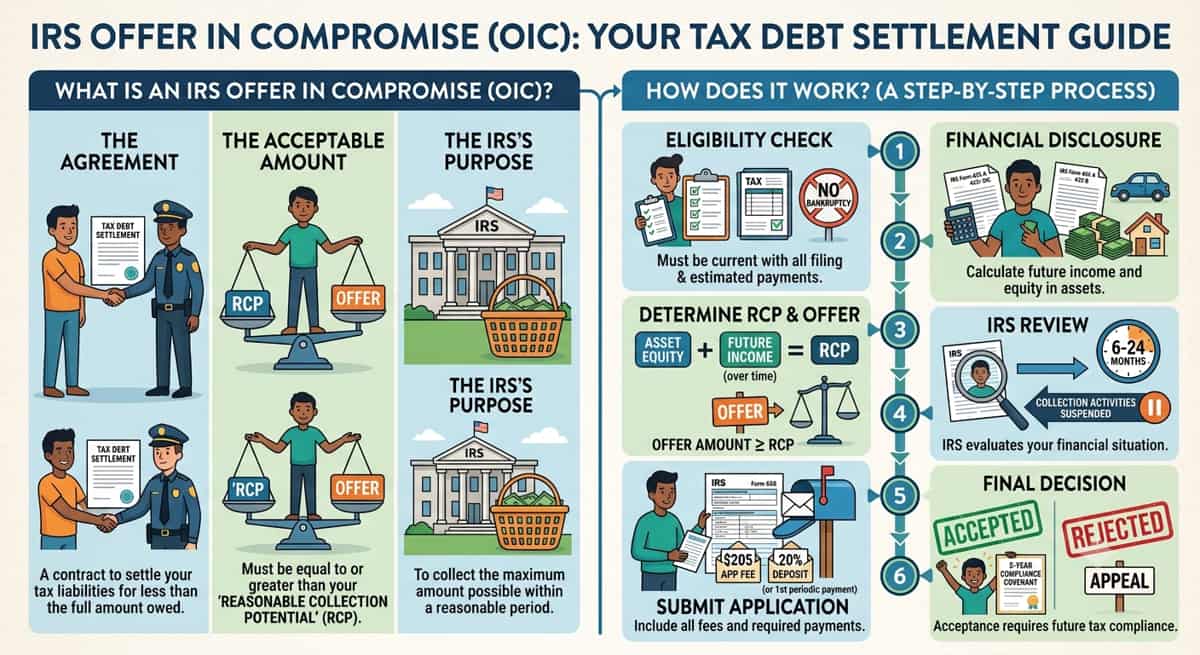
An Offer in Compromise is a way to settle your IRS tax debt for less than you owe. The IRS agrees only if it believes it can't reasonably collect the full amount from you.
The IRS looks at what you own and what you earn, then works out the most it could collect. In the tax world, this is called your "Reasonable Collection Potential." In simple terms, it's:
What you own: the equity you have in things like bank accounts, a car, a home, or investments, plus
What you can pay in the future: the money left over each month after your basic living costs.
If that total is less than your tax bill, you may have a case for an offer.
An OIC may be worth a look if:
You owe a large IRS balance that you truly can't pay in full.
You lost your job, or your income dropped sharply.
Medical bills or a family emergency drained your savings.
Your business closed, and the tax debt stayed behind.
It's probably not the right fit if:
You could pay the full debt with savings or by selling assets.
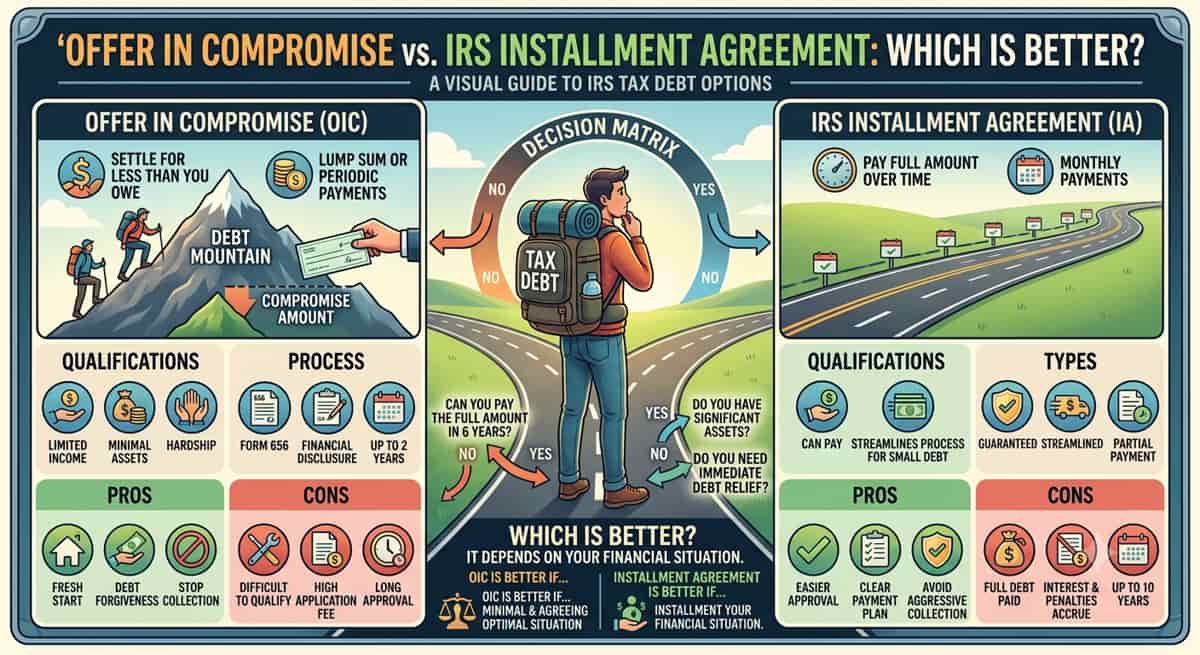
You have a steady income and could pay the balance over time.
Many people do better with an Installment Agreement process than an offer.
Are You Eligible? Check This Before You Fill Out Any Form
The IRS won't even look at your offer until you meet some basic rules. Check these first. It can save you months of waiting and the $205 fee.
Requirement | What it means |
All tax returns filed | Every return you were required to file must be in, even for years you can't afford to pay. |
Estimated payments current | If you're self-employed or have income without tax withheld, this year's estimated payments must be up to date. |
Business deposits current | If you have employees, your payroll tax deposits must be current. |
No open bankruptcy | If you're in an active bankruptcy case, you can't submit an offer. |
If you don't meet these requirements, the IRS can return your whole package without reviewing it. The good news is that these problems can usually be fixed. File the missing returns, catch up on payments, and then apply.
The IRS offers a free tool on IRS called the Offer in Compromise Pre-Qualifier. It gives you a rough idea of whether you may qualify. Treat it as a starting point, not a final answer.
Which OIC Forms Do You Need?
Here's the quick view:
Form | What it's for | Who files it |
Form 656 | The actual offer: what you owe, what you offer, how you'll pay | Everyone |
Form 656-B | The booklet with instructions and all the forms inside | Everyone (use it as your guide) |
Form 433-A (OIC) | Your full financial picture | Individuals and sole proprietors |
Form 433-B (OIC) | Your business's financial picture | Corporations, LLCs, partnerships |
Form 656 and the 656-B Booklet
Form 656 is the form you sign to make your offer. It lists the tax years you want to settle, the amount you're offering, and how you plan to pay.
Form 656-B is the booklet that contains Form 656, the financial statements, and step-by-step instructions. Think of it as your instruction manual. Read it before you write anything.
One important rule: personal tax debt and business tax debt go on separate Forms 656. If you owe both, you'll fill out two, and each one needs its own fee and initial payment.
Form 433-A (OIC) for Individuals
This is the form most people find the most stressful, and it's the most important. It's called a Collection Information Statement. It asks for:
Your income
Your bank accounts
Property, vehicles, and investments
Your monthly living costs
The IRS uses this form to work out how much you can afford to pay. Every number you write must be backed up by a document. If you say you spend a certain amount on rent, you need something that proves it.
Form 433-B (OIC) for Businesses
If your debt belongs to a corporation, LLC, or partnership, you'll fill out this form for the business. Most sole proprietors, such as a single-owner shop or a freelance driver, use Form 433-A instead, because they and the business are the same person for tax purposes.
Other Forms You May Come Across
Form 2848 or Form 8821: If a CPA, Enrolled Agent, or attorney is helping you, one of these lets them speak with the IRS on your behalf or see your tax records.
Form 656-L: This is for a different type of offer, used when you believe you don't owe the tax at all. It isn't the same as the standard offer we discuss here.
Important: The IRS released updated versions of Form 656, Form 433-A (OIC), and Form 433-B (OIC) in April 2026. Always download the newest 656-B booklet from IRS. Please don't reuse an old copy from a friend, a relative, or an old email. An outdated form can cause delays.
Supporting Documentation Checklist: What to Gather and Why
The forms tell the IRS your story. The documents prove it. Start collecting these early, because tracking down old statements can take weeks. The 656-B booklet has an official checklist that says exactly which documents to include and how recent they must be, so use it as your final guide.
Filing Compliance and Identity
Copies of your filed tax returns
Any IRS letters or notices showing what you owe
Your Social Security number or ITIN information
Income Documents
Recent pay stubs
W-2s and 1099s
Profit and loss statements, if you're self-employed
Rental income records
Social Security, pension, or retirement income letters
Records of income from any source outside the U.S.
That last one matters. If you earn rent, interest, or any other money from property or accounts abroad, it belongs on the form.
Bank Accounts, Investments, and Other Assets
Recent statements for every bank account you own
Retirement accounts and brokerage accounts
The cash value of any life insurance policy
Vehicle values and car loan statements
For property: mortgage statements and an estimate of what the property could sell for
Living Expenses
The IRS wants to know what it truly costs to live. Gather proof of:
Rent or mortgage payments
Utilities
Insurance
Medical costs
Court-ordered payments
Childcare
The IRS uses its own standard amounts for many everyday costs, like food and transportation. In many cases, you can claim your actual costs only up to those standards. The 656-B booklet explains which is which.
Extra Items for Business Owners
If you run a motel, convenience store, gas station, restaurant, trucking business, or rideshare work, you'll likely also need:
Profit and loss statements
A balance sheet
Money owed to you by customers (accounts receivable)
Business bank statements
Proof that your payroll taxes are current
Tip: Make a folder, on paper or on your computer, and label each section. When the IRS asks for something months later, you'll be glad you did.
Special Considerations for South Asian Households in the USA
Many of us support families in two countries. That's a beautiful thing, but it can make an IRS financial statement more complicated. Here are the areas where we see the most confusion.
Foreign Bank Accounts and Property
If you own bank accounts, land, or a home in India, Pakistan, Bangladesh, Sri Lanka, or Nepal, they generally need to be listed on your financial statement. This includes accounts you rarely use.
It may feel safer to leave something out. It's not. Leaving out an account or property can damage the IRS's trust in everything else you wrote, and it can lead to bigger trouble. Before you submit, ask a tax professional to review your foreign account reporting, including FBAR and Form 8938. These are separate filings with their own rules, and they're often missed.
Sending Money to Family Abroad
Many people send money every month to parents, siblings, or other relatives. It's love and responsibility, and it feels like a real expense. But the IRS may not count this money as an allowable living expense. Don't just list it and hope for the best. Talk to a professional before including it, so it doesn't surprise you later.
ITIN Holders and Immigration Status
Not everyone has a Social Security number. Some people file taxes using an Individual Taxpayer Identification Number (ITIN). In general, having an ITIN doesn't automatically stop you from applying, as long as you meet the other rules. Check the current instructions in the 656-B booklet or ask a professional, so you know what identification you'll need.
Family-Run and Cash-Based Businesses
Many family businesses handle a lot of cash. If income isn't recorded, it's very hard to prove what you really earn, and that works against you. Start keeping clear records now: daily sales, deposits, and receipts. A well-documented business is much easier to defend than a "we just know" business.
Gold, Jewelry, and Family Property
Gold jewelry, family land, and jointly held accounts are common in our households. Some of these may count as assets. Others may be treated differently depending on who owns them and how they're titled. Don't guess. List what you own, note who owns it, and get advice on how each item is treated.
A Simple Example (Fictional)
Rina is a nurse in New Jersey. She owes the IRS $68,000 after a few hard years, including a period without work. This example is simplified and made up to show how the math works.
Her savings, plus the equity in her car, add up to about $18,000.
After paying her rent, food, insurance, and other allowed costs, she has about $600 left each month. Over 12 months, that's $7,200.
Her rough Reasonable Collection Potential: $18,000 + $7,200 = $25,200.
Rina's tax debt is much higher than what she could realistically pay, so an offer around that figure might be worth exploring. But the IRS does its own math, and it may count things differently. Rina would still need documents for every number, including any money or property overseas.
Fees, Initial Payment, and Low-Income Certification
The short version: The application fee is $205 and is not refundable. Each Form 656 also needs an initial payment. If you qualify as low-income, both are waived.
Lump Sum vs. Periodic Payment
You choose how you'll pay your offer:
Lump sum: You send 20% of your offer amount with the application. If the IRS accepts, you pay the rest in five or fewer payments.
Periodic payment: You send your first monthly payment with the application, and you keep paying monthly while the IRS reviews your offer. If the offer is accepted, you keep paying until it's paid off.
Neither option is "better" for everyone. It depends on how much cash you can gather up front and what your monthly budget looks like.
Low-Income Certification
If your income is low enough, you may not have to pay the fee or the initial payment, or make monthly payments while the IRS reviews your offer. The IRS updated its low-income table in the April 2026 forms, and the new limits may make more people eligible. Check the current table in the 656-B booklet to see if you qualify.
How to Pay
The IRS now prefers payments through EFTPS or your Individual Online Account. Checks and money orders are still accepted. If you mail them, send separate payments for the fee and the initial payment.
Step-by-Step: How to Assemble and Submit Your OIC Package
Confirm you qualify and download the latest 656-B. Make sure all returns are filed and payments are current.
Gather your documents. Use the checklist above and start with the ones that take longest to get.
Fill out Form 433-A (OIC) or 433-B (OIC). Be complete and honest. If a box doesn't apply, write "N/A" instead of leaving it blank.
Work out a realistic offer. Use the booklet's worksheet. An offer that's too low without a good reason is likely to be rejected.
Complete and sign Form 656. If the tax debt is joint, both spouses need to sign.
Include the fee and initial payment. Or include your low-income certification.
Mail it to the right IRS address for your state. Use a trackable method, and keep a full copy of everything.
Respond fast to the IRS examiner. They may ask for more documents. Keep filing on time and stay current on new taxes while you wait.
Common Mistakes That Get an OIC Returned or Rejected
Mistake | How to avoid it |
Using an old form version | Always download the newest 656-B from |
Missing signatures | Check every form. If the debt is joint, both spouses sign |
Leaving out accounts or foreign assets | List everything, and ask a professional to review |
Offer far below what you can pay, with no explanation | Use the worksheet and explain any special circumstances |
Wrong or missing fee or payment | Double-check the amount, and send separate payments if mailing |
Unfiled returns or missed estimated payments | Get current before you apply |
Expenses without proof | Attach a document for every cost you claim |
Is an Offer in Compromise Your Best Option? Other Ways to Handle IRS Debt
Option | Best for | Main trade-off |
Installment agreement | People who can pay over time | You still repay the full amount, plus interest |
Currently Not Collectible | People who can't pay anything right now | The debt stays, and interest continues to add up |
Penalty abatement | People with a good reason for late filing or payment | Only removes penalties, not the tax itself |
Offer in Compromise | People who truly can't pay the full debt | Strict paperwork, long wait, and no guarantee |
If you're not sure which one fits, that's a good reason to talk to a professional before spending money on an application.
Should You Hire a Professional? How to Avoid Tax-Relief Scams
What a professional can do: Working with experienced IRS tax relief experts:
Check whether you qualify.
Help you avoid costly mistakes.
Handle IRS calls and letters for you.
Review foreign account reporting.
You can file an OIC on your own, but it takes time, care, and patience.
Watch out for scams. Some companies advertise aggressively in our community, promising to "erase your tax debt." Be careful if a company:
Guarantees results
Asks for a large payment before doing any work
Pressures you to sign quickly
Won't explain your options in plain language
Always check a professional's credentials before you hire them, and use the IRS directory of federal tax return preparers to confirm they are who they say they are.
Conclusion and Next Steps
To recap: an Offer in Compromise takes Form 656, a financial statement (433-A or 433-B), proof for every number you list, a $205 fee, and an initial payment, unless you qualify for the low-income exception. Take it one step at a time, gather your papers early, and be honest and complete.
If you'd like help, the best next step is a document review. Find a professional who looks at your situation and tells you whether an offer makes sense before you spend any money.
Ready to Get Started?
Get a free consultation with a certified debt consultant to see if debt settlement is right for you.
Get Free ConsultationAbout the Author
Bhupinder Bajwa
.
Get Your Free Consultation
Speak with a certified debt consultant to explore your options.
Start NowNo obligation • Free consultation