Pros And Cons Of Payday Loans: What You Need To Know
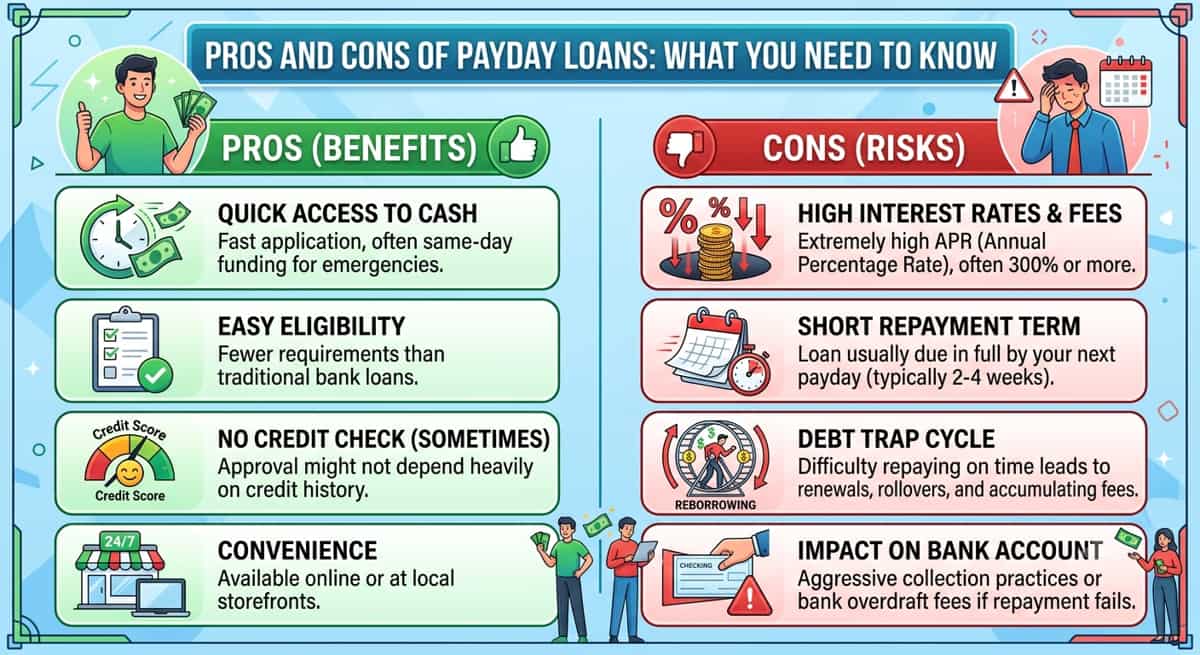
Payday loans can seem like a quick solution when an unexpected expense comes up and you need cash fast. With a simple application process and fewer eligibility requirements than many traditional loans, they may appear convenient, especially when you're dealing with a financial emergency. However, that convenience can come at a high cost. Payday loans often carry high fees and short repayment periods, which can make it difficult to repay the loan on time and potentially lead to another cycle of borrowing.
Before considering one, it’s important to understand both the benefits and the risks involved. Knowing how payday loans work, what they may cost, and the alternatives available can help you make a more informed financial decision.
What Is a Payday Loan?
A payday loan is a small, short-term loan usually between $100 and $1,000 that you're expected to pay back in full, plus fees, by your next payday, typically within two to four weeks. You can get one from a storefront lender in a strip mall or from an online lender, often within the same day you apply.
The appeal is simple: no long paperwork, no waiting days for approval, and money in your account fast. But that speed and convenience come at a price, and it's a much steeper price than most people realize until the bill comes due.
How Payday Loans Work
The Application and Approval Process
Payday lenders usually don't run a traditional credit check. Instead, they mainly want proof of steady income (like a pay stub) and an active checking account. This is a big reason payday loans attract people with little or no US credit history the lender isn't really looking at your credit score at all. Approval can happen in minutes, and funds often show up in your account the same day or the next business day.
How Repayment Is Structured
When you take out the loan, you typically agree to one of two repayment methods: you write a post-dated check for the full amount plus fees, or you authorize the lender to withdraw the money directly from your bank account (an ACH debit) on your next payday. If you can't cover the full amount when it's due, many lenders will offer to "roll over" the loan extending it for another pay period in exchange for another round of fees. This rollover cycle is where most of the real damage happens, and we'll break that down in detail below.
Why Many South Asian Immigrants in the US Consider Payday Loans
If you're newer to the country, payday loans can feel like one of the only fast options, and there are real, understandable reasons for that.
Limited or "Thin" US Credit History After Relocating
Your credit history often doesn't transfer when you move countries. Even if you had years of responsible borrowing back home, US lenders and credit bureaus have no record of it. That means you may not qualify for a traditional personal loan or credit card yet, which pushes people toward lenders who don't check credit at all like payday lenders.
Family and Remittance Financial Pressure
Many South Asian households are supporting family members abroad through regular remittances, on top of their own rent, groceries, and bills in the US. When an unexpected expense hits a car repair, a medical bill, a plane ticket home there's often no cushion left, and a payday loan can feel like the only quick fix.
Unfamiliarity with the US Banking and Credit System
The US credit system works differently from banking systems in South Asia, and it isn't always explained clearly when you open your first account. Concepts like credit scores, credit utilization, and how interest compounds aren't always intuitive at first, and payday lenders rarely take the time to explain the true cost of what you're signing up for.
Cultural Hesitancy to Discuss Debt Openly or Seek Formal Counseling
In many South Asian families, money problems are considered private, even shameful, and asking for help can feel like admitting failure. This can lead people to quietly turn to a payday loan instead of reaching out to a free credit counselor or asking family for support even when those options would cost far less in the long run.
If any of this sounds familiar, you're not alone, and there's no judgment here. The goal of this guide is to make sure you have the full picture before you borrow.
Pros of Payday Loans
To be fair, payday loans do offer a few real advantages which is exactly why they're so tempting in a crunch.
Fast Access to Cash (Same-Day Funding)
Money can land in your account within hours of approval. If you're facing something urgent, like a utility shut-off notice or a medical co-pay, that speed can feel like a lifeline. Just know that this speed is often the trade-off for a much higher cost.
No Traditional Credit Check Required
Because payday lenders mostly look at your income rather than your credit score, you can often qualify even with no US credit history at all. That said, "easy approval" usually means the lender is pricing in a lot of risk and you're the one paying for it through the fees.
Simple Application Process
There's no lengthy application, no stack of documents, and often no in-person meeting required for online lenders. It's designed to be quick and low-friction. But a simple process shouldn't be mistaken for a low-cost one the two are not the same thing.
Available Even With No US Credit History
For someone who's only been in the country a short time, this can feel like one of the few forms of credit accessible to them. It's worth remembering, though, that a payday loan does nothing to build your credit score, so it won't actually help you qualify for better options down the road.
Cons of Payday Loans
Now for the part that matters most: the real cost of borrowing this way, and why it can do more harm than good.
Extremely High APR (Often 300%–400%+)
According to the Consumer Financial Protection Bureau (CFPB), the typical payday loan carries an annual percentage rate (APR) in the range of 300% to over 400%. To put that in perspective, a typical credit card APR is usually somewhere between 20% and 30%. A payday loan can cost you more than ten times as much for the same amount of borrowed money.
The Debt Rollover / Debt Trap Cycle
This is the biggest risk of all. If you can't repay the full amount on payday which is common, since the loan already assumes you were short on cash many lenders let you roll it over by paying just the fee and extending the due date. Each rollover adds another fee on top of what you already owe. The CFPB has found that most payday loan borrowers end up re-borrowing within weeks, and a large share get stuck taking out loan after loan just to cover the one before it. What started as a $300 emergency loan can quietly turn into hundreds of dollars in fees alone, without touching the original amount you borrowed.
Aggressive Collection Practices
If a payment fails or you fall behind, some payday lenders pursue repayment aggressively repeated calls, contacting your workplace, or attempting to withdraw funds from your account multiple times. This can add stress on top of an already difficult financial situation.
Impact on Bank Account and Overdraft Fees
Because repayment is usually pulled automatically from your checking account, a mistimed withdrawal can overdraw your account, triggering separate bank fees on top of the loan fees. It's a domino effect that can leave you paying penalties in more than one place at once.
No Credit-Building Benefit
Most payday lenders don't report your payments to the three major credit bureaus (Experian, Equifax, and TransUnion) not even when you pay on time. That means even if you repay responsibly, a payday loan does nothing to help you build the credit history you may be trying to establish in the US.
Real Cost Example: What a Payday Loan Actually Costs You
Numbers make this easier to see clearly. Here's a typical example based on common payday loan fee structures (around $15 per $100 borrowed for a two-week term):
Loan Amount | Typical Fee | Effective APR | Total You Repay |
$100 | $15 | ~391% | $115 |
$300 | $45 | ~391% | $345 |
$500 | $75 | ~391% | $575 |
That $45 fee on a $300 loan might not sound huge on its own. But stretched out over a full year at that same rate, it's the equivalent of paying almost 400% interest and if you roll the loan over even two or three times, the fees alone can end up costing more than the amount you originally borrowed.
Payday Loans vs. Safer Alternatives
Before you commit to a payday loan, it's worth seeing how it stacks up against other options including some designed specifically for people building credit from scratch in the US.
Option | Typical APR | Speed | Credit Impact | Good for Newcomers? |
Payday Loan | 300%–400%+ | Same day | None (usually not reported) | Yes, but high risk |
Credit Union PAL (Payday Alternative Loan) | Capped at 28% | 1–3 days | Builds credit | Often yes, with membership |
Secured Credit-Builder Loan | 6%–20% | A few days | Builds credit | Yes |
Employer Paycheck Advance | 0% (often free) | Same day | None | Yes, if offered |
Nonprofit Emergency Assistance | 0% (grant, not a loan) | Varies | None | Yes |
As you can see, a Payday Alternative Loan (PAL) through a credit union can offer nearly identical speed and accessibility to a payday loan, at a fraction of the cost and it actually helps you build the credit history you're likely trying to establish.
Culturally Relevant Alternatives for South Asian Households
Beyond the mainstream options, there are a few paths that may feel more familiar or accessible depending on your community and situation.
Formalizing Community Lending Circles (Committee/Kameti-Style Savings) Safely
Rotating savings groups known as committee, kameti, chit funds, or similar names depending on your community are common in South Asian culture and can be a genuinely useful way to access lump-sum cash without interest. If you're part of one, or considering starting one, keep it transparent: put agreements in writing, track contributions carefully, and only participate with people you trust completely, since these arrangements aren't legally regulated or insured the way a bank account is.
South Asian–Serving Nonprofit Credit Counseling Agencies
Several nonprofit credit counseling organizations offer free or low-cost, one-on-one guidance, and some specifically serve South Asian and immigrant communities with culturally aware, sometimes multilingual support. Counselors can help you build a realistic budget, negotiate with creditors, and map out a plan often at no cost to you.
Credit Unions With Low-Barrier Membership for Immigrants
Many credit unions have membership requirements that are easier to meet than you might expect sometimes as simple as living in a certain area or paying a small one-time fee. Because credit unions are member-owned and not purely profit-driven, they tend to offer far lower rates on small loans than payday lenders, including PALs designed specifically for short-term needs.
Building Credit Fast With Secured Cards or Credit-Builder Loans
A secured credit card (backed by a small deposit you provide) or a credit-builder loan can help you start establishing a US credit history within just a few months of consistent, on-time payments. These tools won't help with an emergency today, but they're one of the fastest legitimate ways to make sure you're not stuck relying on high-cost credit again in the future.
Red Flags: How to Spot a Predatory Payday Lender
Not all short-term lenders operate the same way, and some cross the line from expensive to outright predatory. Watch for these warning signs:
Guaranteed approval, no questions asked legitimate lenders still verify basic information; "guaranteed" approval is often a red flag.
Unclear or hidden fee disclosure if you can't find a plain, upfront breakdown of fees and the APR before signing, walk away.
Pressure to roll over or refinance a lender pushing you to extend the loan rather than helping you pay it off is prioritizing their fees over your financial health.
No state license every legitimate lender should be licensed in your state. You can usually verify this through your state's financial regulation or banking department website.
Requests for unusual payment methods be cautious of lenders asking for prepaid debit cards or wire transfers instead of standard bank transactions.
What to Do If You're Already Stuck in a Payday Loan Cycle
If you're already in the middle of this, take a breath there are real steps you can take to get out.
Contact the Lender to Negotiate a Payment Plan
Some lenders offer extended payment plans (EPPs) that let you repay in installments without additional fees, particularly if you ask before you miss a payment. It never hurts to call and ask directly.
Talk to a Nonprofit Credit Counselor (Free or Low-Cost)
A certified credit counselor can review your full financial picture and help you build a realistic plan often for free. Look for agencies affiliated with the National Foundation for Credit Counseling (NFCC), which vets its member agencies.
Know Your Rights Under the Fair Debt Collection Practices Act
If a debt collector is contacting you about a payday loan, federal law limits what they're allowed to do they can't call you at unreasonable hours, use threats, or contact your employer to discuss your debt without permission. Knowing these protections can help you respond with confidence instead of fear.
When to Consider a Debt Management Plan
If you're juggling multiple high-cost debts, not just one payday loan, a debt management plan through a nonprofit credit counseling agency can consolidate what you owe into one manageable monthly payment, often with reduced interest rates negotiated on your behalf.
Making an Informed Borrowing Decision
Payday loans aren't inherently a trap set to catch you but the way they're structured makes it very easy for a short-term fix to turn into a long-term burden, especially if you're not familiar with how US lending works yet. The speed and easy approval are real advantages, but they come with a cost that's often much higher than it first appears.
Before you borrow, take a moment to look at the alternatives above a credit union PAL, a nonprofit counselor, or even a conversation with your employer could solve the same problem for a fraction of the price.
Ready to Get Started?
Get a free consultation with a certified debt consultant to see if debt settlement is right for you.
Get Free ConsultationAbout the Author
Bhupinder Bajwa
.
Get Your Free Consultation
Speak with a certified debt consultant to explore your options.
Start NowNo obligation • Free consultation